A team of astronomers announced a major advance in the field of exoplanets. They found a triple system of super-Earths and another 45 possible planets with a mass below 30 Earth masses.
Since the discovery in 1995 of an exoplanet around the star 51 Pegasi by Mayor and Didier Queloz, more than 270 planets outside our solar system have been found. Most of those planets are giants, like Jupiter and Saturn, and current statistics show that 1 in 14 stars host planets of that type.
"With the advent of precise instruments like the HARPS spectrograph on the 3.6-meter telescope at La Silla, we can now discover smaller planets, with masses between 2 and 10 times the mass of Earth," says Stéphane Udry. Those planets are called Super-Earths, for being more massive than our planet, and less massive than Uranus and Neptune.
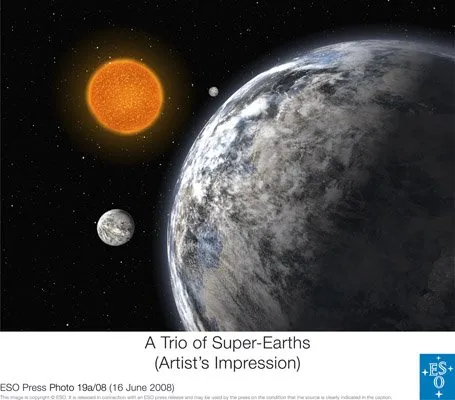
The group of astronomers has now discovered a system of three super-Earths around a star slightly less massive than our Sun, named HD 40307, and it is located 42 light-years away, toward the constellations Doradus and Pictor.
The planets have 4.2, 6.7, and 9.4 times the mass of Earth and orbit their star with periods of 4.3, 9.6, and 20.4 days, respectively.
"The perturbations induced by the planets are really very small," says co-author François Bouchy, of the Institut d'Astrophysique de Paris.
At the same conference where the announcement was made, another one was made, about the discovery of two other planetary systems. In one, a super-Earth, 7.5 times the mass of our planet, orbits the star HD 181433 in 9.5 days. This star also hosts a Jupiter-type planet with a period close to 3 years. The second system contains a 22 Earth-mass planet with a period of 4 days and a Saturn-like planet with a period of 3 years as well.
"Clearly, these planets are only the tip of the iceberg. The analysis of all the stars studied with HARPS shows that about one third of Sun-like stars have either Super-Earths or Neptune-like planets with orbital periods less than 50 days," adds Mayor.
A planet with a short period is easier to find than one in a long orbit.
"It is likely that there are many other planets present: not only Super-Earths and Neptune-like planets, but also Earth-like planets that we cannot detect. Add to that the Jupiter-like planets already known and you will conclude that planets are everywhere," concludes Udry.
These discoveries were announced at the international conference "Earth solar Super-Earths" in Nantes, France, which took place between June 16 and 18.
Two papers on these discoveries were submitted to Astronomy and Astrophysics.
Sources and related links
ESO: A Trio of Super-Earths
About the images
Credit: ESO PR Photo 19a/08 - A Trio of Super-Earths