NASA's MARVELS project will search for Jupiter-sized exoplanets around 6,000 stars, not only to increase the catalog of incredible worlds, but to improve knowledge about how planets form and evolve.
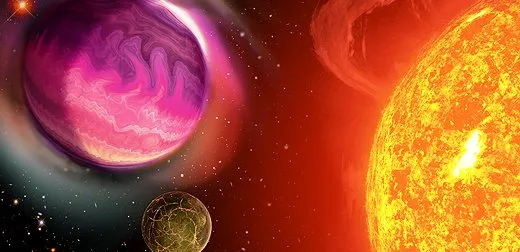
You know the planets of our solar system, each a unique world with its own appearance, size and chemistry. Mars with its red sands, Venus, a burning world wrapped in thick clouds of sulfuric acid, Uranus, on its side and with its strange vertical rings. The variety is impressive.
Now imagine that variety must exist in hundreds of solar systems. There must be worlds out there that make Venus seem hospitable and Uranus truly upright. Just 20 years ago, astronomers were unsure if any of those worlds existed beyond our solar system. Today, they have found more than 280 of them, each with its planetary "personality," each a fascinating example of what a world can be.
But the peak of planetary discoveries is only beginning. This year, astronomers will begin a massive search for new planets by observing about 11,000 nearby stars over 6 years. This number dwarfs the about 3,000 stars that astronomers have searched to date for the presence of planets. Scientists estimate that NASA's project called MARVELS will find at least 150 new planets and perhaps many more.
MARVELS is an acronym for Multi-object Apache Point Observatory Radial Velocity Exoplanet Large-area Survey and also, in English, "Marvels" means "Wonders."
"We are looking in particular for giant planets like Jupiter," says Jian Ge, principal investigator of MARVELS and an astronomer at the University of Florida. Ge compares the large planets to "lighthouse beacons" signaling the presence of entire solar systems. "Once we find a large planet around a star, we know that smaller planets could be there too."
MARVELS will do much more than just catalog a few hundred more planets. By probing Jupiter-type planets around a large number of stars, MARVELS aims to give astronomers the data they need to check competing theories of how planetary systems form and evolve.
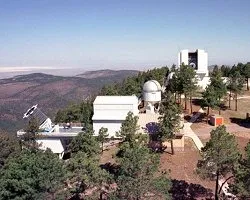
To observe so many stars, MARVELS will use a telescope that can see 60 stars separately at the same time, and this number will eventually be increased to 120. The SDSS telescope at Apache Point Observatory in the Sacramento Mountains, New Mexico, has a 2.5-meter primary mirror and a wide field of view covering 7 square degrees of sky - an area 35 times larger than the Moon.
A set of 60 fiber optic cables will carry the light from the telescope's focal plane to highly sensitive interferometers. These instruments can detect very small changes in the frequency of a star's light.
How does this help search for planets? Ge explains: When a star is pulled by the gravity of an orbiting planet, the star's light shifts in frequency, the so-called Doppler Effect. The powerful gravity of Jupiter-sized planets exerts a powerful pull on the host star, making them relatively easy to find using this method.
If Ge and his colleagues see a star's frequency increase and decrease slowly in a repetitive cycle over days, weeks or months, it's a good bet there's a planet there.
What type of stars have giant gas planets orbiting them?
One theory of how these planets form predicts that stars rich in heavy elements like silicon, oxygen and nickel should be more likely to have giant planets. Imagine a planet-forming disk around such a star: the disk, like the star itself, would be rich in heavy elements. Those elements would form chunks of rock in the disk and those chunks would collide and merge to create "planetary seeds" with enough gravity to gather gas around and grow into giants.
So if MARVELS finds more giant gas planets around stars that have heavy elements, the survey would be supporting that theory.
But some gas giants might not need those heavy elements to form. Another theory suggests that Jupiter-type planets can arise simply by a disturbance in the planet-forming disk starting the gravitational collapse of a region of gas and dust, no seeds required.
By examining a large number of stars MARVELS might be able to distinguish between these two ideas.
The data will also help shed light on other questions about planet formation, such as knowing how often the orbits of gas giants migrate closer to their stars, and how planets sometimes end up with very eccentric orbits instead of the nearly circular ones predicted by theory. The data could give clues about the most favorable conditions for planet creation, knowledge that could guide future detailed individual observations of stars.
The planets we know might be only a hint of the wonders awaiting us out there.
Sources and related links
- Science@NASA: Planets by the Dozen by Dr. Tony Phillips.
- Exoplanet Tracker
About the images
Credit: NASA