The largest black holes may feed the same way as the smaller ones, according to data from the Chandra X-ray Observatory and ground-based telescopes. This discovery supports the implication of Einstein's theory of relativity that black holes of all sizes have similar properties, and will be useful for predicting the properties of a conjectured new class of black holes.
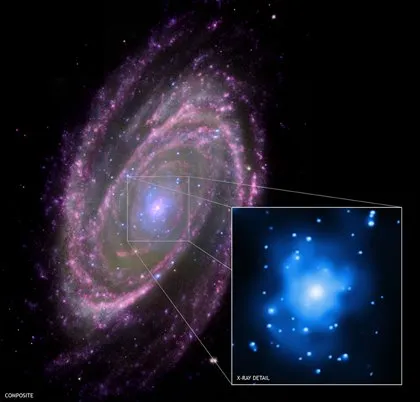
The conclusion comes from a long observation campaign of the spiral galaxy M81, which is 12 million light-years from Earth. At the center of M81 there is a black hole 70 million times more massive than our Sun and it generates energy and radiation by pulling gas in the galaxy's central region at high speed.
In contrast, so-called stellar-mass black holes, which have about 10 times the mass of the Sun, have a different feeding source. These smaller black holes acquire material by pulling gas from an orbiting companion star. Since the large and the smaller black holes are found in different environments with different sources of material from which they feed, the question has remained whether they feed in the same way.
Using the new observations and a detailed theoretical model, a research team compared the properties of the black hole in M81 with those of stellar-mass black holes. The results show that both seem to feed in a similar way and produce a similar distribution of radiation in X-rays, optical, and radio.
One of the implications of Einstein's General Theory of Relativity is that black holes are simple objects and only their mass and spin determine their effect on spacetime. This latest research indicates that their simplicity manifests itself despite the complicated effects of the environment.
"This confirms that the feeding patterns of black holes of different sizes can be very similar," says Sera Markoff of the University of Amsterdam.
The model that scientists used to study the black holes includes a faint disk of material orbiting around the black hole. This structure would mainly produce X-rays and optical light. A region of hot gas around the black hole would be seen more in ultraviolet and X-ray radiation.
"When we look at the data, it turns out that our model works as well for the black hole in M81 as for the smaller ones," adds Michael Nowak, co-author, from the Massachusetts Institute of Technology.
This work should be useful for predicting the properties of a third, unconfirmed, class of intermediate black holes, whose mass would be between that of stellar-mass and supermassive black holes. Some possible members of this class have been identified, but the evidence is controversial, so specific predictions of the properties of these holes would be very useful.
In addition to the Chandra Observatory, three radio arrays (the Giant Meterwave Radio Telescope, the Very Large Array, and the Very Long Baseline Array), two millimeter telescopes, and the Lick Observatory monitored the galaxy M81. The observations were made simultaneously to ensure that brightness variations due to changes in the feeding rate did not confuse the results.
The result confirms a previous, less detailed, work by Andrea Merloni of the Max Planck Institute in Germany that suggested the basic properties of larger black holes were similar to those of smaller size.
The results will appear in the next issue of The Astrophysical Journal.
Sources and related links
Chandra: Black Holes Have Simple Feeding Habits
Results from an Extensive Simultaneous Broadband Campaign on the Underluminous Active Nucleus M81*: Further Evidence for Mass-scaling Accretion in Black Holes
Sera Markoff, Michael Nowak, Andrew Young, Herman L. Marshall, Claude R. Canizares, Alison Peck, Melanie Krips, Glen Petitpas, Rainer Schödel, Geoffrey C. Bower, Poonam Chandra, Alak Ray, Michael Muno, Sarah Gallagher, Seth Hornstein, and Chi C. Cheung
The Astrophysical Journal
DOI:10.1086/588718
About the images
This NASA composite image of the spiral galaxy M81 includes X-ray data from the Chandra Observatory (blue), optical data from the Hubble Space Telescope (green), infrared data from the Spitzer Space Telescope (pink) and ultraviolet data from GALEX (violet). The inset is a close-up of the Chandra image of the central region, which hosts a black hole.
Credit: NASA/CXC/Wisconsin/D.Pooley & CfA/A.Zezas; Optical: NASA/ESA/CfA/A.Zezas; UV: NASA/JPL-Caltech/CfA/J.Huchra et al.; IR: NASA/JPL-Caltech/CfA