If we think about naming other worlds, perhaps Endor, Coruscant, Alderaan come to mind, if we've seen the Star Wars saga. Many other planets are often mentioned in science fiction novels, like Altair IV in Forbidden Planet, Arrakis in Dune or Bajor in Star Trek. But what about V391 Peg b, GJ 3021 b or WASP-15 b? They are also other worlds, but real and right here nearby.
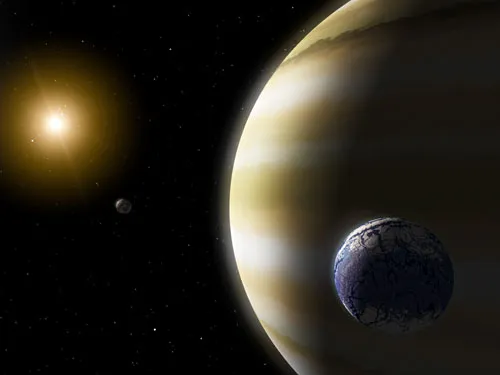
Researchers are learning that our stellar neighborhood is full of exoplanets. Since the 1990s around 300 planets have been discovered orbiting a star other than our Sun. David Bennett, an astrophysicist at the University of Notre Dame and planet hunter, says that an estimated 30% of stars may host planets, although he thinks it could reach 50%, since current technology does not allow easy detection of small planets, like Earth, which are surely out there.
With 100 billion stars populating our Milky Way galaxy, it would mean that between 30 and 50 billion planetary systems could exist. "We think there are actually more planets than stars," says Bennett.
But unlike the planets in novels and movies, none of the exoplanets discovered so far are sufficiently similar to Earth. The vast majority of known exoplanets are of the "Hot Jupiter" type: large, gaseous bodies close to their host stars. It's not a coincidence. It's easier to detect bodies close to stars than those farther away.
Ground-based telescopes collect indirect evidence of the presence of an exoplanet around a star in the form of regular variations in starlight. These differences become more noticeable the larger and closer to the star the planet is. Hence, not many smaller planets or those farther from their star have been found. That is, until now, only a few exoplanets similar to our home in the universe have been found.
But space agencies and organizations have launched or are planning new missions to better identify planets similar to ours. The European satellite COROT has been hunting exoplanets since 2007 and next year NASA plans to launch the Kepler Space Telescope which will observe 100,000 stars over 4 years in search of the tiny signs that betray the presence of planets like Earth.
For now, we must rely on artistic impressions to get an idea of what those strange worlds look like. But in the coming years it may be possible to get real images of these wandering objects. The New Worlds Observer project, tentatively planned for the next decade, will use a flower-shaped screen, called a starshade, to block the glare of stars and thus more easily locate planets that may host. Scientists hope to thus be able to take direct images of exoplanets and study their atmospheres for signs that could betray life, such as water vapor and oxygen. "The New Worlds Observer will allow us to search for evidence of oceans and even continents on exoplanets whose stars are close to Earth," says Webster Cash, starshade developer and astrophysicist at the University of Colorado, Boulder.
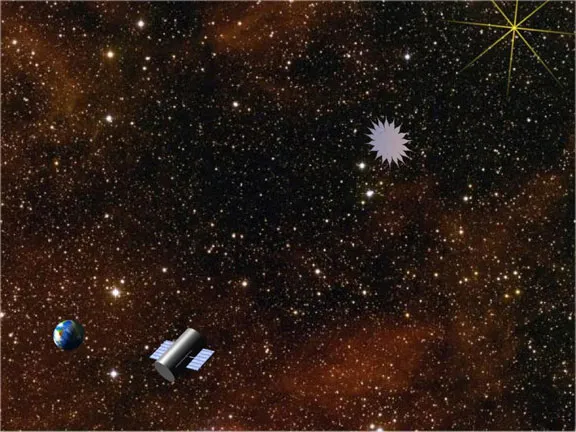
And at some point, these planets will have proper names. Exoplanets are currently referred to by the name of their host star plus a letter. The International Astronomical Union (IAU), which officially names celestial bodies, has resisted naming exoplanets, for now. "But when we find some really important ones, similar to Earth, the IAU will probably be forced to name them," says Cash.
Perhaps our grandchildren will grow up learning about exoplanets with names like those dreamed up by George Lucas...
10 strange worlds in the Milky Way
10.The first exoworld
The first solid evidence of an exoplanet came in 1992 when scientists calculated that two bodies must be orbiting the pulsar PSR 1257. Pulsars are rapidly spinning neutron stars, superdense remnants of the supernova explosion of massive stars. Researchers think the two planets are the rocky cores of gas giants that lost their atmospheres in the supernova explosion or else formed in a second round of planet formation after the explosion.
Names:PSR 1257 b and PSR 1257 c
Star name/Constellation:PSR 1257/Virgo
Distance from Earth: 978 light-years
Mass:4.1 and 3.8 Earths
Distance to its host star:0.36 and 0.46 AU
Year of discovery: 1991
09.Typical star, extraordinary planet
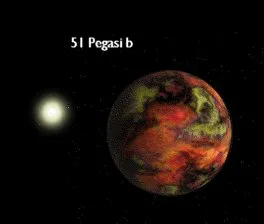
The first exoplanet discovered around a main sequence star: the gaseous 51 Pegasi b, completes an orbit around the star every 4 days (in comparison, Earth takes 365 days). Many exoplanets discovered subsequently are similar giant gaseous planets close to their star, which are called "hot Jupiters." They are usually detected with the so-called radial velocity method. With it, scientists look for regular changes in the star's light, caused by the tug of the exoplanet. 51 Pegasi b was nicknamed Bellerophon, after the mythical Greek hero who captured Pegasus, the winged horse.
Name:51 Pegasi b
Star name/Constellation: 51 Pegasi/Pegasus
Distance from Earth: 48 light-years
Mass: 0.47 Jupiter
Distance to its host star: 0.05 AU
Year of discovery: 1995
08.Survivor of the apocalypse
V391 Pegasi b stands out for being the only known planet orbiting a star that went through its red giant phase. Stars like our Sun, at the end of their lives, when they run out of hydrogen, inflate hundreds of times their original size in the red giant stage. Scientists think the exoplanet was at a distance similar to that of Earth from the Sun. This distance shrank as the star expanded, but the planet migrated to what would be a little farther than the orbit of Mars. Perhaps it is a good example of the fate of Earth and other planets orbiting red giants.
Name:V391 Pegasi b
Star name/Constellation: V391 Pegasi/Pegasus
Distance from Earth: 4,550 light-years
Mass: 3.2 Jupiters
Distance to its host star: 1.7 AU (Astronomical Units)
Year of discovery: 2007
07. Planetary medley
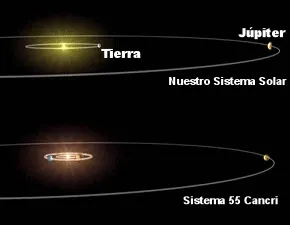
Last year we told of a planetary system composed of 5 planets, around the star 55 Cancri. These are Super-Earths that could be evidence that planetary systems are relatively more common than thought.
More information at:
Fifth planet discovered around a star
Name: 55 Cancri b-f
Star name/Constellation: 55 Cancri/Cancer
Distance from Earth: 44 light-years
Mass: from 18 Earths to 4 Jupiters
Distance to its host star: between 0.04 and 5.9 AU
Year of discovery: 2007
06. The world of strange ice
Scientists think that Gliese 436 b (GJ 43 b), an exoplanet the size of Neptune, is too heavy to be all gas but not heavy enough to be entirely rock. They suspect it is formed of gas, rock, and a type of pressurized ice only known in laboratories as "ice VII" or "ice X".
We told something in "Another 28 exoplanets discovered".
Name: Gliese 436 b
Star name/Constellation: Gliese 436 b/Leo
Distance from Earth: 33 light-years
Mass: from 18 Earths to 22 Earths
Distance to its host star: 0.29
Year of discovery: 2004
05. In the zone
When astronomers detected Gliese 581 c they thought the exoplanet was within the so-called habitable zone, where liquid water can exist on the planet's surface. Gliese 581 c orbits very close to its star, but this is a red dwarf, a star 50 times colder than our Sun. Subsequent studies indicated that it would not be in that zone, although they opened the possibility that Gliese 581 d might be. And given that the Gliese 581 system is the 87th closest star to Earth, it is certainly a good place for more detailed studies.
We told about it in Gliese 581: a planet could be habitable
Name: Gliese 581 c
Star name/Constellation: Gliese 581 c/Libra
Distance from Earth: 20.5 light-years
Mass: 5 Earths
Distance to its host star: 0.073 AU
Year of discovery: 2007
04. Exo-hot
HD 149026 b is one of the hottest known exoplanets, with a surface at 2,000 degrees Celsius. This "hot Saturn" is believed to be frighteningly black, perhaps due to a high concentration of metallic elements.
Name: HD 149026
Star name/Constellation: HD 149026/Hercules
Distance from Earth: 256 light-years
Mass: 0.38 Jupiter
Distance to its host star: 0.042 AU
Year of discovery: 2005
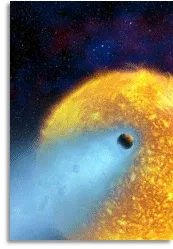
03. A small world
Besides being the first exoplanet directly observed from Earth as it transited in front of its host star, HD 209458 b (also called Osiris), is shrinking. Its proximity to its star heats this world to about 10,000 degrees Celsius, causing it to lose 9,000 metric tons of atmospheric hydrogen per second, forming a comet-like tail. It is thought that it would lose all its atmosphere and leave behind a molten magma core. Furthermore, water vapor was discovered on its surface.
Name: HD 209548
Star name/Constellation: HD 209548/Pegasus
Distance from Earth: 153 light-years
Mass: 0.69 Jupiter
Distance to its host star: 0.045 AU
Year of discovery: 1999
02. Three times Earth
MOA-192 b is the smallest so far with 3.3 Earth masses. It orbits a diffuse star that has 1/12 the mass of our Sun. The tiny size of its star, however, is quite common in the universe, which generates confidence in the possibility of finding planets like ours. The detection of the exoplanet was done with the gravitational microlensing technique, a phenomenon predicted by Albert Einstein that uses the magnified light effect of a star between an observer on Earth and the object of interest.
Name: MOA-192 b
Star name/Constellation: MOA-2007-BLG-192-L/Sagittarius
Distance from Earth: 1,000 light-years
Mass: 3.3 Earths
Distance to its host star: 0.62 AU
Year of discovery: 2008
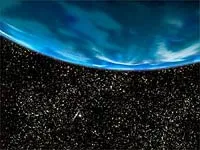
01. The oldest one
PSR B1620-26 b would have formed 13 billion years ago. Nicknamed Methuselah, this probable gas giant resides in a globular cluster, where it orbits two stars, a white dwarf and a pulsar. It is thought that the exoplanet would have orbited a common yellow star like our Sun, which later became a red giant and fed material to a neutron star that later became a pulsar.
Methuselah would live alongside other stars in the cluster, so it is thought to have suffered radiation from several supernovae.
In a cluster very, very far away, a world could exist. Although not a Republic or an Empire...
Name: PSR B1620-26 b
Star name/Constellation: PSR B1620-26/Scorpius
Distance from Earth: 5,600 light-years
Mass: 2.5 Jupiters
Distance to its host star: 23 AU
Year of discovery: 1994
Sources and related links
- Top 10 Exoplanets: Weird Worlds in a Galaxy Not So Far Away by Adam Hadhazy
- COROT satellite
- Exoplanets.org
- The Extrasolar Planets Encyclopedia
- PlanetQuest
About the images
Credits:
Starshade: The Futures channel
Gliese 581 c: ESA
HD 209458 b: ESA/Hubble
PSR B1620-26 b: NASA/G Bacon
51 Pegasi b and 55 Cancri: NASA