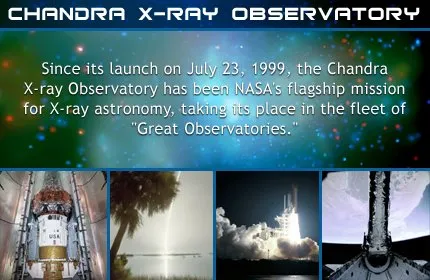
On July 23, 1999, NASA launched the Chandra X-ray Observatory, the third of its Great Observatories. Since then, it has produced incredible results, showing us a new universe. It was launched by the Columbia -unfortunately lost in the 2003 tragedy- on mission STS-93.
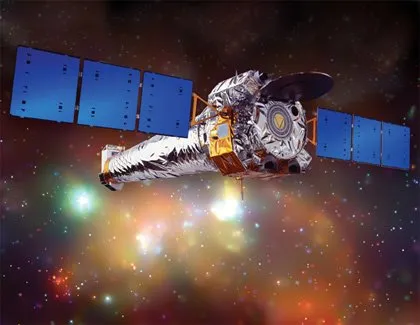
The Advanced X-ray Astronomical Facility (AXAF), as it was previously called, is the third of NASA's four Great Observatories, after the Hubble Space Telescope and the Compton Gamma Ray Observatory. The one that followed was the Spitzer Space Telescope.
It is named after the Indian physicist and mathematician Subrahmanyan Chandrasekhar, winner of the Nobel Prize in Physics in 1983 and well known for his work on what is called the "Chandrasekhar Limit", which stipulates that stars with a mass 1.4 times greater than that of our Sun would collapse into what are called white dwarfs.
The name was chosen through a contest in which many names were proposed and a panel that finally chose the one it currently has, with Tyrel Johnson and Jatila van der Veen being the winners, who were the ones who suggested the name of the renowned Indian scientist.
The public was invited to vote for the best images produced by Chandra between 1999 and 2006. The most voted image corresponds to the Cat's Eye Nebula (NGC 6543), although the ones chosen each year (and a large number of the unchosen ones) are also fabulous.

It is possible to know where Chandra is now (its position relative to the planet's surface) from its website. The elliptical orbit in which it is located takes the satellite to an approximate altitude of 139,000 km, more than a third of the distance to the Moon, and most of the time it is outside Earth's radiation belt.
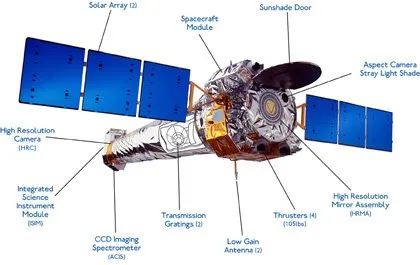
The Chandra telescope system consists of four pairs of mirrors and its support structure.
The Observatory combines the mirrors with four instruments to capture and investigate X-rays from astronomical sources. These rays are studied with the ACIS (Advanced CCD Imaging Spectrometer) and HRC (High Resolution Camera) instruments, which provide information about the X-rays such as their number, position, energy, and arrival time.
Two additional instruments provide detailed information about the energy of the rays: the LETG and HETG spectrometers (for Low Energy Transmission Grating Spectrometer and High Energy Transmission Grating Spectrometer).
Chandra has an excellent website where you can find the most wonderful images of the universe in its photo album, send cards, access podcasts (in English), add Chandra on Facebook, Chandra on MySpace, subscribe to news by email or by RSS, Chandra on Google Sky, its own blog and much more.
Next year the observatory will complete a decade of operations, thanks to an extension until 2009 of the mission that had been planned for five years. It is expected that this extension will be renewed and continue in operation for several more years. 2009 will be the International Year of Astronomy and it is expected that Chandra will celebrate it with the fireworks it has accustomed us to.
Sources and related links
About the images
Credit: Chandra
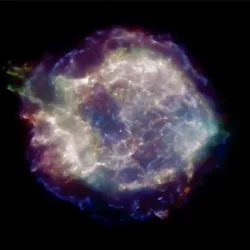
The Cassiopeia A supernova remnant in X-rays, image produced to celebrate the anniversary of Chandra's first light: NASA/CXC/SAO