Messier 101, also known as the Pinwheel Galaxy, is dominated by a jumble of spiral arms. In this new image from the Spitzer Space Telescope, the outer zone is highlighted by the surprising disappearance of organics.
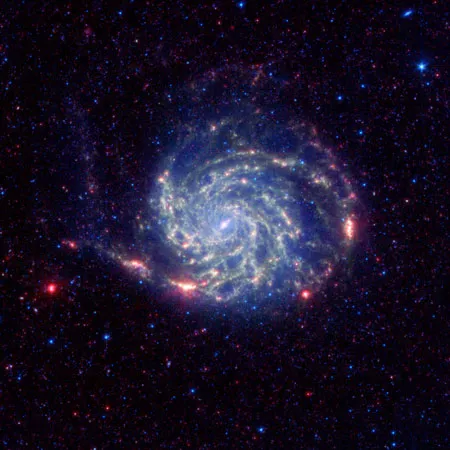
A new study in the July 20 edition of Astrophysical Journal explains that the outer zone, colored red in the image, highlights an area where organic molecules called polycyclic aromatic hydrocarbons, which are present in most of the galaxy, surprisingly disappear.
Polycyclic aromatic hydrocarbons (PAHs for short) are ring-shaped molecules made of carbon and hydrogen. PAHs are organic pollutants that appear in car exhaust fumes or cigarette smoke, for example. Although these substances are harmful to the human body, they have their "positive side": similar molecules are found in DNA and there is a broad consensus among biologists that PAHs were present on Earth 4,500 million years ago when life began. By serving as building blocks of life, PAHs may have played an essential role in the chemical process of genesis.
The Pinwheel Galaxy (or NGC 5457 by its classification in the New General Catalogue) is located 27 million light-years away in the constellation Ursa Major. Its concentration of metals (elements heavier than helium) is greater in its center and declines rapidly with distance. This is because the stars, which produce metals, are crowded in the center.
Karl Gordon of the Space Telescope Science Institute in Baltimore and his team used Spitzer to learn more about this slope of polycyclic aromatic hydrocarbons. The astronomers found that, like metals, these molecules decrease toward the outer portions of the galaxy. But, unlike heavy elements, these organic molecules disappear rapidly and are no longer detected in the outermost zone.
The finding also provides a better understanding of the conditions under which the first stars and galaxies emerged. In the early universe, there were not many metals or polycyclic aromatic hydrocarbons. The outer zone of the Pinwheel Galaxy therefore serves as an example of what the environment in a distant galaxy must look like.
In this image, infrared light of 3.6 microns wavelength is colored blue; 8 microns in green and 24 microns in red.
Sources and related links
- Spitzer Reveals 'No Organics' Zone Around Pinwheel Galaxy
- The Behavior of the Aromatic Features in M101 H ii Regions: Evidence for Dust Processing
Karl D. Gordon et al.
The Astrophysical Journal, 682:336–354, 2008 July 20
DOI:10.1086/589567
About the images
NASA/JPL-Caltech/Potsdam Univ.