What was until now known as NASA's new satellite telescope, GLAST, has been renamed the Fermi Gamma-ray Space Telescope in honor of Professor Enrico Fermi (1901-1954), a pioneer in high-energy physics.
"Enrico Fermi was the first person to suggest how cosmic particles could be accelerated to high speeds," says Paul Hertz, chief scientist of the mission directorate at NASA. "His theory provides the foundation for understanding the new phenomenon that his namesake telescope will discover."
Scientists expect that Fermi, by observing energetic gamma rays, will discover many new pulsars, reveal the internal mechanisms of supermassive black holes, and help scientists search for new laws of Nature.
For two months, since the launch on June 11, 2008, scientists tested and calibrated the satellite's two instruments: the Large Area Telescope (LAT) and the GLAST Burst Monitor (GBM).
Today, the LAT team revealed an image of the sky showing the glow of gas in the Milky Way, the Vela pulsar, and blazars. The map combines 95 hours of observations from the instrument's first light.
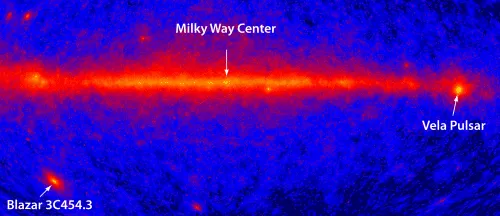
A similar image, produced by the former Compton Gamma Ray Observatory, took years of observations to produce. With Fermi's superior sensitivity, many discoveries are expected to come.
The LAT scans the entire sky every three hours when operating in Survey Mode, which will occupy most of the observing time during the first year of operations. This will allow scientists to monitor rapid changes, characteristic of the violent gamma-ray universe. The telescope is sensitive to photons with energies from 20 MeV (million electron volts) to over 300 GeV (billion electron volts). The final part of this range, corresponding to energy more than 5 million times greater than dental X-rays, has been little explored.
Detail of Fermi's first light map: The Vela pulsar
The secondary instrument, the GBM, detected 31 explosions known as gamma-ray bursts (GRB) in the first month of operations. These bursts occur when massive stars die or when orbiting neutron stars end up merging.
The GBM is sensitive to lower-energy gamma rays than the LAT, providing a complementary view of the broad gamma-ray spectrum. Working together, the two instruments could finally reveal some of the mysteries about GRBs.
"The past decades have been a golden age for astronomy," says GBM principal investigator Chip Meegan of the Marshall Space Flight Center. Fermi, according to him, will continue the good times, providing discoveries that allow a better understanding of the immeasurable cosmos.
Sources and related links
- First Light for the Fermi Space Telescope
- NASA Renames Observatory For Fermi, Reveals Entire Gamma-Ray Sky
- Fermi at NASA
- Goddard Space Flight Center: GLAST
About the images
Credit: NASA/DOE/International LAT Team
Fermi logo: NASA/Sonoma State University/Aurore Simonnet