The Spitzer mission allowed us to observe the incredible infrared universe, from the most distant galaxy to the detection of planets orbiting other stars. Between August 22 and 24, at the Griffith Observatory in Los Angeles, they will celebrate the instrument's first and very fruitful years of life.
On Friday afternoon, as part of the celebration, they will unveil a new image from Spitzer. Furthermore, those who live around there will be in luck as there will be lectures and astronomers from Caltech and JPL will answer questions.
The Spitzer Space Telescope was launched into space by a Delta rocket from Cape Canaveral on August 25, 2003.
But its history goes back to what was called SIRTF (Shuttle Infrared Telescope Facility), an instrument conceived for the Spacelab according to the recommendations of a science committee in 1979. Anticipating the exciting results from the Explorer satellite and the Shuttle mission, the report favored the "study and development of long-duration space flights of infrared telescopes cooled to cryogenic temperatures." Its first flight was expected for 1990. While NASA was preparing to publish this announcement to request proposals, a rocket was launching the first infrared telescope into space: the InfraRed Astronomical Satellite (IRAS). IRAS, an Explorer-type satellite designed to conduct the first infrared sky survey, was the fruit of collaboration between the United States, the Netherlands, and Great Britain.
The mission was successful and they began to think about a long-duration SIRTF mission, independent of the Shuttle.
This decision proved to be very wise, as when the InfraRed Telescope (IRT) flew aboard Spacelab 2 in July 1985, it was discovered that the contaminating infrared emission produced by the Shuttle was considerable. Despite this, this modest 15.2 cm diameter telescope developed by a team from the Smithsonian Astrophysical Observatory demonstrated the success of the telescope's cryogenic design and the possibility of working with superfluid helium in zero gravity.
The decision to proceed with an observatory independent of the Shuttle led to the first, but not last, transformation of SIRTF: Space Infrared Telescope Facility.
In 1989, the National Research Council of the National Academy of Sciences tasked the Astronomy and Astrophysics Survey Committee (AASC) with making recommendations for the most important initiatives in ground-based and space observatories for the next decade.
In this report, Spitzer is considered the "highest priority new space program" for the next decade. Spitzer was seen as the fourth and final element of NASA's Great Observatories Program. The intention was to launch Spitzer early enough to allow it to be contemporary with the Hubble Space Telescope and the Chandra X-ray Observatory (launched in 1999).
Shortly after the report's publication there were serious budget cuts and Spitzer's design was modified. Naturally, some of Spitzer's scientific capabilities have disappeared, but despite the dramatic reduction in its budget (by 80%), Spitzer's vitality and integrity have been maintained. How? Largely thanks to innovative engineering decisions.
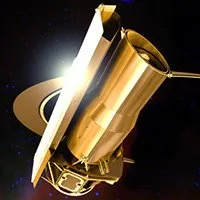
The Spitzer observatory consists of a 0.85-meter telescope with three cryogenically cooled scientific instruments (IRAC, IRS, and MIPS), capable of taking images and spectra from 3 to 180 microns. With its great sensitivity, its array of large-format detectors, its high observational efficiency, and its long cryogenic life, Spitzer offers an unprecedented observational capability.
The final name comes from Dr. Lyman Spitzer, Jr. (1914-1997), considered one of the most influential scientists of the 20th century and one of the first proponents of the idea of space telescopes, proposing this possibility in the 1940s.
Sources and related links
- Celebrate Spitzer's 5th Anniversary at Griffith Observatory!
- Spitzer site, in Spanish
- Spitzer site (English)
- Spitzer site at NASA
About the images
Credit: NASA/JPL-Caltech/T. Pyle (SSC)