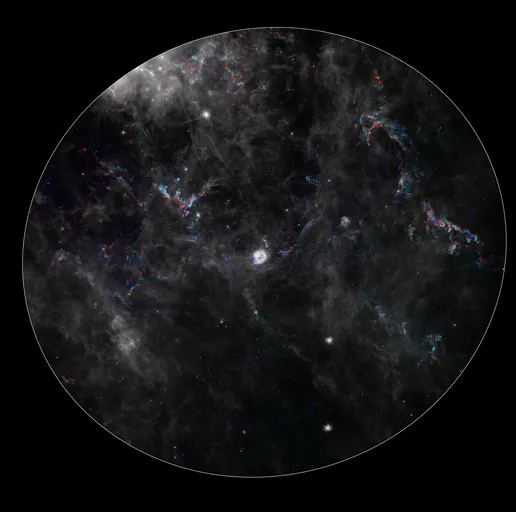
A delicate ribbon of gas floats eerily in our galaxy. It is a very thin section of a supernova remnant caused by a stellar explosion that occurred more than 1000 years ago: SN 1006.
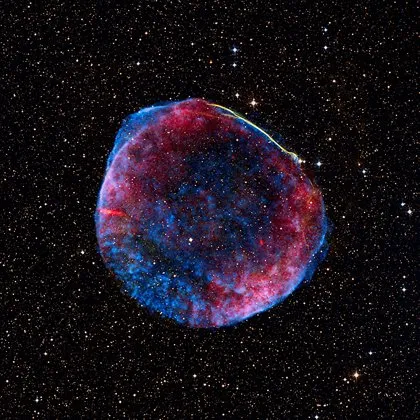
Around May 1, 1006 (AD), observers from Africa to China witnessed the arrival of the light from what is now called SN 1006, a tremendous supernova caused by the explosion of a white dwarf nearly 7,000 light-years away. The supernova was probably the brightest that humans have seen and managed to surpass Venus in brightness. It was visible even during the day for weeks and remained visible to the naked eye for at least two and a half years before fading. It was not until the mid-1960s that radio astronomers detected an almost circular ring of material at the position of the supernova. The ring was about 30 arcminutes, the same angular diameter as the full Moon. The size of the remnant implies that the supernova blast wave expanded at a high speed for 1000 years since the explosion occurred. In 1976, the first detection of an extremely faint optical emission from the supernova remnant was reported, but only for a filament located at the northwest edge of the ring. A small portion of this filament is revealed in detail in the Hubble Space Telescope observation. This ribbon of light seen by Hubble corresponds to locations where the supernova shock wave is sweeping up the very tenuous surrounding gas.
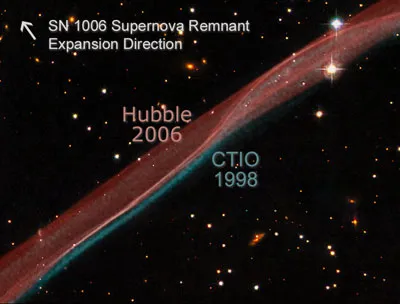
Comparison of hydrogen emission in the northwest filament of SN 1006 by the CTIO telescope in 1998 (in green) and the Hubble ACS camera in 2006 (in red). The hydrogen gas heated by this fast shock wave emits radiation in visible light. Thus, the optical emission provides astronomers with a detailed snapshot of the current position and geometry of the shock front. We now know that SN 1006 has a diameter of almost 60 light-years and is still expanding at 6 million miles per hour. Even at that enormous speed, however, it requires observations separated by years to see significant motion of the wave against the background stars. SN 1006 is located 7000 light-years from Earth in our Milky Way galaxy. Sources and related links
Hubble Sees Stars and a Stripe in Celestial Fireworks SN 1006: Liberating Star Stuff About the images
Top image: Credit: NASA/CXC/Rutgers/G.Cassam-Chenaï, J.Hughes et al.; Radio: NRAO/AUI/NSF/GBT/VLA/Dyer, Maddalena & Cornwell; Optical: Middlebury College/F.Winkler, NOAO/AURA/NSF/CTIO Schmidt & DSS Bottom image: Credit: Hubble data: NASA, ESA, and the Hubble Heritage Team (STScI/AURA); CTIO data: Winkler/CTIO/NOAO/AURA