Astronomers have unearthed the secrets of the tomb of a star that exploded as a supernova long ago. By decoding the ghostly light echoes traveling from the supernova remnant Cassiopeia A, scientists have been able to piece together what the star was like in life and how its end came about.
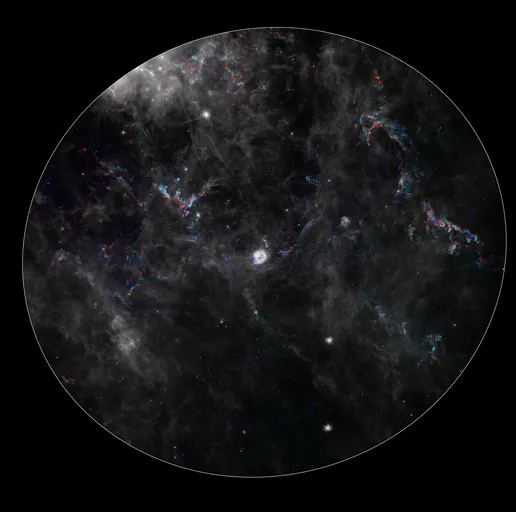
"Cassiopeia A lies in our cosmic backyard and offers a sharp view of what remains hundreds of years after a supernova explosion," says Oliver Krause of the Max Planck Institute in Germany, author of the paper about the discovery that appears in this week's edition of Science. "The light echoes we found around Cassiopeia A offer us a 'time machine' to go back and see its past."
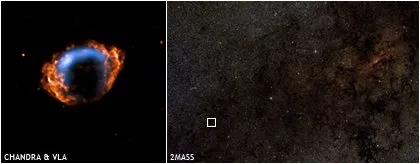
Cassiopeia A is one of the most explored objects in the sky and has been the subject of more than a thousand scientific papers. (See Spitzer Telescope solves mystery of a supernova) It is the corpse of a massive star that ended as a supernova more than 11,000 years ago. In fact, until recently, it was the most recent supernova remnant in our Milky Way. The new record is held by G1.9+0.3, recently discovered by the Chandra Observatory and other telescopes. Since Cassiopeia A is more than 11,000 light-years away from Earth, the light from its explosion would have reached our planet about 300 years ago.
Using the infrared capability of the Spitzer Space Observatory, astronomers Krause and his colleagues found in 2005 the so-called infrared echoes, which occur when a flash of light from the supernova passes through clouds, heating them and making them glow in infrared.
In the new study, astronomers used the infrared echoes from Cassiopeia A to focus on the visible light echoes that occur when visible light from the supernova scatters off dust. Unlike infrared echoes, they act as signals from the tombs of exploded stars.
Since these echoes can fade quickly, astronomers used the spectrometer on Subaru to reveal the signatures of the atoms present when the star exploded. The resulting light spectrum revealed hydrogen and helium - which reveal that Cassiopeia A was a red supergiant star whose core collapsed in a rare type IIb supernova.
"This is an exciting result," adds Alex Filippenko of the University of California, Berkeley, a supernova expert who did not participate in the study. "Cassiopeia A has been studied extensively with many telescopes over a wide range of wavelengths. It is gratifying that we finally know what kind of star exploded so long ago."
The findings also offer insight into another mystery about this star. When Cassiopeia A originally exploded, the event should have been widely seen on Earth as a bright star in the sky. The most likely sighting is believed to be by astronomer John Flamsteed in 1680, but he made only one observation of a diffuse star.
Now that astronomers have learned how the star was forged, they think they know why its death went unnoticed. "Type IIB supernovae fade quickly. This, plus a few cloudy nights, could explain the historical enigma around Cassiopeia A," says co-author George Rieke of the University of Arizona, Tucson.
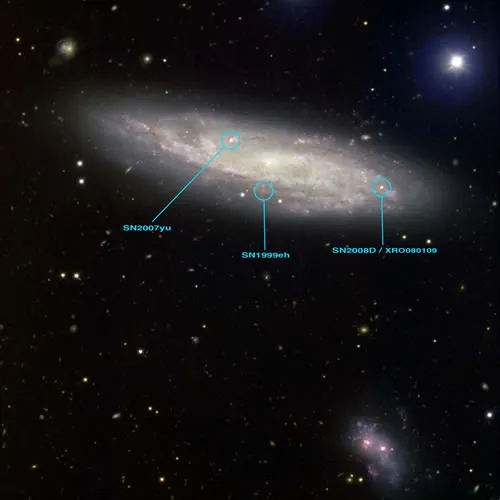
Recently, using the Chandra, XMM-Newton and Gemini observatories, astronomers were able to use light echoes to identify the origins of a supernova outside our galaxy. (See Determining the power of a supernova). That study, along with this new one, demonstrates the power of light echoes to conjure up the 'ghosts' of dead stars.
Sources and related links
- JPL NASA:Scientists Hold Seance for Supernova
- Spitzer:Scientists Hold Séance for Supernova
- The Cassiopeia A Supernova Was of Type IIb
Oliver Krause et al.
Science 30 May 2008:Vol. 320. no. 5880, pp. 1195 - 1197
DOI: 10.1126/science.1155788
About the images
This composite image from Spitzer shows the remnant of the exploded star, Cassiopeia A (in the center) and the surrounding "light echoes," dances of light through dust clouds, created when the star exploded. The light echoes are colored and the surrounding dust clouds are in gray.
Credit:NASA/JPL-Caltech