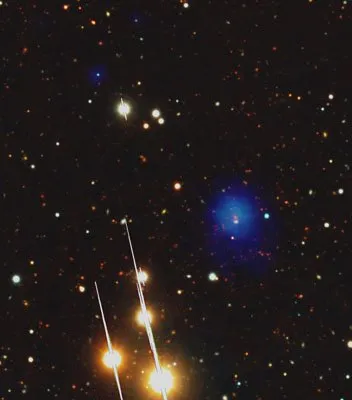
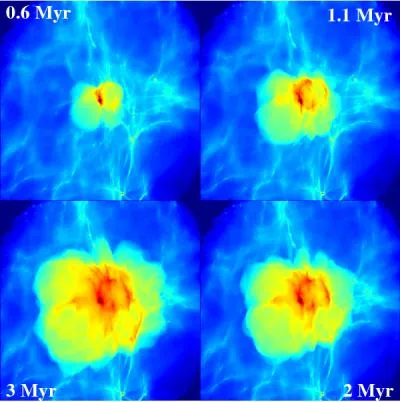
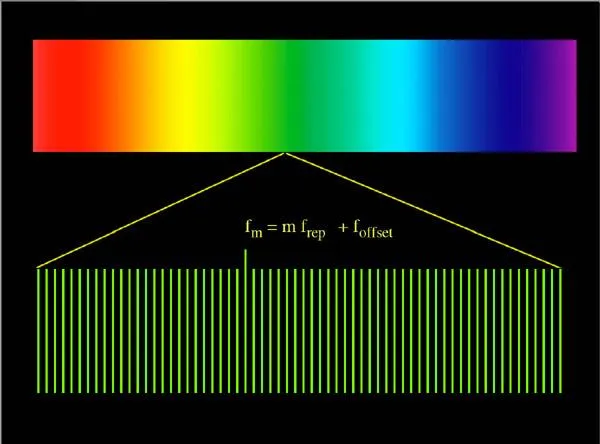
Cosmic cartographers are beginning to work on the largest 3D map of the Universe so far. It would reveal to us the undulating landscape sculpted by the big bang and could give us clues about the hidden shape of space and the nature of dark energy.
The Sloan III project is the latest in a sequence of sky surveys that uses a wide-field telescope in Sunspot, New Mexico. Since the completion of Sloan I (between the years 2000-2005) and Sloan-II (2005-2008), the telescope's camera and optics have been updated, making the instrument more sensitive.
While most of the effort in the previous investigations was dedicated to relatively nearby galaxies, the goal of Sloan III will be to chart the positions of the most luminous galaxies up to a distance of 8 billion light-years. SDSS-III will be a six-year program composed of four investigations: Boss, will measure the cosmic distance scale; SEGUE-2 will map the structure of the Milky Way; APOGEE will use infrared spectroscopy to see through the dust; and MARVELS will investigate the population of giant planets in 11,000 stars.
"I'm glad we didn't know at the beginning how difficult it would be and how long it would take," says Jim Gunn, the Princeton astronomer who has guided the project from the start.
The survey uses a 2.5m telescope equipped with two specialized instruments: a 125 Megapixel camera and spectrographs that observe 640 objects at the same time. SDSS managed to achieve its original goals by making deep and colorful maps covering more than a quarter of the sky and measuring the distances of about one million galaxies and more than one hundred thousand quasars, thus creating the largest map of cosmic structure.
With the determination of the locations of millions of these galaxies on a map of that scale, the team hopes that an underlying pattern will emerge. They are looking for a relic of an older pattern, seen in the cosmic microwave background radiation that was emitted
380,000 years after the big bang. In turn, that was created by strong sound waves traveling through the hot and dense early cosmos.
In this cosmic cacophony, a particular note was louder than the rest, and has survived to this day as a characteristic wavelength in the clustering of galaxies.
A couple of years ago, two studies revealed that the sound waves that traveled through space after the big bang left a subtle imprint on the way galaxies cluster. Generally speaking, the distance between galaxies matches the pattern of the sound waves of the early universe.
"It is more likely that galaxies are separated by 500 million light-years than by 400 or 600 million light-years," says Daniel Eisenstein, director of the new project at the University of Arizona.
Gas clouds
They also hope to see these imprints in the way intergalactic gas clusters, whose presence is revealed by its absorption of light from distant quasars. "It's the first time anyone has tried to do this," says Eisenstein.
The study will attempt to elucidate the history of cosmic expansion to learn more about changes in acceleration and find out if dark energy is getting stronger or weaker.
Furthermore, they will try to learn more about the shape of the universe. If spacetime is curved on large scales, it will magnify or shrink the relative size of distant objects. Those changes could be distinguishable from others caused by dark energy because the curvature of space would produce stronger effects at higher redshifts, according to the astronomers.
"The sound waves that traveled in the early universe left a characteristic scale in the distribution of galaxies," says Eisenstein. "We can use this scale as a 'standard ruler' to measure the history of the expansion of the universe, just as supernovae have been used as standard candles," he adds.
Sloan III will also probe close to home, mapping the Milky Way:
The SEGUE (Sloan Extension for Galactic Understanding and Exploration) study will study our galaxy in visible light, while another will be done in infrared to penetrate the interstellar dust that obscures our view of the galaxy.
A fourth study will monitor 10 thousand stars in search of giant planets, by detecting the wobbles that giant planets generate in their host stars.
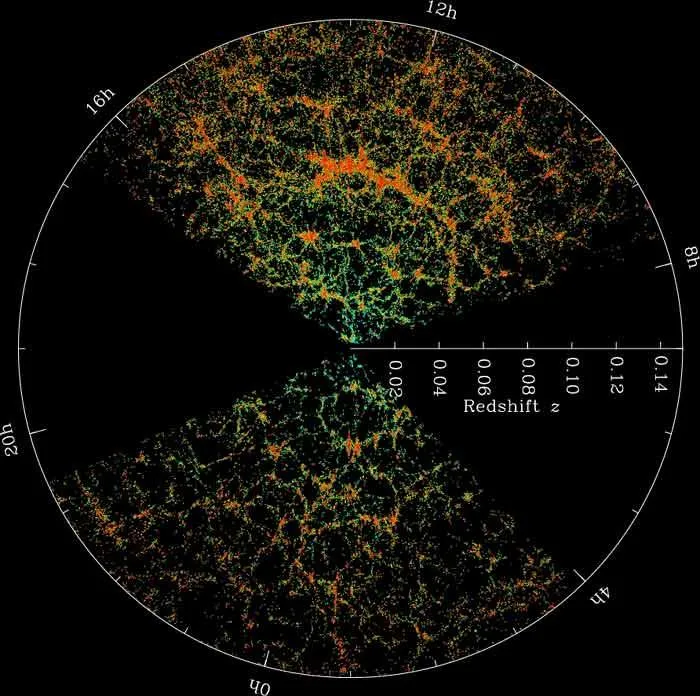
The Sloan Digital Sky Survey has made detailed 3D maps of relatively nearby galaxies. Earth is at the center of these wedges, with the outer circle at a distance of 2 billion light-years. The region between the wedges was not mapped by the SDSS because of dust in our galaxy that obscures the view of the distant universe in those directions.
SDSS-II completed its observations on July 14 and will release its final data to the public in October. SDSS-III began on July 15.
See and interact with the Universe in 3D
Computer technology and the personal effort of some researchers give us the opportunity not to just stand amazed at the astronomical data from the galaxy distribution survey or the studies on the cosmic microwave background radiation. We can also have images, videos and computer programs based on this real data.

One example is Galaxy Explorer, by Tamas Szalay. The software shows the 3D distribution of galaxies observed by the SDSS. The data consist of the positions of more than 130 thousand galaxies and enable the observation of galactic clustering in walls and filaments.
The program is very simple to operate. We move the mouse to look around and use the left button to go forward and the right button to go back. The keys W, S, A, D, +, -, R, space bar, escape, allow us to go up, down, left, right, increase speed, decrease speed, go to initial position, flight mode and exit, respectively.
Version 3 of the program is now available!
It can be downloaded from http://cas.sdss.org/dr6/en/help/download/gex2/default.asp
SkyServer
This site is designed for learning and using tools for teaching.
If you know about SQL databases, you can make queries of that type (but be prepared to spend several hours, it's addictive!)
The site, in Spanish, is at:
http://cas.sdss.org/dr6/sp/
To learn more and use other tools, videos and images, visit the education section of the SDSS:
http://www.sdss.org/education/
There you will find a link to Cosmus, a site with many tools, among which you can explore cosmic rays thanks to data from Argentina's Pierre Auger Observatory at:
http://astro.uchicago.edu/cosmus/projects/auger/
and much more at Cosmus:
http://astro.uchicago.edu/cosmus/projects/
Sources and related links
- SDSS-III
- Sloan Digital Sky Survey
- Biggest 3D galaxy map to probe dark energy's history
- A giant astronomical survey completes its mission: A new mission begins
- Tools to see the universe in 3D: Cosmus
About the images
A slice of the three-dimensional map of the galaxy distribution from SDSS. Earth is at the center and each point represents a galaxy, colored according to the age of its stars: the redder ones are older. The outer circle is at two billion light-years. The region between the wedges was not mapped by SDSS due to dust in our galaxy that obscures the view of the distant universe in those directions.
(Illustration: M Blanton/ SDSS)