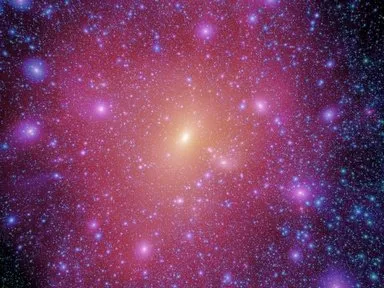
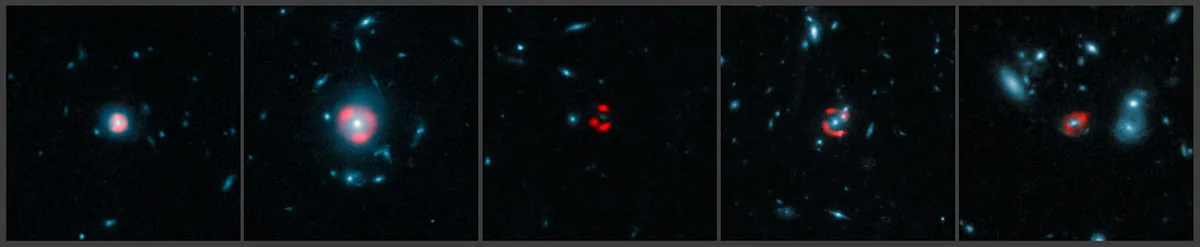
Researchers believe our universe began with the Big Bang 13,700 million years ago and that subsequently matter began to form as small grains of dust and gas. How the first stars formed from that gas and dust has been difficult to answer, but a state-of-the-art computer simulation now offers the most detailed picture of how these primordial stars formed in the universe.
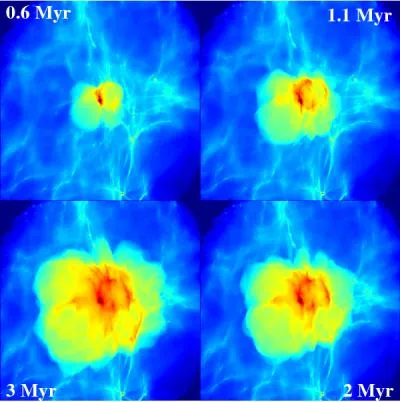
The composition of the early universe was quite different from today's and the physics that governed the early cosmos was in some ways simpler. Dr. Naoki Yoshida and colleagues in Japan and the United States incorporated those conditions of the early universe, often referred to as "the dark age," to simulate the formation of an astronomical object that would eventually shine.
The result is a detailed description of the formation of a protostar - the early stage of a massive primordial star of our universe. The simulation - which has been nicknamed the "Cosmic Rosetta Stone" - sets a benchmark for future research on the star formation process. Research in this field is very important since the formation and eventual explosion of stars provides the elements that will form the next stellar population.
According to the simulation, gravity acts on the variations in matter, gases and the mysterious dark matter after the Big Bang to form this early stage of a star - a protostar with a mass of 1% of our Sun. The simulation reveals that the protostar would likely evolve into a massive star capable of synthesizing heavy elements, not in later generations of stars, but very soon after the "Big Bang".
"This general picture of star formation and the ability to compare how stellar objects form in different periods and regions of the universe will ultimately allow research into the origins of life and planets," says Lars Hernquist, professor of astronomy at Harvard University and co-author of the report presented in the August 1 issue of Science.
"Dr. Yoshida has taken the study of primordial star formation to a new level with this simulation, but we are still halfway to our goal. It's like laying the foundations of a skyscraper," says Volker Bromm, professor of astronomy at the University of Texas and author of an article accompanying the report.
Sources and related links
- American Association for the Advancement of Science (AAAS):
New Research Shows How the First Stars in the Universe Came into Existence - EurekAlert:Dust and gas in the early universe
- Protostar Formation in the Early Universe
Naoki Yoshida, Kazuyuki Omukai, Lars Hernquist
Science August 1, 2008:Vol. 321. no. 5889, pp. 669 - 671
DOI:10.1126/science.1160259 - The Cosmic Rosetta Stone
Volker Bromm
Science August 1, 2008: pp. 647-648 - Computer simulation of the distribution of first galaxies
About the images
Credit:Dr. Naoki Yoshida of Nagoya University via Science-AAAS