Astronomical instruments need to answer crucial questions, such as the search for planets like Earth or the way the Universe expands, with the greatest possible precision. Scientists presented a new spectrograph calibration method to obtain more precise measurements, with a technique called "laser frequency comb".
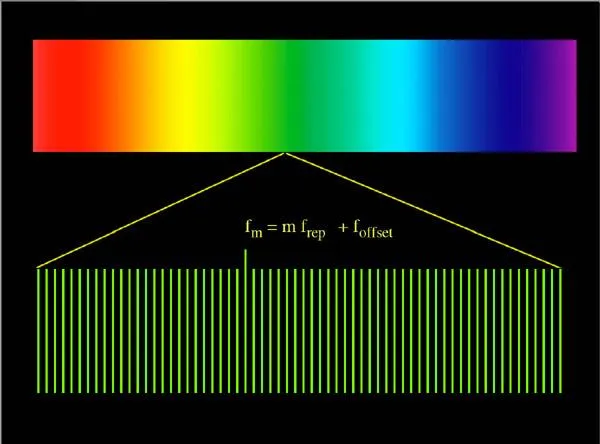
"It seems as if we are going to fulfill one of the astronomers' dreams," says Theodor Hänsch, director at the Max Planck Institute for Quantum Optics (MPQ) in Germany. Hänsch, together with John Hall, was awarded the 2005 Nobel Prize in Physics for his work that includes the frequency comb technique.
Astronomers use instruments called spectrographs to study the light from celestial objects, separating it into its colors or frequencies, in the same way that water droplets create a rainbow from sunlight. Thus, they can measure the velocities of stars, galaxies and other objects, search for planets around other stars, or study the expansion of the Universe. A spectrograph must be precisely calibrated so that the light frequencies can be correctly measured. It is similar to our need to have precise rulers to measure distances correctly. In this case, a laser provides that kind of "ruler", to measure colors instead of distances, with extreme precision.
New and very precise spectrographs will be needed in experiments planned for the future European Extremely Large Telescope (E-ELT), which is being designed by the ESO Observatory. These new spectrographs will need to be calibrated with very precise "rulers", as much as one part in 30 billion!
"We will need something beyond what current technology can offer, and that is where the laser frequency comb comes into play. It is worth remembering that the kind of precision required, 1 cm/s, corresponds, in the focal plane of a typical high-resolution spectrograph, to a few tenths of a nanometer, that is, the size of some molecules," explains doctoral student and ESO team member Constanza Araujo-Hauck.
The new calibration technique comes from the combination of astronomy and quantum optics, in a collaboration between researchers from ESO and MPQ. It uses ultra-short pulses of laser light to create a "frequency comb", light of many frequencies separated by a constant interval, to create the kind of precise "ruler" to calibrate a spectrograph.
After successful tests in the MPQ laboratory in 2007, the team satisfactorily tested a prototype device using the laser comb at the Vacuum Tower Telescope (VTT) Solar Telescope in Tenerife, on March 8, 2008, measuring the spectrum of the Sun in infrared light. The results are impressive, according to the scientists, and the technique promises to achieve the precision needed to study the big astronomical questions.
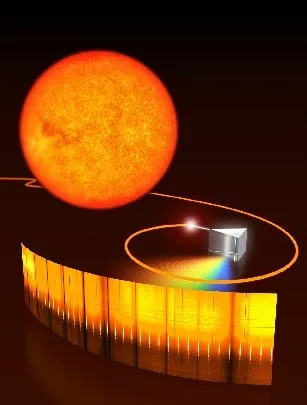
Using a telescope, the Sun's light was spliced into an optical fiber that guides it to a spectrometer (prism) to detect its spectral lines. These spectral lines of the Sun (Fraunhofer lines) appear as dark bands because they represent the wavelengths of light that have been absorbed by the Sun's photosphere. Superimposed are many short, bright (white) spectral lines from the laser frequency comb.
"In our tests in Tenerife, we have already reached a state-of-the-art precision. Now we will make the system more versatile and develop it further," says Tilo Steinmetz of Menlo Systems GmbH, a company of the Max Planck Institute founded to commercialize the technique.
A new version of the system is being created for the planet-finding instrument HARPS on ESO's 3.6 m telescope at La Silla, Chile, before being considered for future generations of instruments.
One of the ambitious projects to be carried out by the E-ELT, called CODEX, will attempt to measure the recently discovered acceleration of the universe directly, by tracking the velocities of distant galaxies and quasars over a period of 20 years. This would allow astronomers to test Einstein's General Theory of Relativity and the nature of the mysterious dark energy.
"We must measure the motion of these distant galaxies, a few centimeters per second, and track it for decades. These velocities are somewhat faster than the pace of a snail, and the laser frequency comb is absolutely crucial for this," says Antonio Manescau of ESO.
Astronomers also use spectrographs to hunt planets around other stars, by observing the subtle motions of the star as the planet orbits it. To be detected with current technology, those planets must be relatively massive or very close to their star, compared to Earth. A more precise spectrograph would allow astronomers to find planets with characteristics similar to our own.
Sources and related links
- ESO:A FINE-TOOTH COMB TO MEASURE THE ACCELERATING UNIVERSE
- Laser Frequency Combs for Astronomical Observations
Tilo Steinmetz et al.
Science 5 September 2008: Vol. 321. no. 5894, pp. 1335 - 1337
DOI: 10.1126/science.1161030 - New Scientist:Laser 'comb' used to disentangle Sun's light
- Supplementary materials on the Laser Frequency Comb
About the images
A frequency comb, which is the light from a laser pulse, consists of many colors that are only revealed when observed with a high-resolution spectrometer, like those used in astronomical telescopes. The spectral lines of the comb can be stabilized to the frequency given in the graph using an atomic clock.
Credit:Theodor Hänsch
Experiment diagram:ESO