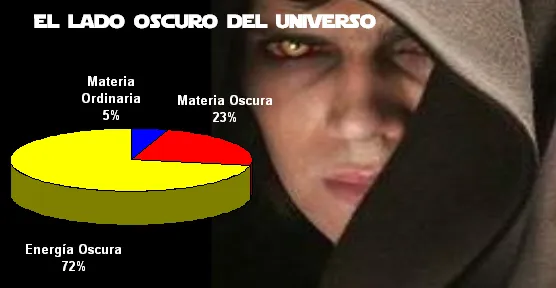
Dark energy is thought to make up almost 75% of the universe. Scientists do not know what dark energy is, but they can detect its effects and believe it would be responsible for the increase in the expansion rate of the cosmos.
In a new study, astronomers led by István Szapudi of the University of Hawaii say they have detected signs of dark energy in superclusters and supervoids.
Superclusters are crowded sets of galaxies, while supervoids are areas of space that notably lack galaxies.
The study is based on the detection of changes in microwave energy before and after passing through these regions. It is the detection of what is called the "Sachs-Wolfe effect," a property of the cosmic microwave background.
"When a microwave enters a supercluster, it gains a bit of gravitational energy and thus vibrates a little faster," says Szapudi. "Then, upon leaving the supercluster, it must lose the same amount of energy. But if dark energy causes the universe to stretch at a faster rate, the supercluster flattens out in the 500 million years it takes the microwave to cross it. In that way, the wave retains some of the energy it gained upon entering the supercluster."
Szapudi, together with his colleagues Mark Neyrinck and Benjamin Granett analyzed a map of the variation in the energy of the cosmic microwave background radiation (CMB) and compared that data with the 50 largest superclusters and supervoids based on information from the Sloan Digital Sky Survey, a project that maps the distribution of galaxies in the sky.
Apparently, just as the researchers predicted, the microwaves were a bit stronger when passing through a supercluster and a bit weaker when passing through a supervoid.
"With this method, for the first time we can see what happens to the microwaves as they pass through superclusters and supervoids," added Granett.
The study has been submitted to The Astrophysical Journal Letters.
Sources and related links
- Space:Dark Energy Signs Seen in Giant Clusters and Voids, by Clara Moskowitz
- University of Hawaii:
Hawaii Scientists Find Direct Evidence of “Dark Energy” in Supervoids and Superclusters - An Imprint of Super-Structures on the Microwave Background due to the Integrated Sachs-Wolfe Effect
Benjamin R. Granett, Mark C. Neyrinck, and Istvan Szapudi
The Astrophysical Journal Letters
arXiv:0805.3695v2 - Dark Energy Detected with Supervoids and Superclusters
Benjamin R. Granett, Mark C. Neyrinck, István Szapudi
arXiv:0805.2974v2 - Superclusters and supervoids:
Researchers' site on this investigation - What the background radiation tells
About the images
The researchers compared the directions in the sky where superclusters (red circles) and supervoids (blue circles) are located with the energy of the cosmic microwave background radiation. The superclusters seem to coincide with the areas where the microwaves are usually strong (colored red/orange) and the supervoids with the places where the microwaves are weaker (in blue).
Credit:B. Granett, M. Neyrinck, I. Szapudi