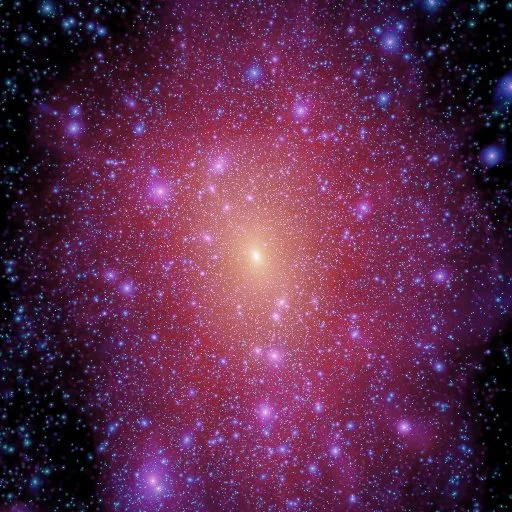
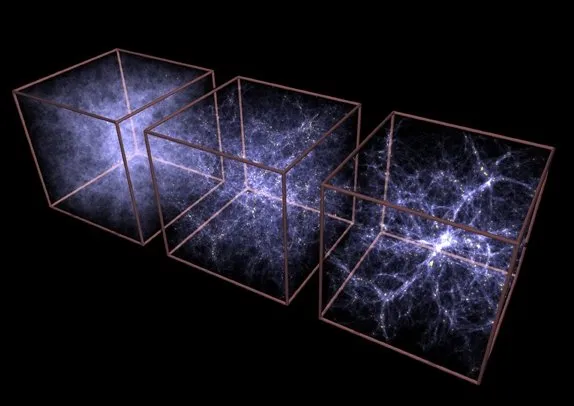
It seems humiliating to think that the universe is composed of only 5% normal matter, like that which forms what we know in everyday life. The rest would form the "dark side of the universe," composed of dark matter and dark energy. Physicists are now thinking that, perhaps, this "dark sector" is much more complex: dark photons, dark electromagnetism, and even its own dark chemistry and biology.

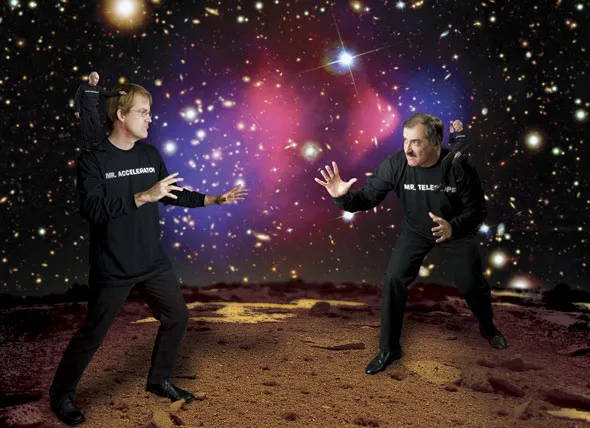
We have commented here before about Sean Carroll, a physicist at the California Institute of Technology and author of Cosmic Variance, a blog where he shares his ideas.
In a recent post, Carroll again introduces us to very interesting theoretical possibilities about the "dark sector." There he explains that this dark sector is composed of 25% dark matter. It is known to be "matter" because it behaves as such, in particular it accumulates under the force of gravity and its energy dilutes as the universe expands. And there is a dark energy that makes up 70% of the universe, which seems to be remarkably uniform, smoothly distributed through space and persistent (it does not dilute) over time. (See "The universe is like this")
But, so far, there is no evidence of anything more interesting, beyond that. In fact, the individual components of dark matter and dark energy seem relatively simple. Taking their characteristics to the minimum provides a good agreement with the data. For dark matter, minimum means that the particles are cold (they move slowly) and basically do not interact with each other. For dark energy, it means that it is perfectly constant through space and time.
However, there are upper limits, but no firm conclusions. It is certainly possible that there is a great deal of physics hidden in the dark sector, but it is too subtle for us to notice. Therefore, it is important for theorists to propose specific, testable models with characteristics beyond the minimal ones.
So Carroll, together with Lotty Ackerman, Matt Buckley and Marc Kamionkowski, are investigating a provocative possibility: that, just as ordinary matter is bound to a long-range force known as electromagnetism, mediated by particles called photons, dark matter is bound to a new long-range force that could be called "dark electromagnetism," mediated by "dark photons."
What they imagine is that there is a new type of photon, which relates to dark matter but not to ordinary matter. So there could be dark electric fields, dark magnetic fields, dark radiation, etc. This dark matter would consist of particles with a dark charge of +1 and the other half with a charge of -1, the dark antiparticles. Now, it is known that, speaking of normal matter, antimatter exists. It is speculated that at the beginning of the Big Bang they existed in very similar parts but there was a little more matter than antimatter. It happens that when particles of matter and antimatter meet, they annihilate each other. It is thought that since there was more matter, a part would not have been annihilated and thus we have today a locally predominant universe of matter. So, how would it be possible for 50% dark matter and 50% dark antimatter to exist and not annihilate each other?
According to Carroll, there are a variety of possibilities that would explain that. For example, that the mass of the dark matter particles was sufficiently large and their density, therefore, would have been very low, so there would not have been much annihilation, since they would not easily find each other if the density is very low. I imagine a locality where the population density is 1 inhabitant per 5 km2. It would not be very common to run into a neighbor, at least compared to what happens in Buenos Aires, with a density of over 13,000 inhabitants per km2!
Another possibility is that the dark electromagnetic force was extremely weak, it would not be effective enough to make particles collide with their antiparticles.
According to Carroll, the interesting thing is that when doing calculations, they seem to be quite reasonable, as far as particle physics is concerned. For dark matter particles weighing several hundred times more than the mass of the proton, there would be one dark matter particle in a volume of space similar to a coffee cup. The strength of dark electromagnetism is characterized by the dark fine-structure constant, just as the electromagnetic force we know is characterized by the fine-structure constant (alpha = 1/137). And, according to the scientist, the upper limit required on the dark fine-structure constant to stop the annihilation of dark matter particles is very similar.
Other ideas are being developed in this regard, theorizing about the possibility of long-range forces or quintessence, invoking scalar fields.
As Carroll points out, one difference between dark electromagnetism and the scalar force is that the former has both positive and negative charge and thus, attractive and repulsive forces. So it is possible to imagine much more than a single species of dark matter. What if you have two different types of stable particles that carry the dark charge? Then we would be able to make dark atoms and one could start writing about dark chemistry. Dark biology would be just a few steps away.
No, of course, for "dark minds," none of that is needed. Unfortunately, they already exist.
Sources and related links
- Cosmic Variance:Dark Photons
- Dark Matter and Dark Radiation
Lotty Ackerman, Matthew R. Buckley, Sean M. Carroll, Marc Kamionkowski
arXiv:0810.5126v1
About the images