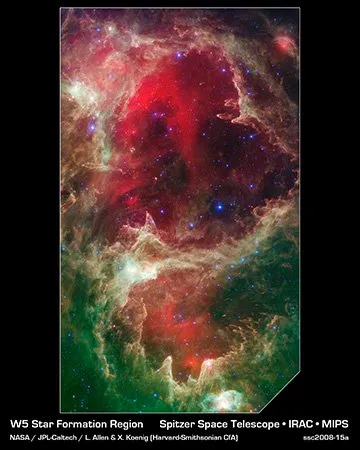
A new image from the Spitzer Space Telescope shows us W5, a colorful cosmic cloud of multiple generations of stars. The image is part of the celebration of the Spitzer Telescope's fifth anniversary and was unveiled today at the Griffith Observatory in Los Angeles.
The image also provides new evidence that massive stars, through their strong winds and radiation, can trigger the birth of stars.
The image is part of the celebration of the Spitzer Telescope's fifth anniversary, as we had anticipated.
The most massive stars in the universe form in dense clouds of gas and dust. These stars are so massive, between 15 and 60 times the mass of our Sun, that some of their material forms strong winds. The powerful radiation from these massive stars and their strong winds sweep away the surrounding material, carving growing cavities.
Astronomers have suspected that this process causes the gas to compress into successive stellar generations. As the cavities grow, it is believed that more and more stars arise at the edges of the cavities. The result is a radial family tree of stars, with the oldest stars in the middle of the cavity and the youngest ones farther away.
Evidence for this hypothesis can be easily seen in images of many star-forming regions, such as W5, Orion, and Carina. For example, in the new Spitzer image of W5, the most massive stars (some of the blue dots) are in the center of two cavities and the younger stars (in pink or white) reside in the elephant trunk-shaped pillars as well as beyond the cavity edges. However, it is possible that the younger stars could be near the edge of the cavities and have not been triggered by the massive stars.
"Triggered star formation remains difficult to investigate. But our preliminary analysis shows that the phenomenon can explain the multiple generations of stars seen in the W5 region," says Xavier Koenig, from the Harvard-Smithsonian Center for Astrophysics, CfA, in Cambridge. Koenig is the lead author of a new scientific paper about the discoveries in the December 1, 2008 issue of Astrophysical Journal.
Koenig and his colleagues wanted to test the triggered star formation theory by studying the ages of the stars in the W5 region. They used Spitzer's infrared vision to see through the dust clouds and get a better view of the different stages of stellar evolution. They found that the stars in the cavities of W5 are older than the stars at the edges and older than the stars beyond the cavity boundaries. This staggered separation of ages provides good evidence that the massive stars, in fact, originate the younger generations.
"Our first look at this region suggests that we are seeing one or two generations of stars that were triggered by massive stars," says Lori Allen, co-author. "We plan to continue with more detailed measurements of the stars' ages to see if there is a distinctive difference between the stars inside and outside the edges."
Within millions of years, the massive stars in W5 will die in tremendous explosions. In doing so, they will destroy some of the nearby young stars, the very ones they may have helped create.
W5 spans an area of the sky equivalent to four full moons and is 6,500 million light-years away, in the constellation Cassiopeia. The Spitzer image was taken over a 24-hour period. The red color shows heated dust permeating the cavities of the region. The green color highlights the dense clouds and the white pinpoint areas are where the youngest stars are forming. The blue dots are older stars in the star-forming cloud, as well as unrelated stars in front of and behind the cloud.
Sources and related links
- Generations of Stars Pose for Family Portrait
- Clustered and Triggered Star Formation in W5: Observations with Spitzer
Xavier P. Koenig, Lori E. Allen, Robert A. Gutermuth, Joseph L. Hora, Christopher M. Brunt, and James Muzerolle
The Astrophysical Journal
About the images
Credit: NASA/JPL-Caltech/Harvard-Smithsonian CfA