The Spitzer telescope detected water in a cloud of gas and dust around a young star, whose jets are breaking the water molecules.
A young star forms from a dense, rotating cloud of gas and dust. Powerful jets of gas emerge from the cloud above and below. As the cloud compresses more and more under its own gravity, the star finally ignites and the remaining dust and gas flatten into a disk from which planets will later form. When the star's ignition begins and the accumulation of material from its cloud stops, the jets will cease.
Achim Tappe, from the Harvard-Smithsonian Center for Astrophysics and his colleagues, used the Spitzer Space Infrared Telescope to observe through the dust surrounding a star being born. It is the star called HH 211-mm, where its very young gas jets, 1,000 years old, were observed, and they are some of the most collimated or focused jets known. Spitzer's spectrometer analyzed the light coming from these jets, revealing information about their molecules.
To the astronomers' surprise, Spitzer detected the "signature" of fragments of water molecules, called hydroxyls or OH. In fact, these molecules absorbed so much energy (through a process called excitation) that they are rotating with energies equivalent to 28,000 Kelvin (27,700 degrees Celsius). This far exceeds normal expectations. Water, composed of two hydrogen atoms and one oxygen atom (H2O); hydroxyl (OH) contains one oxygen atom and one hydrogen atom.
The results reveal that the jet is hitting the material very fast and with such force that it creates a shock wave. This generates ultraviolet radiation that breaks the water molecules, leaving extremely hot hydroxyl molecules, as Tappe explains.
According to the scientist, this process also occurs in our solar system, when the Sun vaporizes the ice of comets that approach it.
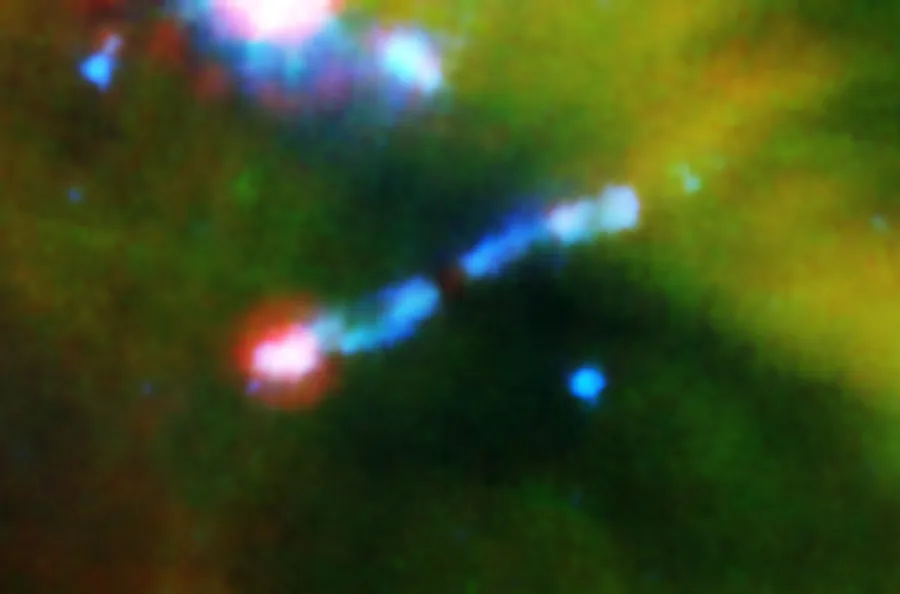
The young star HH 211-mm is covered in dust and cannot be seen. But the bipolar jets emerging from it can be seen, in blue in the image. The pink part at the end of the jet, bottom left, shows the region where the jet is colliding with a wall of material. It does so with such force that shock waves are created, which cause the vaporization of ice from dust grains. The ultraviolet radiation generated by the heating of the material by the shock waves produces ultraviolet radiation that breaks the water molecules.
The red color at the end of the jet represents heated iron, sulfur, and dust, while the blue color in both jets denotes the heating of hydrogen molecules.
HH 211-mm is part of a cluster of 300 stars, called IC 348, 1,000 light-years away from Earth in the constellation Perseus.
"This is a unique observation that provides important information about the chemistry in planet-forming regions, and could give us clues about the chemical reactions that make water, and even life, possible in our solar system," adds Achim Tappe.
Sources and related links
- Water Hit with Young Star's Best Shot
- Discovery of Superthermal Hydroxyl (OH) in the HH 211 Outflow
A. Tappe, C. J. Lada, J. H. Black, and A. A. Muench
The Astrophysical Journal Letters, 680:L117–L120, June 20, 2008
About the images
Credit: NASA/JPL-Caltech/Harvard-Smithsonian CfA