Astronomers captured multiple massive galaxies merging 4 billion years ago. The discovery supports one of the theories about how galaxies form.
The most widely accepted answer about how galaxies form is the hierarchical formation model, a process in which smaller galaxies merge to create massive galaxies. One can think of galactic formation in a way similar to how streams join to form rivers, which then join to form larger rivers. This theoretical model predicts that massive galaxies grow through many merger events in their lifetime. But, when does their cosmological growth end?
To answer this question, astronomers study massive galaxies in clusters. "Whether the brightest galaxies in clusters have grown substantially in the last few billion years is intensely debated. Our observations show that at this time, these galaxies have increased their mass by 50%," says Kim-Vy Tran from the University of Zürich, Switzerland, leader of the research.
Astronomers made use of several instruments and telescopes, including ESO's Very Large Telescope (VLT) and the Hubble Space Telescope, to study in great detail galaxies located 4 billion light-years away. These galaxies lie in an extraordinary system composed of four groups of galaxies that will merge into a cluster.
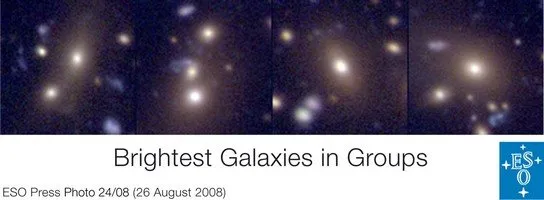
In particular, the team took images with the VIMOS instrument and spectra with FORS2, on the VLT. From these and other observations, astronomers were able to identify a total of 198 galaxies that belong to these four groups.
The brightest galaxies in each group contain between 100 billion and one trillion stars, a property that makes them comparable to the most massive galaxies belonging to clusters.
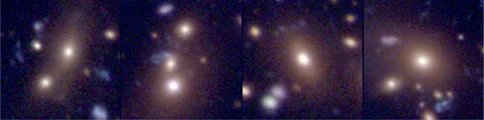
"The most surprising thing is that in three of the four groups, the brightest galaxy has a bright companion galaxy. These galactic pairs are merging systems," says Tran.
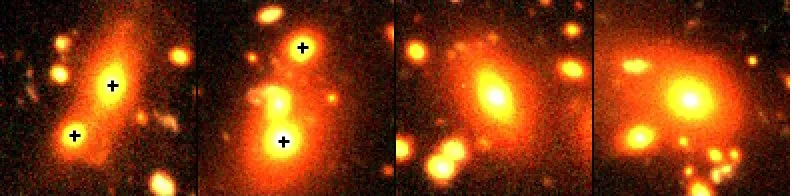
The brightest galaxy in each group can be ordered in a time sequence showing how much they continued to grow by mergers until recently, that is, in the last 5 billion years. It seems that, due to the most recent episode of "galactic cannibalism," the brightest galaxies became at least 50% more massive. The discovery provides powerful validation for hierarchical formation.
"The stars in these galaxies are already old so we must conclude that the recent merger did not produce a new generation of stars," adds Tran. "Most of the stars in these galaxies were born at least 7 billion years ago."
Sources and related links
- ESO: How Do Galaxies Grow?
- The Late Stellar Assembly of Massive Cluster Galaxies via Major Merging
Kim-Vy H. Tran et al.
The Astrophysical Journal Letters, 683:L17–L20, August 10, 2008 - arXiv:0806.4387v1
About the images
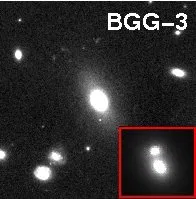
Image composite of the brightest galaxies in four groups located 4 billion light-years away. The galaxies are ordered by increasing stellar mass. The brightest galaxies in groups 1 and 2 have bright companions, as seen in image 2 (crosses). The inset in image 3, obtained with the Hubble Space Telescope, shows that the brightest galaxy in group 3 also has a double nucleus. Thus, these galaxies are in a merging process. The discovery is a powerful validation of hierarchical formation.
Credit: ESO PR Photo 24/08 Merging Galaxies in Groups