In commemoration of its 100,000th orbit around Earth in its 18 years of exploration and discovery, scientists pointed the famous space telescope toward a dazzling region of stellar births.
We recently commented here on the approach of Hubble's 100,000th orbit, during which a special photograph would be taken and we could participate in a drawing for it.
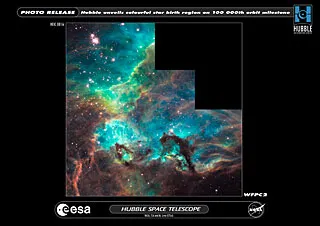
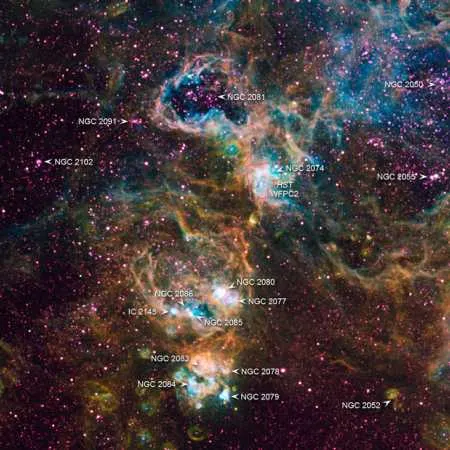
During its 100,000th orbit it photographed the nebula near the star cluster NGC 2074. The region lies 170,000 light-years away near the Tarantula Nebula, one of the most active star-forming regions in our Local Group of Galaxies.
The image reveals ridges and valleys of dust, sinuous "pillars of creation" heads, and gaseous filaments glowing under torrential ultraviolet radiation. The region is on the edge of a dark molecular cloud that is an incubator for the birth of new stars.
The high-energy radiation from the clusters of young stars already born in NGC 2074 is sculpting the nebula's wall by slowly eroding it. Another young cluster may be hiding beneath a circle of bright blue gas at the center, bottom.
In this fantasy landscape approximately 100 light-years in diameter, dark towers of dust rise above a bright wall of gases on the surface of the molecular cloud.
Below, the seahorse-shaped form is approximately 20 light-years long.
The region is in the Large Magellanic Cloud, a satellite galaxy of our Milky Way. It is a fascinating laboratory for observing star-forming regions and their evolution. Dwarf galaxies like the Large Magellanic Cloud are considered the primitive building blocks of larger galaxies.
This image was taken on August 10, 2008, with the Wide Field Planetary Camera 2. The red color shows emissions from sulfur atoms, the green is from glowing hydrogen, and the blue from oxygen.
Sources and related links
- SpaceTelescope:Hubble unveils colourful star birth region on 100 000th orbit milestone
- Press release on HubbleSite
About the images
Credit:NASA, ESA and M. Livio (STScI)