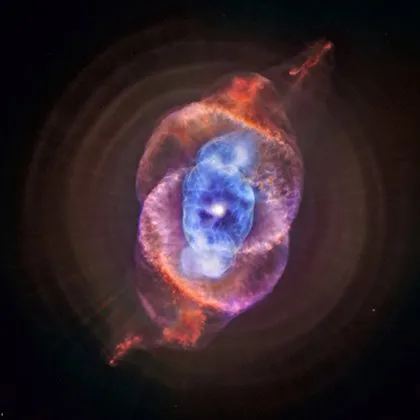
The image composite shows NGC 6543, better known as the Cat's Eye Nebula. The famous object is a planetary nebula, representing a phase of stellar evolution that our Sun should experience in several thousand million years.
When a star like the Sun consumes all its hydrogen, it becomes a red giant star. In this phase, the star expels its outer layers and leaves a hot core that collapses to form a white dwarf.
A fast stellar wind emanating from the hot core pushes the ejected atmosphere and creates these fabulous filamentary structures.
The image is composed of data from the Chandra X-ray Observatory and the Hubble Space Telescope. Data from the former (colored blue) show that its central star is surrounded by a cloud of very hot gas. By comparing where the X-rays lie in relation to the structures seen in optical light by Hubble (red and purple), astronomers were able to deduce that the chemical abundances in the hot gas region were like those of the central star's wind and different from the cooler outer material.
In the case of the Cat's Eye, the material expelled by the star is flying at a speed of 6.5 million kilometers per hour.
The creation of the Cat's Eye Nebula:Video on Youtube
(it's part 1. At the end, see below part 2 in related videos)
Sources and related links
About the images
Credit:X-ray: NASA/CXC/SAO; Optical: NASA/STScI