It's impossible not to get excited about the start of the Large Hadron Collider (LHC). It's the largest and most ambitious scientific experiment humans have ever attempted.
But it's not the first nor will it be the only one. There are already projects to build other particle accelerators to complement the LHC.
The effort to understand, cure and prevent deadly diseases, the disproportionate distribution of wealth, which generates so much hunger in the world, the already palpable problems of environmental pollution, are, among others, surely priority issues. But how can we stop asking ourselves what the universe is made of? Ultimately, the curiosity to understand the Cosmos is a way of inquiring about our own origin and destiny.
But if the LHC is stimulating for the answers (and questions, above all) it can generate, it is not alone. Certainly, other particle accelerators exist in the world, like Fermilab. And there will be others. Plans already exist for at least two new particle accelerators: the ILC or International Linear Collider and the CLIC or Compact Linear Collider.

The International Linear Collider
The ILC is a proposed electron-positron accelerator to complement the LHC. It would consist of two opposing linear accelerators that will launch 10 billion electrons and their counterparts, positrons, towards each other at a speed close to that of light.
With an approximate length of 31 kilometers, the electron beams will collide 14,000 times each second at extremely high energies: 500 GeV. Each collision will create a set of new particles that could answer some of the fundamental questions of all time. The baseline design allows for an upgrade to 50 kilometers, 1 TeV, during the project's second phase. (The LHC will reach, in its final phase, 14 TeV!).
The planning, design and funding will be guided by the GDE, Global Design Effort led by Barry Barish. The team establishes the strategy and priorities for the work of hundreds of scientists and engineers at universities and laboratories around the world. Its goal: to produce the ILC Technical Design Report by the end of 2012, which will be used to decide the future of the project.
How it will work
Scientists will use two main linear accelerators ("linacs"), one for electrons and one for positrons, each 12 kilometers long, to accelerate bunches of particles towards the collision point.
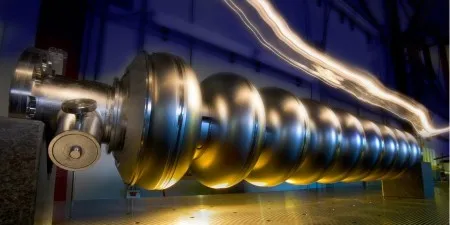
Each linac consists of 8,000 superconducting cavities nested in a series of vessels cooled to form cryomodules.
The modules use liquid helium to cool the cavities to -271ºC, just a little above absolute zero.
Scientists will launch electromagnetic waves into the cavities to "push" the particles and accelerate them to energies of 500 GeV.
Positrons
Positrons, the antimatter particles similar to electrons but with a positive charge, do not exist naturally on Earth. To produce them, scientists will send a beam of high-energy electrons through an undulator, a set of magnets that create a turbulent motion causing the electrons to emit a stream of photons. Then the electrons return to the main accelerator, while the photons will strike a titanium target and produce electron-positron pairs. The positrons will be collected and launched into their own 250-meter, 5 GeV accelerator.
The rings
When created, neither the electron bunches nor the positron bunches are compact enough to achieve the high density needed to produce collisions within the detectors. Scientists will solve this problem by using rings with a seven-kilometer circumference, one for electrons and one for positrons. In each ring, the bunches will travel through a series of devices (wigglers) consisting of magnetic dipoles to alternate polarity.
The electrons
To produce the electrons, high-intensity light pulses from a laser will be fired at a target and thus billions of electrons per pulse will be collected, using magnetic fields to create particle bunches and launch them into the linear accelerator.
The Compact Linear Collider
By 2010, GDE members will produce a detailed design for the ILC. By the same year, a small international group will try to prove that the Compact Linear Collider (CLIC), a machine that could potentially reach five times the energy of the ILC, is a viable project.
Based at CERN, Switzerland, CLIC is an ambitious project that proposes colliding beams of electrons and positrons at an energy of 3 TeV over a distance approximately similar to that of the ILC.
"CLIC can do what a TeV collider can do with precision, but it can do more," says Albert de Roeck, a CERN physicist, member of the CMS experiment at the LHC.
The LHC will give physicists a first glimpse into a new realm of particle discoveries. Physicists anticipate that the Higgs boson, the particle thought to give others their mass, will be one of the discoveries. But the big question is, Will the Higgs be a light or heavy particle?
If the Higgs exists at an energy below 300 GeV, as experiments at Fermilab, SLAC and CERN suggest, the ILC will be sufficient. But if the Higgs or similar particles are heavier and can only be produced with a multi-TeV machine, then CLIC will be necessary.
"A multi-TeV machine will verify the discovery," adds De Roeck. "Due to the higher energy, CLIC can be a good machine for measuring subtle properties of the light Higgs and especially good for discovering and measuring heavy Higgs. If supersymmetry exists, does it have a high or low mass? CLIC would be the machine that can measure particles with masses above 500 GeV with great precision. We don't know if supersymmetry exists or not, but we know it is possible."
An alternative technology
If CLIC used the same acceleration technology as the ILC, it would need to be 118 km long to reach its goal. To build a 30 km collider, scientists will use a new acceleration technique, characterizing the project from other proposals.
High acceleration gradients (the amount of acceleration per meter of machine) are necessary to limit the length of a multi-TeV machine. These gradients are easy to achieve with electric fields oscillating at high frequency. CLIC physicists selected a frequency of 30 GHz, to achieve a gradient of 150 million volts per meter. In comparison, the ILC will operate at a frequency of 1.3 GHz to produce a gradient of 35 million volts per meter.
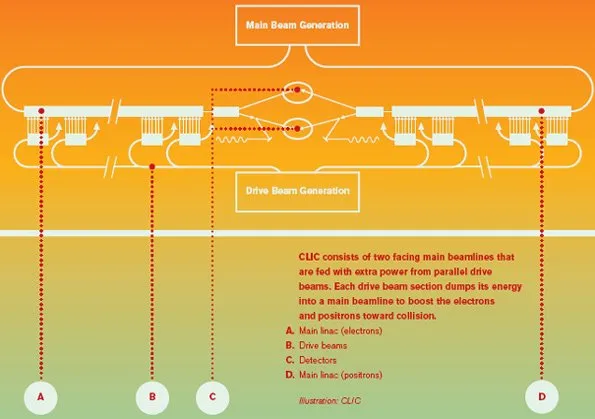
In a conventional linear accelerator, the radio-frequency (rf) power used to accelerate the main beam is generated by devices called klystrons. These create rf waves in a manner similar to a microwave oven. Since klystrons use a lot of energy at high frequencies and 3 TeV would require many of them, scientists propose an innovative solution based on a two-beam accelerator scheme. Parallel to the main beams of the linear accelerator would run low-energy beam conductors. Each conductor powers a 670-meter section of the main linac. "At the end of each section, the conductor is sent to a dump and another conductor takes over, like a relay race," says Ian Wilson of CERN.
CLIC would require 21 conductors to reach 3 TeV. The distance between the conductors and the linacs is only 60 cm, so the power is supplied close to where it is needed. This technique maximizes the energy transfer from the conductor to the linac, making it an attractive solution for accelerator experts.
Let Physics Decide
Within five years, many questions about the future of particle physics should be close to being answered. Data from the LHC will be flowing, the feasibility of CLIC technology will be known, and the ILC will have an engineering design. Until then, instead of being on two different teams, the scientists from these two possible accelerators are working together for the future of the field.
"We feel we are all working towards a common goal," adds Steffen Doebert, a physicist at SLAC who worked on CLIC and ILC. "We want to provide a machine for particle physics and both, CLIC and ILC, are very interesting research and development projects."
Cost
Information about the cost of the LHC is ambiguous, but it is speculated to climb to $10 billion. For the ILC the cost would be 7 billion dollars. The figures are chilling, certainly. Of course, one would also have to consider that the war in Iraq has wasted the most terrifying 550 billion! US dollars.
A B-2 bomber costs 2 billion "Washingtons" with the goal of producing only death and destruction.
The science needed for the design, construction and evaluation of the results of particle accelerators produces education, knowledge and innovations that translate into technology transfer to other areas of society.
And of course, the goal is to discover, learn and be amazed at the wonderful Nature hidden in atomic nuclei and black holes.
And, even if they say otherwise, the Earth is not in danger.
Sources and related links
- Symmetry: CLIC,The Compact Linear Collider
- Space Disco:Beyond the LHC: What's the Next Colossal Collider?
- ILC
- CLIC
About the images
Credits:ILC, CLIC