The detection of extra dimensions, beyond the familiar four -the three dimensions of space and that of time- would be one of the greatest, if not the greatest, discoveries in the history of physics. Now, scientists at Fermilab are designing a new experiment that could investigate the suggestive clues that extra dimensions might indeed exist.
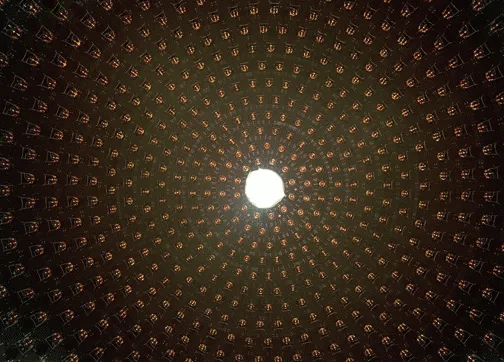
Last year researchers in the Fermilab study called MiniBooNE, which detects the elusive subatomic particles called neutrinos, announced they had found a surprising anomaly. (Ciencia Kanija reported it in "MiniBooNE opens the box") Neutrinos, which have no charge and very little mass, are formed in nuclear reactions and particle decay. They are thought to come in three classes or "flavors": electron, muon, and tau neutrinos; and they oscillate between one flavor and another. By observing a beam of muon neutrinos generated by Fermilab's particle accelerator, the researchers found that an unexpectedly high number of particles in the low-energy range (less than 475 million electron-volts) transformed into electron neutrinos. After a year of analysis, the researchers have failed to find a conventional explanation for this excess. The mystery then focused attention on an intriguing and very unconventional hypothesis: a fourth class of neutrino could be going back and forth from extra dimensions.
String theorists, who seek to unify the laws of gravity with those of quantum mechanics, predicted the existence of extra dimensions long ago. Some physicists proposed that almost all particles in our universe could be confined to a four-dimensional "brane" housed in a 10-dimensional "bulk." A hypothetical particle, called a sterile neutrino, which would interact with other particles only through gravity, might be able to travel from one brane to another, cutting a path through the extra dimensions. In 2005, Heinrich Päs (University of Dortmund, Germany), Sandip Pakvasa (University of Hawaii) and Thomas J. Weiler (Vanderbilt University) predicted that the extradimensional pilgrimages of sterile neutrinos could increase the probability of flavor oscillations at low energies, exactly the result found by the MiniBooNE team two years later.
The team then proposed a new experiment called MicroBooNE that could test the sterile neutrino hypothesis. The new detector, a cryogenic tank filled with 170 tons of liquid argon, could be capable of detecting low-energy particles with much greater precision than its predecessor. A particle emerging from a neutrino interaction would ionize argon atoms along its path, inducing currents in wires on the perimeter of the tank. Scientists could then determine the particle's trajectory, allowing them to better distinguish between electron neutrino interactions and other events and thus determine if there really is an excess of oscillations at low energies.
With an estimated cost of $15 million, the MicroBooNE tank would be located near the MiniBooNE detector at Fermilab, and thus could observe the same neutrino beam. Last June, Fermilab's physics advisory committee approved the design phase of the project and, if all goes well, the detector could begin operations in 2011.
Researchers hope that MicroBooNE will lead to the development of larger detectors, containing hundreds of thousands of tons of liquid argon in tanks as large as football stadiums. Such facilities could search for hypothetical phenomena like extreme proton decay. "It's a fantastic new technology," says Bonnie Fleming, a physicist at Yale University and spokesperson for MicroBooNE. "And it's crucial for taking the next step in physics."
And What is a neutrino?
From the cosmic dance of galaxies to the pulsating nucleus of atoms, four forces rule. Gravity and electromagnetism push and pull every object: apples fall, magnets "stick" to refrigerators. Deep within the atomic nucleus, the strong force holds nuclear components together, and the weak force can separate them. The electromagnetic force is also important in the microworld, because we can only detect particles when their electric charge gives them away, leaving traces in detectors.
Particles that feel the weak force are called leptons (from the Greek Leptos meaning light). The most common are electrons, negatively charged particles that orbit the atomic nucleus. Neutrinos are leptons, but as their name indicates, they are "little neutral ones," they have no electric charge, so they are revealed only when they collide with other particles.
Neutrinos are important because they initiate the thermonuclear fusion that lights the Sun, bring us information from distant supernovae, and can tell us much about the universe and how it works.
More at:Wikipedia:Modelo de física de partículas
Sources and related links
- Scientific American:Fermilab Looks for Visitors from Another Dimension, by Mark Alpert
- MicroBoone
- Boone
- The adventure of particles
About the images
Credit:Boone