After nearly a decade of meticulous observations, an international team of astronomers has measured, with greater precision than ever before, the distance to our neighboring galaxy, the Large Magellanic Cloud. These new measurements also expand our knowledge of the rate of expansion of the Universe — the Hubble constant — and are a crucial step forward in understanding the nature of the mysterious dark energy that is causing the expansion to accelerate.
To accurately know increasingly distant distances in the cosmos, astronomers probe the scale of the universe by first measuring the distance to nearby objects, using them as reference points (standard candles).
But this chain is only as accurate as its weakest link. Until now, finding a precise distance to the Large Magellanic Cloud (LMC), one of the galaxies closest to the Milky Way, has proven to be imprecise. Since stars in this galaxy are used to set the distance scale for more remote galaxies, the measurements are of crucial importance.
The meticulous observation of a rare type of double star has allowed a team of astronomers to deduce a much more precise value for the distance to the LMC: 163,000 light-years.
“I am very excited because astronomers have been trying for a hundred years to measure precisely the distance to the Large Magellanic Cloud, and it has proven to be extremely difficult,” says Wolfgang Gieren (Universidad de Concepción, Chile), one of the researchers leading the team. “Now we have solved this problem with a demonstrable result and with a precision of 2%.”
The team uses telescopes installed at ESO's La Silla Observatory in Chile, as well as other telescopes around the world. These results appear in the March 7, 2013 issue of the journal Nature.
The improvement in the measurement of the distance to the Large Magellanic Cloud also makes it easier for us to better know distances to many Cepheid variable stars.
These bright pulsating stars are used as reference stars to measure distances to more remote galaxies and to determine the rate of expansion of the universe — the Hubble Constant. This, in turn, is the basis for probing the universe out to the most distant galaxies that can be seen with current telescopes. Therefore, a precise distance to the Large Magellanic Cloud immediately reduces the inaccuracy in current measurements of cosmological distances.
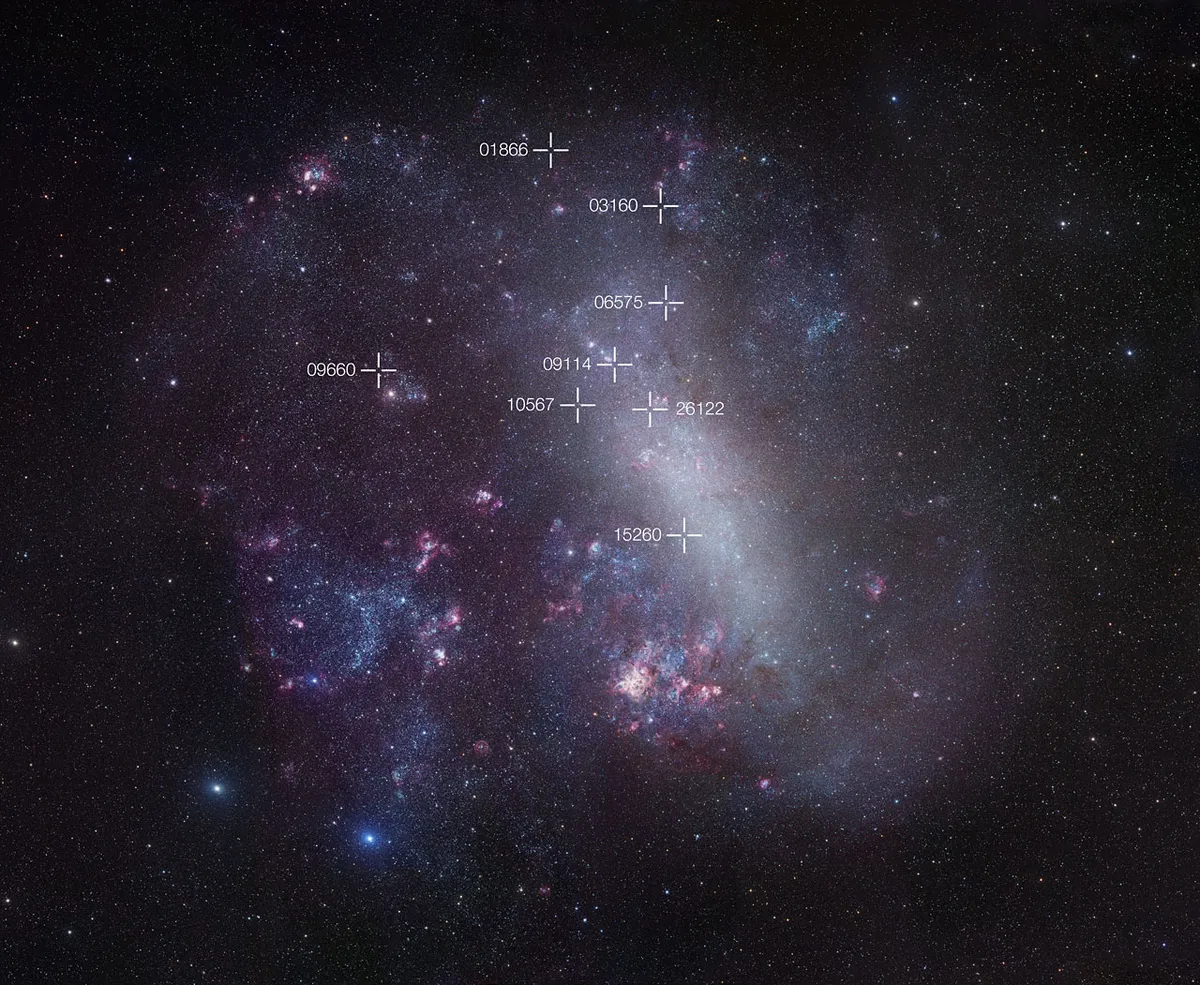
Astronomers obtained the distance to the Large Magellanic Cloud by observing a strange pair of nearby stars (OGLE-LMC-ECL-06575), known as eclipsing binaries.
Since these stars orbit each other, they pass in front of one another. When this happens, as seen from Earth, the total brightness decreases, both when one star passes in front of the other and when it passes behind (although the amount is different). This work is part of the Araucaria Project to improve measurements of distances to nearby galaxies.
The researchers point out that the OGLE team has monitored about 35 million stars in the LMC field for more than 16 years. In that data, a dozen eclipsing binary systems with very long periods (60-772 days) were found. Those systems are an opportunity to use eclipsing binaries as distance indicators and calibrate the cosmic scale. For that, they observed 8 of those systems over the last 8 years with telescopes at Las Campanas and ESO.
By tracking these brightness changes very precisely, and measuring the orbital velocities of the stars, it is possible to know the size of the stars, their masses, and other information about their orbits. When this is combined with meticulous measurements of the total brightness and color of the star, remarkably precise distances are obtained.
This method has been used before, but with hot stars. However, in that case certain assumptions must be made and these distances are not as precise as desired. Now, for the first time, eight extremely rare eclipsing binaries have been identified, in which both stars are cool red giants. These stars have been carefully studied and result in much more precise distance values — up to about 2%.
“We are working to improve our method even further and hope to have a distance to the LMC (Small Magellanic Cloud) of 1% within a few years. This has far-reaching consequences not only for cosmology, but for numerous fields of astrophysics,” concludes Dariusz Graczyk, the second author of the new Nature paper.
Sources and related links
- G. Pietrzyński et al.(2013), “An eclipsing binary distance to the Large Magellanic Cloud accurate to 2 per cent”, Nature (March 7, 2013)
- ESO Press Release 1311es: The Most Precise Measurement of the Universe
About the images
- This photograph shows the Large Magellanic Cloud, a neighboring galaxy of the Milky Way. The positions of eight faint and extremely rare eclipsing binaries are marked with red crosses (these objects are too faint to appear directly in the image). By studying how their light changes, and other properties of these systems, astronomers can measure distances to eclipsing binaries in a very precise way. A long series of observations of these objects can now lead us to a more precise determination of the distance to the Large Magellanic Cloud — a crucial step in determining distances in the universe.
Credit: ESO/R. Gendler