The PRIMA instrument of ESO's VLT Interferometer recently saw its first light at its new site atop Cerro Paranal in Chile. When fully operational, PRIMA will enhance the VLTI's capabilities to detect sources much fainter than previous interferometers and will allow astronomers precisions unmatched by other facilities. PRIMA will be a unique tool for the detection of exoplanets.
"PRIMA is specifically designed to detect if a star 'wobbles' due to some unseen planetary companion," says scientist Gerard van Belle. "This allows us not only to detect exoplanets but also to measure their masses."
PRIMA's microarcsecond astrometric precision is unmatched by other astrometric facilities, whether on the ground or in orbit. When a planet orbits a star, its gravity affects the latter, making it 'wobble'. This motion is usually measured by observing variations in the star's radial velocity, but if sufficiently precise measurements of the star's position are made, it should be possible to detect this 'wobble' directly. PRIMA, an acronym for "Phase Referenced Imaging and Microarcsecond Astrometry", should be precise enough to make these measurements for Jupiter-type planets. It will be able to measure angular differences of about ten microarcseconds, the angle a human hair grows in one second, seen from 100 meters away!
In addition to performing precise astrometric measurements, PRIMA will be key to observing faint sources with the VLTI using the AMBER and MIDI science instruments.
Interferometry combines the light received from two or more telescopes, focusing on the very small differences between the signals to measure angles with exquisite precision. Using this technique, PRIMA can capture details as sharp as a single telescope with a diameter equivalent to the greatest distance between the observatories. For the VLTI, the distance between two telescopes is about 200 meters.
The instrument is unique among those existing at the VLTI in that it is effectively two interferometers in one. PRIMA will take data from two sources in the sky simultaneously: the brighter source can be used for tracking, allowing the interferometer to 'lock onto' the fainter source for longer than is currently possible with conventional interferometers. Although there have been previous experiments to test this technique, PRIMA represents the first facility of its kind that is open to all astronomers.
The instrument parts arrived at the summit of Paranal at the end of July and were integrated and tested during the following months. On September 2 of this year, as a first milestone, light from two 1.8 m auxiliary telescopes fed the PRIMA system and the first signals were detected. Three days later, the system was used routinely to track the signals and compensate for atmospheric turbulence.
First light, which in the case of interferometers are the first signals (or "first fringes"), occurred ahead of schedule. All subsystems were successfully installed for use with the two auxiliary telescopes and will now undergo intensive testing before being offered to the astronomical community for routine observations.
Sources and related links
- ESO: Future Looks Bright for Interferometry
About the images
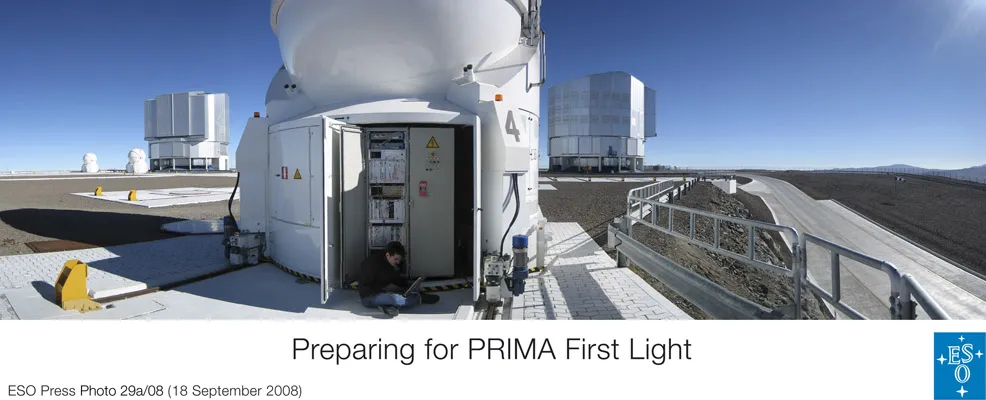
Team member Nicola Di Lieto battles the winds at the summit of Paranal to perform updates to the system of auxiliary telescope number 4 in support of the PRIMA installation.
Credit: ESO PR Photo 06/08
ESO PR Photo 29a/08
Preparing for PRIMA First Light