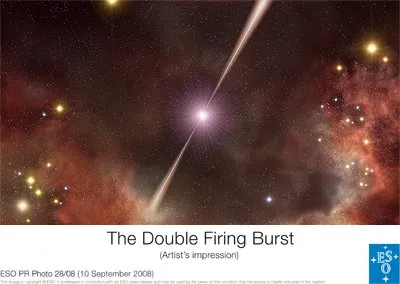
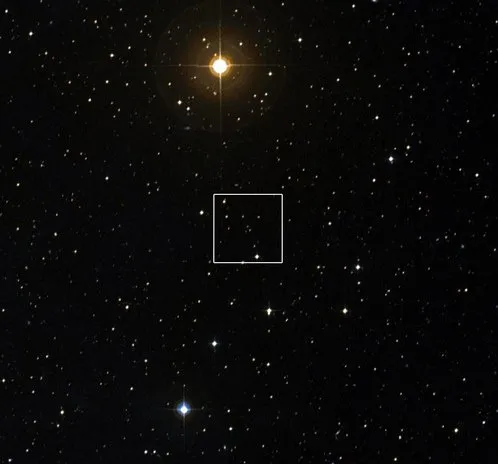
NASA's Swift satellite found the most distant gamma-ray burst (GRB) to date. Designated GRB 080913, it arose from the explosion of a star 12.8 billion light-years away.
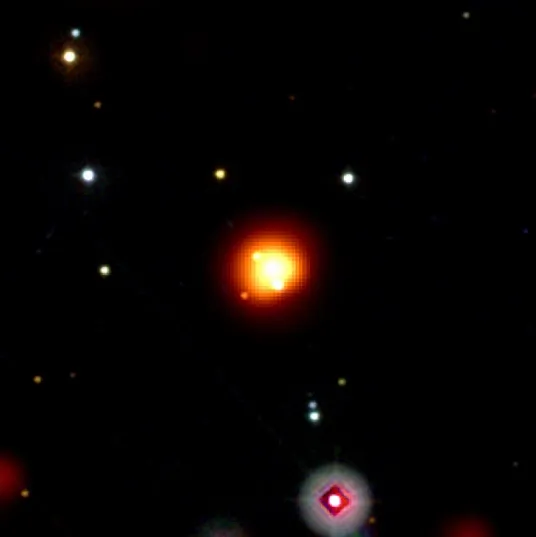
"This is the most amazing burst Swift has seen," says mission lead scientist Neil Gehrels at Goddard Space Flight Center. "It's coming to us from nearly the edge of the visible universe."
Since light moves at a finite speed, looking farther into the universe means looking back in time. The distance to GRB 080913 occurred less than 825 million years after the Big Bang.
The star that caused the burst died when the universe was less than 7% of its present age.
Gamma rays triggered Swift's Burst Alert Telescope at 1:47 a.m. EDT on September 13. The spacecraft established the event's location in the constellation Eridanus and quickly began examining the region. Less than two minutes after the alert, Swift's X-Ray Telescope began observing the position. There it found a faint, previously unknown X-ray source.
Astronomers on the ground also followed the event. Using the 2.2m ESO telescope at La Silla, Chile, a team led by Jochen Greiner of the Max Planck Institute in Germany captured the burst's afterglow.
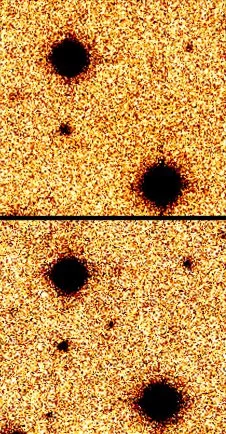
The telescopes' software heard Swift's alert and automatically turned to the indicated position. Then, the Gamma-Ray burst Optical/Near-Infrared Detector or GROND team captured light simultaneously in seven wavelengths. "Our first exposure began just one minute after the X-Ray Telescope started its observations," says Greiner.
In certain colors, the brightness of a distant object shows a characteristic drop caused by gas clouds along the way. The farther away the object, the longer the wavelength at which this drop begins. GROND exploits this effect and allows astronomers a rapid estimate of the shift toward the less energetic red end of the electromagnetic spectrum or "redshift," which suggests its distance.
An hour and a half later, as part of Greiner's investigation, the VLT at Paranal observed the afterglow. Analysis of the spectrum established that the redshift is 6.7, among the most distant known objects.
Gamma-ray bursts or GRB by its acronym in English, are the most luminous explosions in the universe. Most occur when a massive star runs out of its nuclear fuel and its core collapses into a black hole or a neutron star. As the collapse occurs, jets of gas, through a process not fully understood, are expelled into space. There, they collide with gas previously expelled by the star and heat it, generating bright afterglows.
The previous record was held by a GRB with a redshift of 6.29, which placed it 70 million light-years closer than GRB 080913. It was GRB 050904, which, as its designation indicates, was detected on September 4, 2005, and was reported by Astroseti in "Stellar death at the edge of the universe."
Sources and related links
About the images
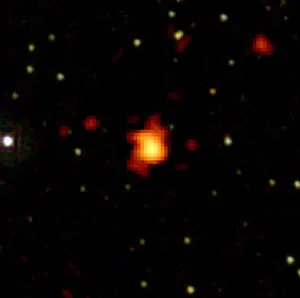
Image 1:
The image combines the view through Swift's Ultraviolet/Optical Telescope, which shows bright stars, and the X-ray telescope, which captures the burst (in orange and red).
Credit: NASA/Swift/Stefan Immler
Image 2:
GRB 080913 exploded on September 13 at an incredible distance of 12.8 billion light-years in the constellation Eridanus. The inset indicates the area of the sky shown in the Swift image.
Credit: DSS/STScI/AURA
Image 3:
GRB 080913 cannot be seen in one of GROND's optical filters (top), but appears in another (bottom). The sudden appearance of objects at longer wavelengths indicates greater distance.
Credit: MPE/GROND