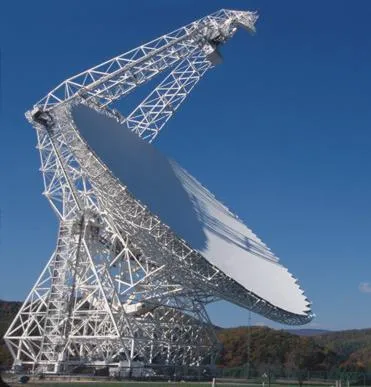
The Very Large Array of antennas that scans the skies for radio signals is being upgraded and digitized to obtain signals with much greater resolution and sensitivity.
"New radio waves originating in the center of the Milky Way are detected...There are no indications of interstellar signals".(1)
So read the New York Times in its May 5, 1933, issue, regarding the accidental discovery by Bell Laboratories technician Karl Jansky.
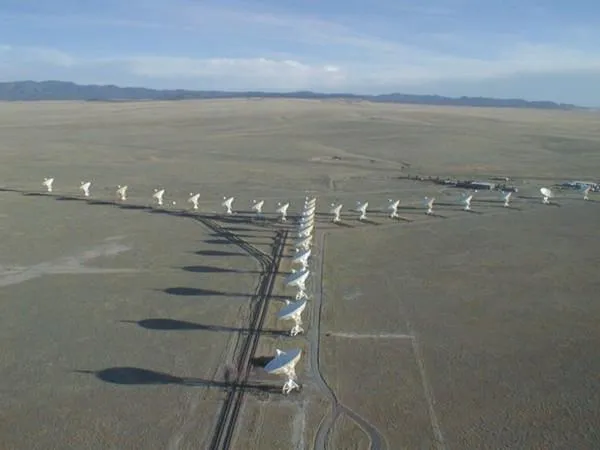
The finding would change the history of astronomy, allowing the cosmos to be scanned for radio signals through enormous antennas. Since then, technology enabled the creation of arrays of radio telescopes that allow the signals from many antennas to be synthesized as if they were a telescope whose aperture is equal to the space between the most distant elements. Of these arrays, the Very Large Array or VLA (in Spanish it would be "Conjunto Muy Grande"), near Socorro, New Mexico, has been operating since 1980. It has 27 active antennas (and one spare) mounted on rails in a Y shape. This extremely powerful array is receiving a digital upgrade that will increase its resolution and sensitivity.
Using more sophisticated computers and electronics that will notably increase its resolution, sensitivity, and data handling capacity, the VLA will transform into the EVLA: Expanded Very Large Array.
The heart of the EVLA, as in any radio telescope array, is the correlator, the supercomputer system that processes, compares, and combines the signals from the antennas.
The engineers also updated the path by which signals are transferred from the antennas to the correlator, using digital optical fibers that replaced the previous analog waveguides. The antennas are being renovated with new digital receivers, providing continuous coverage from 1 to 50 GHz. These improvements imply an increase in the array's capabilities of up to 10 times, making it capable of detecting signals as weak as a cell phone call from Jupiter.
With $100 million from the National Science Foundation and VLA's Canadian and Mexican partners, the researchers completed the installation of the digital lines and the upgrade, last May, of 16 of the 28 antennas. The upgrade process is expected to be completed by 2012.
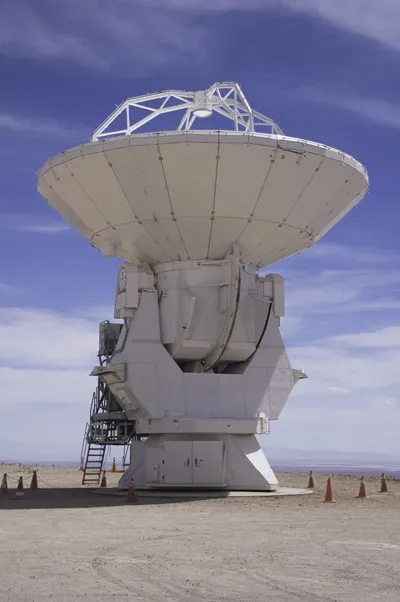
Meanwhile, the new generation of radio astronomy observatories is taking shape. The ALMA project (Atacama Large Millimeter/submillimeter Array) is under construction in Chile's Atacama Desert. The high altitude, 5,000 meters above sea level, will allow ALMA's 12-meter antennas to investigate the shortest radio waves, near infrared, which the atmosphere tends to filter.
"These two instruments will rewrite radio astronomy," predicts Rick Perley, a veteran VLA researcher.
Other, new and smaller projects, like the Low Frequency Array in Europe and the Allen Telescope Array in California, also promise to help shine the future of radio astronomy. "It is very difficult to predict precisely the science that will come from these instruments. The best is what cannot be anticipated," Perley finally adds. Kark Janksy, who made an enormous contribution to science, would undoubtedly agree.
A successful first step
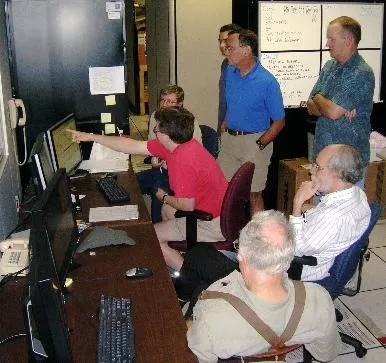
On August 7, an important step in the EVLA upgrade was taken, successfully completing tests of the advanced digital hardware designed to combine the signals from the upgraded antennas to produce high-resolution images of celestial objects.
The correlator called WIDAR was designed and built by the National Research Council of Canada (NRC). The correlator's design incorporates a new digital electronic architecture, patented by NRC. The successful test used electronic prototypes to combine the signals from two renovated antennas to combine them into a high-resolution system called an Interferometer. The technical term for this achievement is called "first fringes" or "primeras señales".
Each renovated antenna produces 100 times more data than the original ones. When all 27 antennas are renovated, they will send data to WIDAR at a rate equal to 48 million cell phone calls. To process that torrent of data, the correlator will perform trillions of calculations per second.
Powerful radio telescope systems use pairs of antennas as their basic building blocks. Each of the 27 antennas is electronically combined with the others to form multiple pairs. Each pair contributes information that is used to create very detailed images of astronomical objects. Thus, the successful test of two antennas verifies the design of the new correlator.
"This achievement marks the first time the complete EVLA electronic chain worked together, and represents a huge milestone in the project," says Fred Lo, Director of the National Radio Astronomy Observatory (NRAO).
Sources and related links
- Scientific American:Digital Upgrades for a Radio Astronomy Revolution, by Mark Wolverton
- (1)Historia de los espejos, by Mark Pendergrast; Ediciones B - Mexico, 2003;ISBN 846661351X, 9788466613514
- High-Tech 'Heart' of New-Generation Radio Telescope Passes First Test
- Very Large Array Retooling for 21st-Century Science
- Very Large Array
About the images
The NRAO team observing the successful results of the first WIDAR tests on the computer screen.
Credit:Finley, NRAO/AUI/NSF
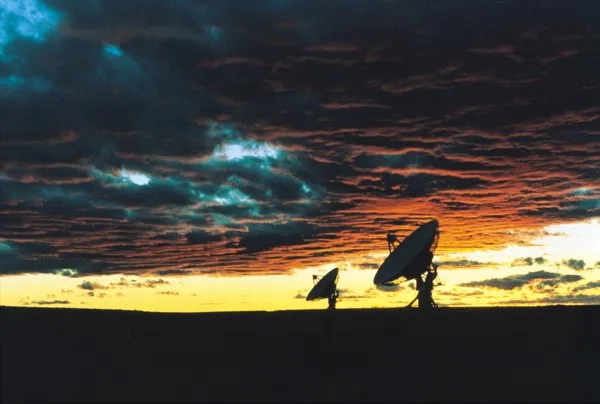
VLA sunset. Image courtesy of NRAO/AUI
Panoramic view of VLA, looking South. Image courtesy of NRAO/AUI