Radio telescopes from all over the world will join forces this week to perform an observation of three quasars, distant galaxies with supermassive black holes in their nuclei.
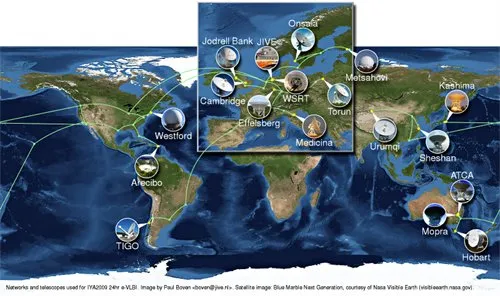
The nearly continuous 33-hour observation will be carried out between January 15 and 16 as part of a demonstration at the inaugural event of the International Year of Astronomy 2009, in Paris.
17 telescopes in Asia, Australia, Europe, North America and South America will be part of the phenomenal project that will observe the quasars named J0204+1514, 0234+285 and 3C395.
"The unique aspect of these observations is that telescopes located all around the world will come together to work in real time as a giant instrument," noted Arpad Szomoru, Head of Technical Operations at the Joint Institute for VLBI in Europe (JIVE).
Using a technique called e-VLBI, electronic real-time Very Long Baseline Interferometry, the participating telescopes will observe the same object simultaneously. The data from each telescope will be transmitted across the globe via a high-speed optical network to a supercomputer at JIVE, the Netherlands. The machine acts as the focus of the giant distributed telescope, combining the signals collected from the instruments.
"By combining information from radio telescopes so widely separated we can produce incredibly sharp images with up to 100 times better resolution than those available from the best optical telescopes," said Simon Garrington, Director of the MERLIN/VLBI facility in England.
With e-VLBI's ability to send data electronically and combine it in real time, there is the added advantage of providing results to astronomers within hours of the observation being made, instead of weeks later through the traditional VLBI method of recording data to disks and sending them to the correlator.
The director of JIVE, Huib Jan van Langevelde explained: "With VLBI we can observe the most energetic events in the universe, and the new e-VLBI technique allows us to do it fast enough to capture these events on the timescale on which they occur and respond quickly."
Representatives from the participating institutes will attend the Inaugural Ceremony in Paris to demonstrate the observation to 800 participants.
Participating telescopes:
- Arecibo (PR/USA)
- ATCA (Australia)
- Cambridge (England)
- Effelsberg (Germany)
- Hobart (Australia)
- Jodrell Bank (England)
- Kashima (Japan)
- Medicina (Italy)
- Metsähovi (Finland)
- Mopra (Australia)
- Onsala (Sweden)
- Sheshan (China)
- TIGO (Chile)
- Torun (Poland)
- Urumqi (China)
- Westerbork (Netherlands)
- Westford (USA)
Sources and related links
- Physorg: Radio-astronomers form telescope the size of Earth
- Univ. of Manchester: Radio-astronomers form telescope the size of Earth
- 24 hours of e-VLBI/Demo
About the images
Credit: Joint Institute for VLBI in Europe.