The ESO Observatory captured the intricate swirls of the spiral galaxy Messier 83. Shining with the light of billions of stars and the red glow of hydrogen, it is a beautiful example of a barred spiral galaxy, whose shape earned it the nickname Southern Pinwheel.
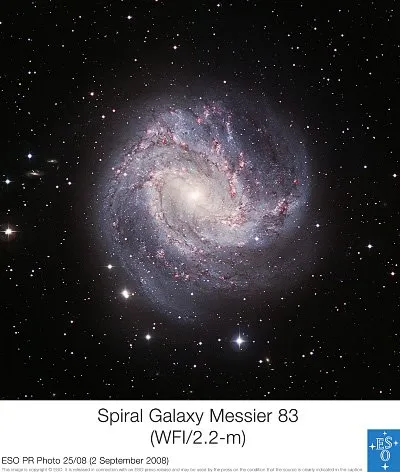
M83 lies 15 million light-years away in the direction of the southern constellation Hydra. It spans about 40,000 light-years, making it almost 2.5 times smaller than our own Milky Way. However, in some respects, Messier 83 is quite similar to our galaxy, for example both possess a bar crossing their nuclei.
This detailed image shows the spiral arms of M83 adorned by countless bright bursts of red light. These are enormous clouds of hydrogen gas. The ultraviolet radiation from massive newborn stars is ionizing the gas in these clouds, causing these hydrogen regions to glow red. These star-forming regions are dramatically contrasted in the image against the ethereal glow of the older yellow stars near the galaxy's central bar. The image also shows the delicate tracings of dark dust lanes across the galactic arms.
Messier 83 was discovered by the French astronomer Nicolas Louis Lacaille in the 18th century. Decades later it was listed in the famous catalog of deep-sky objects compiled by another French astronomer and famous comet hunter, Charles Messier. Recent observations of this enigmatic galaxy in ultraviolet light and radio waves showed that even the outermost and desolate zones of the galaxy are populated by baby stars. X-ray observations of the galaxy's heart have shown that its center is a hive of vigorous star formation. M83 is also one of the most prolific galaxies in producing supernovae, that is, the explosion of stars: this is one of the two galaxies that have had 6 supernovae in the past 100 years. One of them, SN 1957D, was observable for 30 years!
The Wide Field Imager (WFI) is a specialized astronomical camera attached to the 2.2-meter telescope of the Max-Planck Society/ESO at the La Silla Observatory. Located at about 2400 m above sea level, atop the mountains of the Atacama Desert, La Silla enjoys one of the clearest and darkest skies on the entire planet, making the site ideal for studying deep universe objects.
To make the image, the WFI focused on M83 for almost 100 minutes through a series of special filters, thus allowing the most diffuse details of the galaxy to be revealed. The brightest stars in the background are part of our galaxy, while behind the darkness of M83 is sprinkled with diffuse smudges of distant galaxies.
Sources and related links
- ESO: The Thousand-Ruby Galaxy
(Visit the ESO site for wider and more detailed images!) - M83 on DeepSkysatro
- Seds: Messier Object 83
About the images
Credit: ESO PR Photo 25/08
The Spiral Galaxy Messier 83
Image composite of the galaxy Messier 83. The data were extracted from the ESO Science Archive and processed by Davide De Martin.