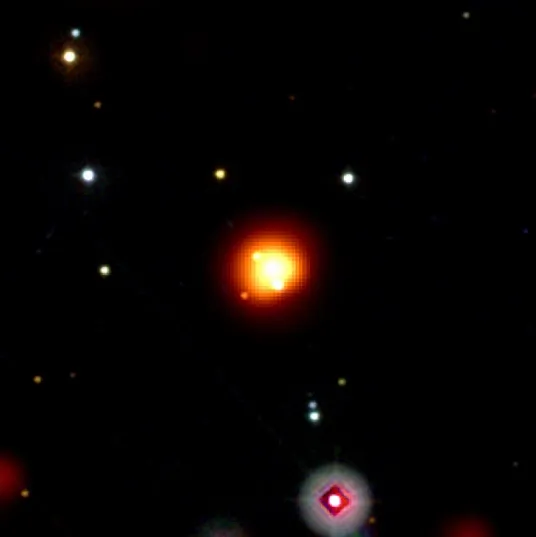
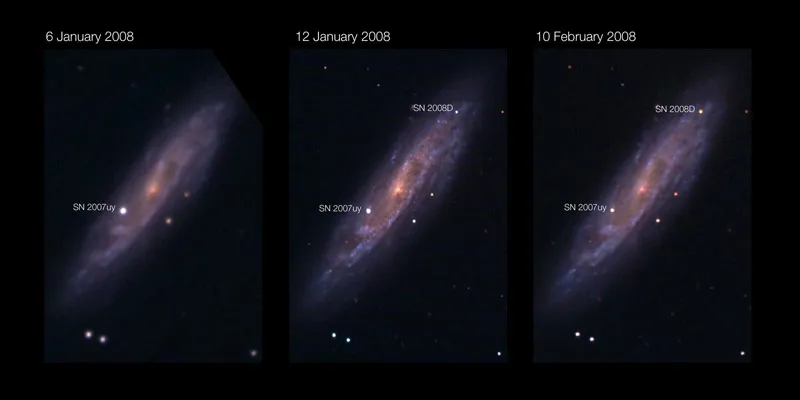
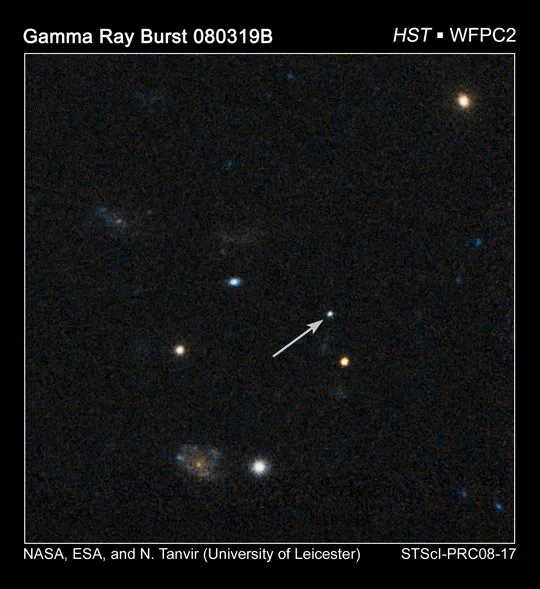
Astronomers announced today that a remarkable gamma-ray burst, visible to the human eye this year, came from a stellar jet pointed almost directly at Earth.
The Swift satellite detected the burst, known as GRB 080319B on March 19 of this year.
We talked about it in "Naked-eye burst brightest in the Universe" and in "The brightest burst, three weeks later".
It was a burst that was bright enough to be seen with the naked eye. Its position in the constellation Bootes was determined and a series of observations were made with a global set of satellites and ground-based observatories.
These types of explosions are known as Gamma-Ray Bursts, or GRBs, for their acronym in English.
In a paper in today's September 11, 2008 edition of Nature, Judith Racusin of Penn State University and a team of 92 co-authors report on observations that began 30 minutes before the explosion and followed its afterglow for months. The team concludes that the incredible brightness of the GRB came from a jet that shot material directly toward Earth at 99.99995% the speed of light!
In the first 15 seconds, the burst shone brightly enough to be seen with the naked eye and briefly reached magnitude 5.3. It is estimated that the explosion from the death of a star caused the jet. That star would be 7.5 billion light-years away!
Telescopes around the world were studying the afterglow of another burst when GRB 080319B exploded, only 10 degrees away. TORTORA, a robotic wide-field camera operated in Chile, took images of the event. (The archive can be accessed at http://www.nasa.gov/wmv/271561main_Naked_Eye_TORTORA.wmv)
Immediately after the burst, Swift's ultraviolet/optical and X-ray telescopes indicated they were blind. Racusin thought something was wrong with the telescopes. Within minutes, however, as reports arrived from other observers, it was clear this was a special event.
Gamma-ray bursts are the most luminous explosions in the universe. Most occur when massive stars run out of nuclear fuel. As their core collapses, black holes or neutron stars are created, in a process that is still not fully understood, and powerful jets of gas are generated. Those jets of matter emit radiation into space.
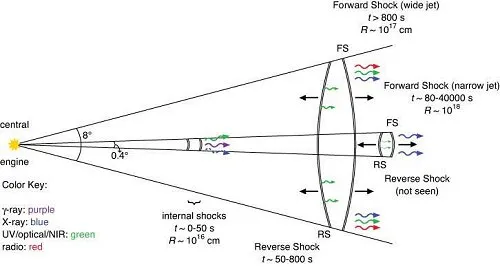
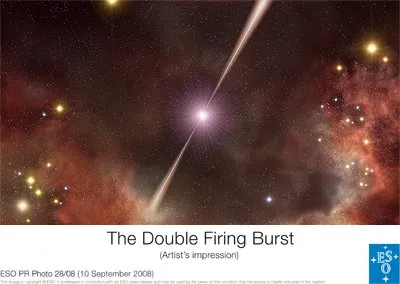
The team believes the jet directed toward Earth contained an ultra-fast component 0.4 degrees wide. The idea theorists have had for a while about GRBs is that an intense beam of matter lies within a larger one. And that what is detected from GRBs is that wider beam. Being right in the path of the inner beam is, therefore, very rare. However, this seems to be the case and hence its so incredible brightness.
Sources and related links
- Science@NASA: Naked-Eye Gamma-ray Burst Aimed Directly at Earth
- ESO: The Double Firing Burst
- Broadband observations of the naked-eye big gamma-ray burst GRB 080319B
J.L. Racusin et al.
Nature 455, 183-188 (11 September 2008)
DOI:10.1038/nature07270
About the images
GRB with two jets. Illustration from ESO PR Photo 28/08.
A two-component model explains the timing and spectral evolution of GRB 080319B. Credit: Nature/Judith Racusin.