A group of galaxies has given astronomers clues about how stars are born. A deep study using the Hubble Space Telescope observed about 14 million stars in 69 galaxies. Some galaxies are full of old stars, while others
The detailed study is called ANGST, for "ACS Nearby Galaxy Survey Treasury", which in Spanish would be, Survey of Nearby Galaxies by the Advanced Camera for Surveys. ANGST explored a region called the Local Volume, where galactic distances range from 6.5 million light-years to 13 million light-years from Earth.
A typical galaxy contains billions of stars that, seen from a great distance, appear as a collection in which individual resolution is difficult. The galaxies observed by Hubble in this study are close enough for the telescope's cameras to resolve the brightness and color of some individual stars. This allows scientists to determine the history of star formation in a galaxy and clarifies subtle features in a galaxy's shape.
"Past Hubble observations of the local neighborhood generated insights into the star formation histories of individual galaxies, but the number of galaxies studied in detail has been rather small," says Julianne Dalcanton of the University of Washington in Seattle and leader of the study. "Instead of choosing particular galaxies to study, our survey will be complete, by virtue of observing 'all' the galaxies in the region. This gives us a multi-color picture of when and where all the stars in the local universe formed."
Many stars in nearby galaxies are the fossil equivalents of new stars forming in the distant universe. "When we look back in time at young distant galaxies, we see a lot of vigorous star formation. However, we can only guess about what those galaxies might have eventually become," explains Dalcanton. "Using the galaxies in the nearby universe as a fossil record, we can compare them with young distant galaxies. The comparison gives us a star formation history and provides a better understanding of the masses, structures, and environments of galaxies."
Previous results from ANGST show the rich diversity of galaxies. Some are made of old stars, while others have been forming stars continuously throughout their lives. There are even some examples of galaxies that have only begun to form stars in the recent past. "With these images, we can see what makes each galaxy unique," notes Benjamin Williams, a team member.
The study also includes maps of many large galaxies, including M81. "With these maps we can trace when different parts of the galaxy formed," explains Evan Skillman of the University of Minnesota.
In a separate report describing the star formation history of M81, astronomers confirmed that massive spiral galaxies form most of their stars in the early Universe. Analyzing the outer disk of M81, astronomers found that most stars formed more than 7 billion years ago, when the Universe was half its current age. M81 and other large galaxies also experienced a rapid enrichment of chemical elements heavier than hydrogen and helium (which were produced during the Big Bang), such as carbon, through the death of massive stars in supernova explosions.
"We were surprised about how quickly the elements formed and how the subsequent star formation rates for the ensemble of stars in M81 changed after that," says Williams, lead author of the report.
This rich information adds to Hubble's legacy, also generating a foundation for future studies. "With this information, we will be able to trace the entire star formation cycle in detail," Dalcanton concludes.
Sources and related links
- SpaceTelescope:When it comes to galaxies, diversity is everywhere
- HubbleSite:When it comes to galaxies, diversity is everywhere
- ANGST site
- The ACS Nearby Galaxy Survey Treasury
J. Dalcanton et al, 2008, submitted to The Astrophysical Journal Supplement Series - The ACS Nearby Galaxy Survey Treasury I. The Star Formation History of the M81 Outer Disk
B. Williams et al, 2008, submitted to The Astrophysical Journal
About the images
Image taken by the Hubble Telescope:
Credit:NASA, ESA, J. Dalcanton & B. Williams (University of Washington, USA).
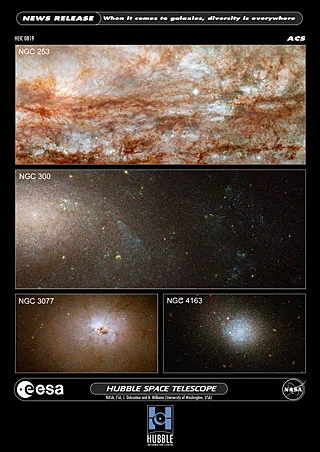
A close look at four galaxies from the nearby galaxy survey. They have different masses and sizes and show the diversity found in the ANGST study. Although the galaxies are separated by many light-years, they are presented as if they were all at the same distance to show their relative sizes.
In the image composite, above, NGC 253 is illuminated by the light of thousands of young blue stars. The spiral galaxy is undergoing intense star formation. The galaxy is the dominant member of the Sculptor Group of galaxies and resides about 13 million light-years from Earth.
The next image belongs to NGC 300 in which young blue stars are concentrated in the spiral arms. The yellow patches are glowing hot gas that has been heated by radiation from the nearest young stars. NGC 300 is a member of the Sculptor Group of galaxies and is located 7 million light-years away.
The next small, dense galaxy is NGC 3077 near whose bright core there is dark material belonging to the remnants of its interactions with its larger neighbors. The galaxy belongs to the M81 group of galaxies and resides 12.5 million light-years from Earth.
Finally, the composite shows NGC 4163, a member of a group of dwarf galaxies near the Milky Way. It is located 10 million light-years away.