The research agencies of 13 European countries joined their efforts in the ASPERA network to have a common tool in astroparticle physics. With seven major projects they want to find answers to some of the most exciting questions about the Universe.
"New exciting discoveries lie ahead; it is up to us to take the initiative in them in the next decade," says Christian Spiering, head of the strategy committee. After a two-year process, the publication of the European Strategy for Astroparticle Physics is an important step that outlines a leading role for Europe.
From laboratories underground and under the sea to the most desolate deserts and outer space, experiments in astroparticle physics take on very exciting challenges. It is a promising and fast-growing field of research at the intersection of particle physics, cosmology and astrophysics, trying to detect the most elusive particles and penetrate the most intimate secrets of the Universe.
The Magnificent Seven are large and exotic research projects:
- CTA: The Cherenkov Telescope Array is a mega-instrument designed to detect gamma rays with unprecedented precision and will dominate this type of astronomy for the next decade.
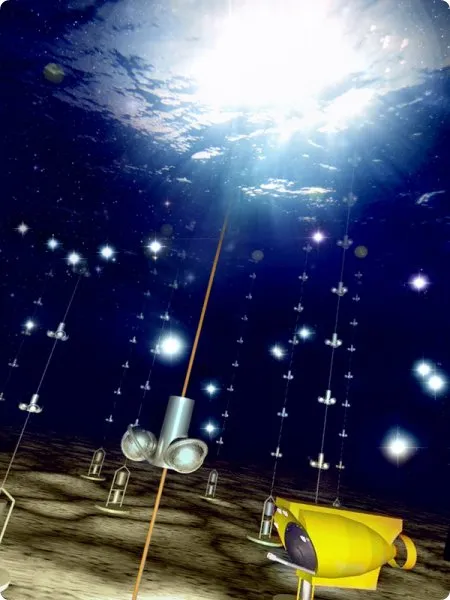
- KM3NeT is a future research infrastructure project in the Mediterranean Sea. The facility would host a 1 cubic kilometer telescope to detect neutrinos and would provide access to measurements for a variety of marine sciences, such as biology, oceanography, etc. KM3NeT would complement the IceCube experiment at the South Pole.
- Dark matter search detectors:
EURECA (European Underground Rare Event Calorimeter Array), the DAMA Collaboration at the Gran Sasso Laboratory - A detector for the search of proton decay, neutrino research and their properties: LAGUNA (Large Apparatus studying Grand
Unification and Neutrino Astrophysics) is a large-scale detector: 105 tons of liquid argon or water - A large array for the detection of charged cosmic rays: Pierre Auger Observatory
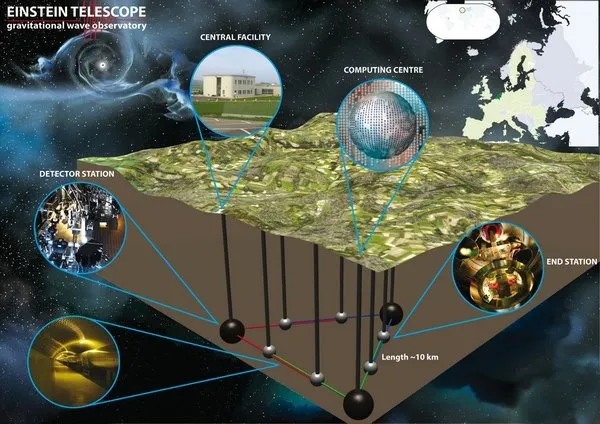
- A third-generation underground gravitational antenna: Einstein Telescope
With these experiments, they will try to answer some of the big questions about the Universe:
Do protons have a finite lifetime?
The Grand Unified Theories (GUTs) of particle physics predict that the proton has a finite lifetime. This is one of the most generic and verifiable implications of those theories and could be related to the generation of the matter-antimatter asymmetry in the universe.
The discovery of the finite lifetime of the proton would be one of the fundamental discoveries of physics and cosmology. To try to discover if this is the case, large underground detectors will be used.
What are the properties of neutrinos and what is their role in cosmic evolution?
The Standard Model in particle physics states that neutrinos have no mass. But in the past decade it was discovered that they do. Furthermore, it is thought that neutrinos oscillate between different states, from which the mass difference between them was inferred, but not their absolute value. The experiments to be developed will try to find out the absolute value of their masses and whether neutrinos are their own antiparticles, among other things.
What do neutrinos tell us about the interior of the Sun and the Earth and about Supernova explosions?
Neutrinos coming from the Sun and from a supernova (SN 1987A) have been detected, but only a fraction of the total produced, the high-energy ones. Precise measurements of the low-energy spectrum of solar neutrinos will test our understanding of the oscillations of these elusive particles. Furthermore, the study of neutrinos from supernova explosions would give a detailed knowledge of the mysterious process that sustains those explosions. And neutrinos from the interior of the Earth have also been reported, which would inform about nuclear processes on our planet.
What is the origin of high-energy cosmic rays?
Almost a century ago, physicist Victor Hess discovered cosmic rays, charged particles that hit our atmosphere like a regular rain. Later, it was noted that some of these particles have energies hundreds of millions of times greater than those we can generate in accelerators.
Can we detect gravitational waves?
Just as electromagnetism generates electromagnetic waves, it is thought that gravitation generates gravitational waves, as established by the Theory of General Relativity. With the new tools available, the detection of these waves could be just around the corner.
What is the Universe made of?
Only 4% of the Universe is composed of ordinary matter, like the one we humans and everything we know are made of. 73% would be dark energy and the remaining 23% dark matter. Astroparticle physics has developed a variety of tools in search of the Neutralino, a candidate dark matter particle.
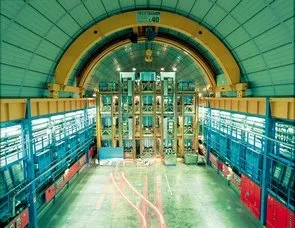
ASPERA is the European astroparticle network: Astroparticle ERA-NET. ERA comes from European Research Area.
The European Strategy for Astroparticle Physics can be obtained at:
http://www.aspera-eu.org/index.php?option=com_content&task=view&id=35&Itemid=72
Sources and related links
- The 'Magnificent 7' of European astroparticle physics unveiled to the world
- First international meeting of the Cherenkov Telescope Array (CTA) project
- The seven wonders...astronomical
- The hunt for dark matter
About the images
Credits:
KM3NeT
F.Montanet, CNRS/IN2P3 and UJF for Antares/M.Angelo Silva/D.Rouable
Gran Sasso laboratory / credit: ASPERA / INFN / Volker Steger
Einstein telescope / credit: ASPERA / Nikhef / Jo van den Brand