A group of researchers were able to measure the capacity that Titan, Saturn's moon, has to retain the magnetic field of the planet to which it is usually exposed. The work was published in Nature and Science.
The Cassini space mission around Saturn has just made unprecedented measurements near its largest moon, Titan. These measurements, made by the spacecraft's magnetometer, and analyzed by a group of researchers led by Dr. César Bertucci - a Conicet researcher recently repatriated to work at the Instituto de Astronomía y Física del Espacio (IAFE) - allowed measuring the capacity that Titan has to retain Saturn's magnetic field to which it is usually exposed. For the first time in the history of Titan's space exploration -which began more than 28 years ago- Cassini found Titan in the plasma of the solar wind, that is, outside the area of influence of Saturn's magnetic field. However, and to the surprise of the researchers, the measurements revealed that the magnetic field enveloping Titan was stratified into two layers of different polarization: an outer layer, corresponding to the Sun's magnetic field, and a layer at lower altitude populated by 'fossil' lines of Saturn's magnetic field to which the moon had been exposed minutes before the encounter with Cassini. In this way and, as in archaeology, these measurements showed that the layers of magnetic field at higher altitudes above Titan correspond to more recent magnetic conditions. “It was when we tried to know the 'age' of these 'fossil' magnetic fields, in other words, how long ago these lines were deposited in Titan's atmosphere. Cassini's observations allowed placing this timescale between approximately 20 minutes and 3 hours,” explained Dr. César Bertucci.
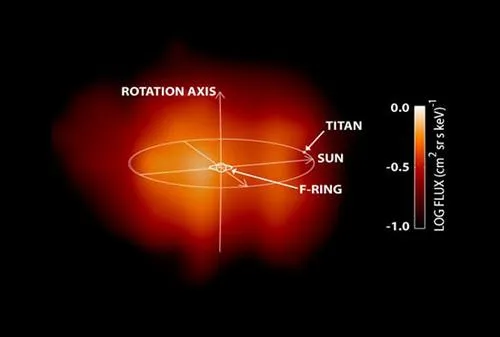
Why is it so important to know this time? “It serves to measure the erosion of Titan's atmosphere by the action of Saturn's and the Sun's external plasma,” says Bertucci. At this moment, numerical simulations are trying to obtain these estimates of atmospheric loss from the transit times derived from the present study.
Key points:
· The Cassini/Huygens mission is a joint project of the National Aeronautics and Space Administration (NASA) and the European Space Agency (ESA) aimed at studying the planet Saturn and its system of rings and moons.
· It was launched from Cape Canaveral in October 1997 and arrived at Saturn in July 2004. Since then it has been in orbit around the ringed planet.
· Titan (radius = 2575 km) is Saturn's largest satellite and the only one that possesses a dense atmosphere. Its chemical composition includes organic compounds similar to those that existed on Earth before the emergence of life.
· Unlike Earth, Titan does not possess a global magnetic field that protects its atmosphere from the ionized gases (plasmas) and the external magnetic fields to which its atmosphere, ionized by the Sun's ultraviolet rays, is exposed.
· Like a stone in a stream, Saturn's plasma and magnetic field (which rotates with the planet) flows around Titan, generating a wake behind the object called a 'magnetic tail', similar to that of comets.
· Due to the size of its orbit (at 1.2 million km from Saturn) Titan is located at the confines of Saturn's magnetosphere (region where the planet's own magnetic field dominates).
· For the first time in the history of its exploration, Titan was observed by Cassini at the moment when the moon was outside the region dominated by Saturn's magnetic field (magnetosphere).
· However, at the moment of the encounter with Cassini, Titan was still enveloped by 'fossil' magnetic fields from Saturn, to which the moon had been exposed minutes before.
Sources and related links
- Conicet: Argentine scientist measures the magnetic memory of Titan's atmosphere
- The Magnetic Memory of Titan's Ionized Atmosphere
C. Bertucci et al.
Science 12 September 2008: Vol. 321. No. 5895, pp. 1475 - 1478
DOI:10.1126/science.1159780 - JPL: Saturn's Magnetic Personality Rubs Off on Titan
- Article in Nature
About the images
First image:
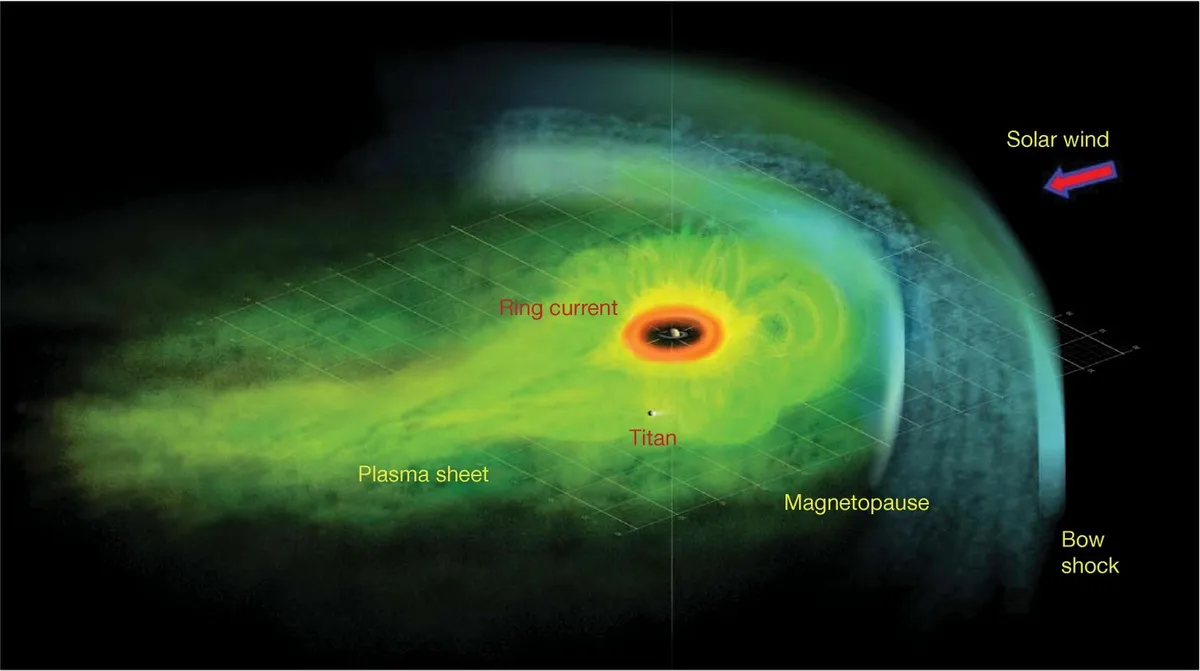
Artistic image of Saturn's magnetosphere and Titan within it (Krimigis et al., Nature, Vol 450, 13 December, 2007).
Second image:
Saturn's magnetosphere is seen in this image taken by Cassini on June 21, 2004. A magnetosphere is a magnetic envelope of charged particles that surrounds some planets, including Earth. The image describes Titan's orbit through Saturn's magnetosphere.
NASA/JPL/Johns Hopkins University