A powerful nearby supernova was captured by web telescopes. After more than a decade of exploding, one of the closest supernovae in the last 25 years has been identified. The result was possible by combining data from the vast online archives of many telescopes around the world.
The supernova, called SN 1996cr, was detected by Franz Bauer in 2001. He noted a bright and variable source in the spiral galaxy Circinus, using the Chandra X-ray Observatory. Although the source showed some exceptional properties, Bauer and his colleagues at Penn State could not identify its nature with certainty at that time.
It was not until years later that Bauer and his team were able to confirm that this object was a supernova. Clues from a spectrum obtained by ESO's VLT led the team to begin a true detective work of searching through data from 18 telescopes, on the ground and in orbit. Since the object was found in an interesting nearby galaxy, the public archives of these telescopes contained abundant observations.
The data show that SN 1996cr ranks among the brightest supernovae ever seen in radio and X-rays. It also has some incredible similarities with the famous supernova SN 1987A, which occurred in a nearby galaxy only 160,000 light-years from Earth.
"This supernova seems to be the wild cousin of SN 1987A," says Bauer. "They resemble each other in several ways, except that this new supernova is intrinsically a thousand times brighter in radio and X-rays."
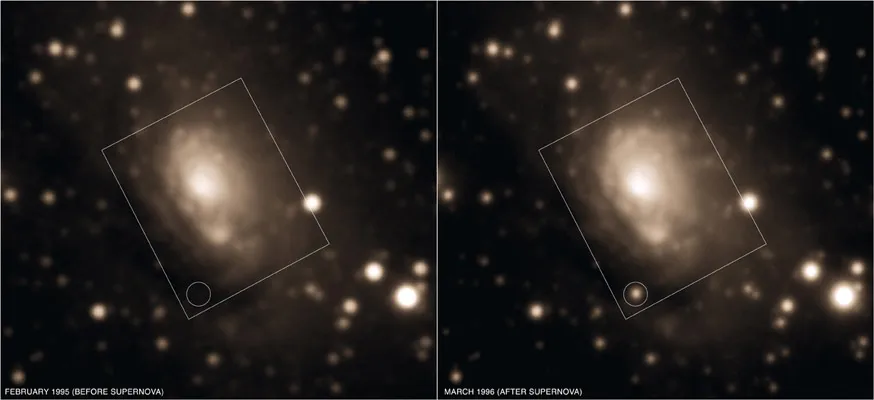
Visible light images from the archives of the Anglo-Australian Telescope show that SN 1996cr exploded sometime between February 28, 1995 and March 15, 1996, but it is the only one of the five closest supernovae in the last 25 years that was not seen shortly after the explosion.
Other orbiting X-ray observatories like ROSAT and ASCA did not detect it, but since it was first detected by Chandra in 2001 it has become steadily brighter. Previously, SN 1987A was the only known supernova with X-ray emission that increased over time.
"It's a masterstroke to find SN 1996cr like this, and we couldn't have done it without the fortuitous data taken by all these telescopes. We have truly entered a new era of 'internet astronomy'," adds Bauer.
The combined data, along with theoretical work, has led the team to develop a model for the explosion. Before the star exploded, it cleared a large cavity in the surrounding gas, either via strong winds or by an eruption from the star. The shock wave from the explosion could thus expand relatively freely into the cavity. When the wave hit the dense material around SN1996cr, the impact caused the system to light up brightly in X-rays and radio emission. This emission from SN 1987A is probably weaker because the surrounding material is less compact.
Astronomers think that both supernovae show evidence of these pre-explosion outbursts that clear the environment of the doomed star. Having two nearby examples suggests that this type of activity could be relatively common during the death of massive stars.
"Not only does our work suggest that SN 1987A is not unusual as previously thought, but it also teaches us more about the tremendous upheavals that massive stars can have throughout their lifetime," notes co-author Vikram Dwarkadas of the University of Chicago.
Sources and related links
- ESO: The Wild, Hidden Cousin of SN 1987A
- Supernova 1996cr: SN 1987A's Wild Cousin?
F. E. Bauer, V. V. Dwarkadas, et al.
Accepted for publication in The Astrophysical Journal
arXiv:0804.3597v3
About the images
ESO PR Photo 32a/08
SN 1996cr in Circinus Galaxy
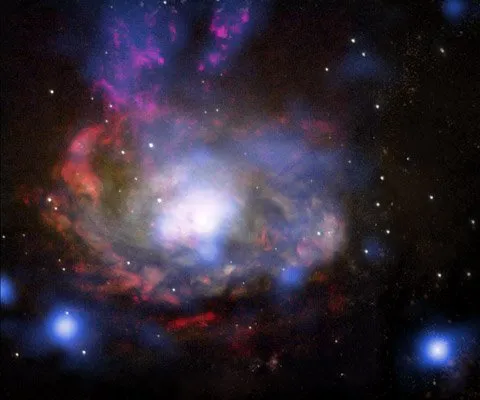
The image composite shows the central regions of the nearby galaxy Circinus, located about 12 million light-years away. Data from the Chandra Observatory are shown in blue, and data from Hubble in yellow, red, cyan, and light blue. The blue source near the left corner of the image is supernova SN 1996cr.
Credit: X-ray (NASA/CXC/Columbia/F.Bauer et al); Visible light (NASA/STScI/UMD/A.Wilson et al.)
ESO PR Photo 32c/08
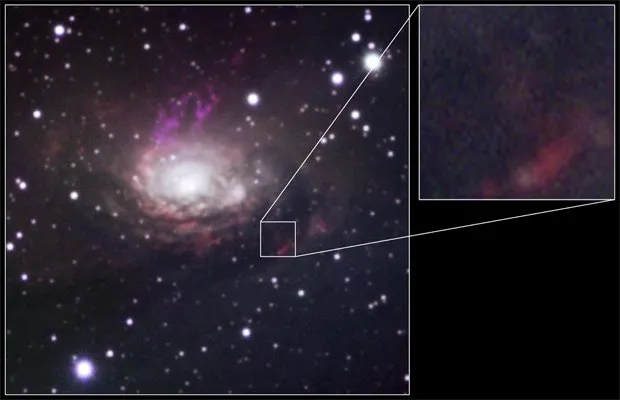
The Circinus Galaxy and the position of SN 1996cr
The image from the SuSI New Technology Telescope shows the location of supernova SN 1996cr. The data were obtained in April 1994 when the supernova was not yet visible in the image. However, a small and powerful region of ionized gas is apparent and could be related to the winds from the star that exploded. Credit: ESO
ESO PR Photo 32d/08
Circinus Galaxy before and after SN 1996cr appeared
These two optical images from the Anglo-Australian Telescope show the Circinus galaxy before (February 1995) and after (March 1996) the supernova explosion SN 1996cr was visible. The field of view of the Chandra/Hubble telescopes is shown with a rectangle, along with the position of SN 1996cr. Credit: Anglo-Australian Observatory.