Echoes near the scattered remains of an exploded star are replaying the first moments of the explosion, scientists indicate.
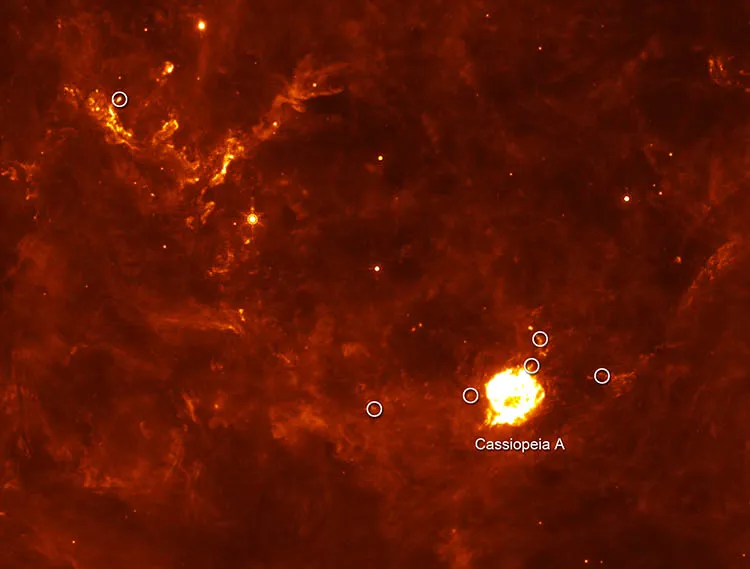
Eli Dwek of the Goddard Space Center and Richard Arendt of the University of Maryland say that these echoes are generated by the radiation from the shock wave of the supernova Cassiopeia A that shattered the star 11,000 years ago.
"We are seeing the first flash of the supernova," says Dwek.
Previously, other Spitzer researchers discovered hot spots near the supernova remnant Cassiopeia A and recognized their importance as the light echoes of the original outburst. Dwek and Arendt used Spitzer data to investigate this hot dust and determine the cause of the echoes more precisely.
Six knots of dust near the remnant show temperatures between -173 and -123 degrees Celsius. Although this may seem very cold by everyday Earth standards, these temperatures are very hot compared to typical interstellar dust.
The scientists show in a report from October 1 in The Astrophysical Journal that the only event that can generate such hot grains is the powerful and short pulse of ultraviolet and X-ray radiation that marks the death of a star. The outburst was about one hundred billion times brighter than the Sun, but lasted only about a day.
"They identified the precise event during the demolition of the star that produces the echo we see," says Michael Werner, a Spitzer scientist at the Jet Propulsion Laboratory in Pasadena.
The light from the explosion reached Earth in the 17th century, but no one noticed it. The finding gives astronomers a second chance to study the supernova.
Although the explosion originally escaped detection, its remains—a hot expanding gas cloud known as Cassiopeia A (or Cas A, for short)—is one of the best-studied supernova remnants. The burst zone lies 11,000 light-years away in the constellation Cassiopeia.
When a massive star runs out of nuclear fuel, its core collapses into a super-dense neutron star. As it forms, it contracts and expands. This triggers an enormous shock wave that shatters the star's outer layers. The shock creates a flash of high-energy light that precedes the emergence of the supernova in visible light.
Evidence of a flash associated with this shock existed only in computer simulations until January 9 of this year. That day was when NASA's Swift satellite detected a 5-minute-long X-ray pulse from a galaxy NGC 2770. A few days later, a new supernova—designated as SN 2008D—appeared in the galaxy.
The infrared echoes of Cas A arise from dust clouds about 160 light-years farther away than the remnant. The initial pulse of radiation from the supernova expands through space at the speed of light, finds the clouds, and heats their dust grains. The dust, in turn, radiates the energy at infrared wavelengths.
This radiation took 160 years to reach the clouds and, once heated, the infrared energy from the grains has to travel the same distance. This extra journey results in 320 years between the initial flash and the arrival of the dust's infrared echo on Earth. The researchers plan to use these echoes to paint an intimate portrait of the explosion, the star, and the immediate environment.
When the light from supernova Cas A reached Earth in the late 1600s, no one reported the sighting of a new star. On August 16, 1680, the English astronomer John Flamsteed might have seen the supernova without recognizing it. He recorded a faint star near the position of Cas A, but none exists there now.
Sources and related links
- Infrared Echoes give NASA's Spitzer a Supernova Flashback
- Unveiling the mysteries of Cassiopeia A
- Infrared Echoes Reveal the Shock Breakout of the Cas A Supernova
Eli Dwek and Richard G. Arendt
The Astrophysical Journal, 685:976–987, October 1, 2008
DOI:10.1086/589988
About the images
NASA/JPL-Caltech/E. Dwek and R. Arendt