A group of researchers proposes searching for stars that explode as supernovae, as well as stars that simply disappear or failed supernovae. This would reveal a myriad of new astronomical phenomena.
The study would be the first of its kind, according to a recent report in Astrophysical Journal.
"When you do something for the first time, you might find something you didn't expect," says the study leader, Christopher Kochanek, of Ohio University.
When stars die, their cores collapse and explode. Most stars release this energy as an outward shock wave that ejects the star's outer layers: a supernova. This is visible as a sudden brightening and a subsequent dimming of the star.
However, some stars might simply go out, the researchers say. Searching for these "failed novae" in wide-field surveys would allow astronomers to determine how common they are.
To carry out the study it would be necessary to observe sections of space with a radius of 10 megaparsecs (32.6 million light-years) to observe a million supergiant stars. Since these stars live, approximately, a million years, this should guarantee the observation of at least one death during the study period.
The "missing" stars could be detected by photographing the sky with a wide-field camera attached to an eight-meter diameter telescope to try to detect the disappearance between two images of the same area of the sky.
Kochanek says his team has already begun data collection using the 8.4-meter mirrors of the Large Binocular Telescope in Arizona and tries to continue its observations regularly over a five-year period.
The survey could help resolve supernova formation models. In the standard model, supergiant stars (8 to 30 times the mass of the Sun) explode as supernovae but leave a dense compact object: a neutron star. Larger stars, in contrast, leave behind a black hole. The assumption is that they are all supernovae, whether they leave a black hole or a neutron star, Kochanek points out.
"Our point is that there is no observational basis for this assumption - we know that some explode, and we know it's really hard to make them explode in computational models - so we point out that we must find out if there are black holes forming without the dramatic signature of a supernova explosion," he adds.
The possibility that "silent" black holes exist, that is, that they form from massive stars that do not explode as supernovae, was already addressed by the Argentine astronomer Félix Mirabel, in 2003, when studying the famous source Cygnus X-1. (Axxón covered the news then in "An Argentine unveiled part of the mystery of black holes")
As can be read in the summary of the new report, the study would place new limits on the total core collapse rate, which is critical for determining the validity of supernova models. It would also determine the properties of the progenitors of these explosions, find and characterize a large number of Cepheids, luminous blue variables and eclipsing binaries, and allow the discovery of any new phenomenon in the study area.
Sources and related links
- Looking for stars that vanish from the sky
- A Survey About Nothing: Monitoring a Million Supergiants for Failed Supernovae
Christopher S. Kochanek et al.
The Astrophysical Journal, 684:1336–1342, September 10, 2008
DOI:10.1086/590053
arXiv:0802.0456v2 - Formation of a Black Hole in the Dark
I. Félix Mirabel, Irapuan Rodrigues
Science 16 May 2003:Vol. 300. no. 5622, pp. 1119 - 1120
DOI: 10.1126/science.1083451
About the images
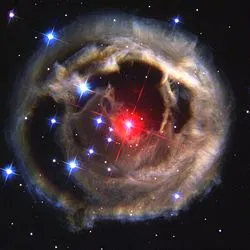
Variable star V838 Monocerotis
NASA/ESA