Two planets orbiting a mature star similar to our Sun, but 300 light-years from Earth, recently suffered a violent collision, according to new research.
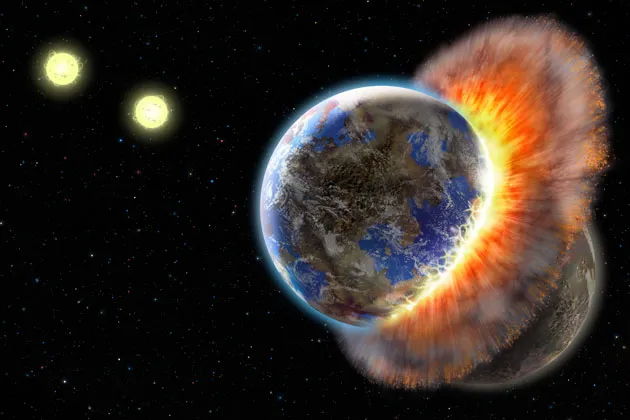
"It's as if Venus and Earth collided with each other," says Benjamin Zuckerman, professor of physics and astronomy at UCLA and co-author of the report to appear in the December issue of Astrophysical Journal. "Astronomers have never seen anything like this before. Apparently, catastrophic collisions can occur in fully mature planetary systems."
"If any life was present on either planet, the massive collision would have wiped out everything in a matter of minutes, a mass extinction event," adds Gregory Henry, an astronomer at the University of Tennessee and also co-author of the report. And he adds: "A massive dust disk around the star provides silent testimony to this sad fate."
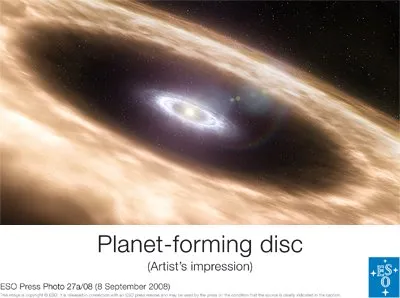
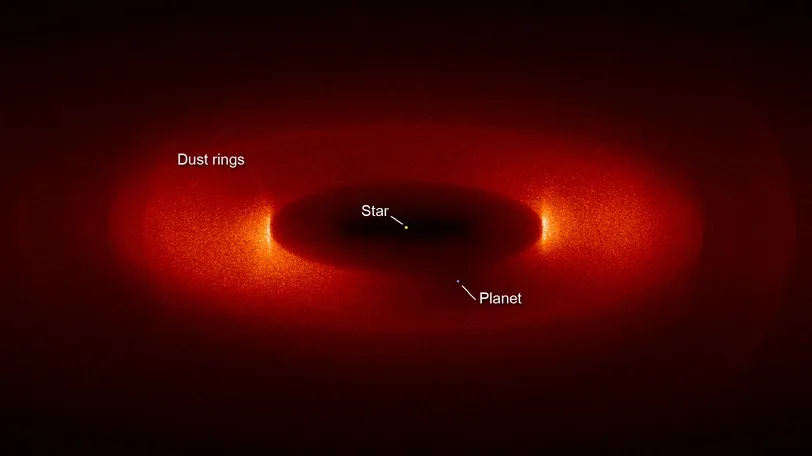
Zuckerman and Henry, along with Michael Muno, an astronomer at Caltech at the time of the research, were studying a star known as BD+20 307, which is surrounded by dust. A lot of dust. A million times more dust than orbits our Sun. The star is located in the constellation Aries. The astronomers gathered X-ray data using the Chandra Observatory and data obtained with the automated telescopes in southern Arizona, to try to measure the star's age.
"We expected to find that BD+20 307 was relatively young, a few hundred million years old at most, with the massive dust disk indicating the final stages in the formation of the star's planetary system," notes Muno.
Those expectations proved premature, however, when astronomer Alycia Weinberger of the Carnegie Institution of Washington announced in the May 20 issue this year of Astrophysical Journal [1] that BD+20 307 is, in fact, a binary system, two stars orbiting each other, very closely, around a common center of mass.
That discovery forced a radical revision of the data and transformed the star into a unique and intriguing system, according to Francis Fekel who, along with Michael Williamson of Tennessee contributed additional spectroscopic data to help understand the system.
The new data confirmed that it is two stars, both very similar in mass, temperature and size to our own Sun. They orbit around their common center of mass every 3.42 days.
"The patterns of elemental abundances in the stars show that they are much older than a few hundred million years, as originally thought," says Fekel. "On the contrary, the system appears to be several billion years old, comparable to our solar system."
As Henry explains, "the planetary collision in BD+20 307 was not observed directly but was inferred from the extraordinary amount of dust particles orbiting the binary pair at a distance similar to that of Earth and Venus from our Sun." And he adds that if the dust indeed indicated the presence of terrestrial planets, this would represent the first known example of planets of any mass in orbit around a binary system, with its components very close together.
Zuckerman and colleagues reported in the July 2005 issue of Nature that BD+20 307, which at that time was thought to be a single star, was surrounded by more dust than any other Sun-like star known to astronomers. The dust is orbiting the system very closely, where planets like ours are most likely to be and where dust usually does not survive long. Small dust particles are expelled by stellar radiation, while larger particles are reduced in collisions within the disk and then expelled. Thus, the supposed collision that would have formed the dust disk near this system must have occurred recently, probably within the last few hundred thousand years and perhaps more recently, according to the researchers.
From which two very interesting questions arise, says Fekel: "How do planetary orbits become unstable in such an old and mature system, and could such a collision occur in our solar system?"
"The stability of planetary orbits in our solar system has been considered for about two decades by astronomer Jacques Laskar in France and, more recently, by Konstantin Batygin and Greg Laughlin, in the United States," reports Henry. "Their computational models predict planetary motions in the distant future and find a small probability for collisions of Mercury with Earth or Venus sometime in the next few billion years. The small probability could be related to the rarity of very dusty planetary systems like BD+20 307."
"There is no doubt, however, that large collisions have occurred in the past of our solar system. Many astronomers believe that our Moon was formed by the collision of two planetary embryos: the young Earth and a Mars-sized body, a collision that created tremendous debris, some of which condensed to form the Moon," notes Zuckerman. And he adds that in contrast to the massive collision in the BD+20 307 system, the collision of an asteroid with Earth, 65 million years ago, the most favored explanation for the extinction of the dinosaurs, was "barely insignificant."
Sources and related links
- Eurekalert: Worlds in collision
- UCLA: Worlds in collision
- Automated Astronomy Group: Worlds in Collision
- Planetary systems around close binary stars: the case of the very
dusty, Sun-like, spectroscopic binary BD+20 307
B. Zuckerman, Francis C. Fekel, Michael H. Williamson, Gregory W. Henry, M. P. Muno
Forthcoming in The Astrophysical Journal
(Abstract in pdf) - [1]: On the Binary Nature of Dust-encircled BD +20 307
A. J. Weinberger
The Astrophysical Journal Letters, 679:L41–L44, May 20, 2008
DOI: 10.1086/589180
About the images
Artistic impression by Lynette Cook