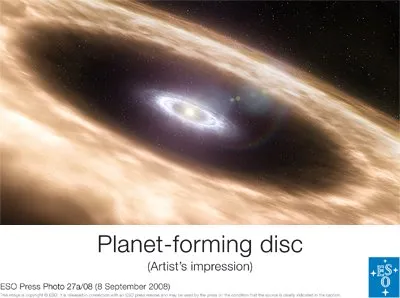
Astronomers have been able to study the planet-forming disks around stars like our Sun in great detail, clearly revealing the motion and distribution of gas in the inner regions of the disk. This result, which possibly implies the presence of giant planets, was made possible by combining an ingenious method at ESO's Very Large Telescope.
Planets can be home to other forms of life, so studying them ranks very high in contemporary astronomy. More than 300 exoplanets are already known orbiting other stars distinct from the Sun, and these new worlds show an incredible diversity in their characteristics. But astronomers do not only look at systems with already formed planets. They can also gain knowledge by studying the disks around young stars where planets may currently be forming. "This is like going 4.6 billion years back in time to see how the planets of our Solar System formed," says Klaus Pontoppidan of Caltech, leader of the research.
Pontoppidan and his colleagues analyzed three Sun-like stars that are, each one, surrounded by a disk of gas and dust from which planets can form. These three disks are only a few million years old and are known to have gaps or holes in them, indicating regions where the dust has been cleared and the possible presence of young planets.
The new results not only confirm that gas is present in the dust gaps, but also allow astronomers to measure how the gas is distributed in the disk and how these disks are oriented. In regions where the dust seems to have been cleared, molecular gas is still very abundant. This may mean that the dust collapsed to form planetary embryos or that the planet has already formed and is in the process of clearing the gas in the disk.
For one of the stars, SR 21, a possible explanation is the presence of a massive giant planet orbiting at less than 3.5 Astronomical Units (or AU, which is the distance between Earth and the Sun, an average of 150 million km), while for the star HD 135344B, a possible planet could be orbiting between 10 and 20 AU. The observations of the third star, TW Hydrae, might require the presence of one or two planets.
"Our observations with the CRIRES instrument on ESO's Very Large Telescope reveal that the disks around these three young Sun-like stars are very different and will most likely result in different planetary systems. Nature, certainly, does not like to repeat itself," adds Pontoppidan.
"This kind of observation complements the work of the ALMA Observatory, which will be observing these disks in great detail and on a larger scale," says Ewine van Dishoeck of Leiden Observatory.
Studying the gaps in the dust disk that are the size of the Solar System around other stars located 400 light-years away is quite a challenge that requires an ingenious solution and the best possible instruments.
The disks are about 100 AU in diameter, but the stars are more than 200 light-years away (one light-year is 200,000 AU). To detect structures on scales of 1 AU in these systems, corresponds to reading a vehicle license plate at a distance of 2,000 km, almost the distance between London and Stockholm.
"Traditional observations cannot see details on the scale of planetary distances for objects located so far away," explains Dishoeck. "Interferometry can do better, but it would not allow us to follow the motion of the gas."
Astronomers used a technique known as "spectro-astrometric imaging" to give them a window into the inner regions of the disks where planets like Earth may be forming. Thus they were able not only to measure distances as small as one-tenth of the Earth-Sun distance, but also to measure the velocity of the gas at the same time.
"The particular configuration of the instrument and the use of adaptive optics allowed astronomers to carry out observations with this technique in a very user-friendly way. As a consequence, Spectro-astrometric imaging with CRIRES can now be performed routinely," says ESO member Alain Smette.
Sources and related links
- ESO:MIND THE GAP
- Spectroastrometric Imaging of Molecular Gas within Protoplanetary Disk Gaps
Klaus M. Pontoppidan et al.
The Astrophysical Journal, 684:1323–1329, September 10, 2008
DOI:10.1086/590400
About the images
ESO PR Photo 27a/08
Planet-forming disks, artist's impression. Credit:ESO