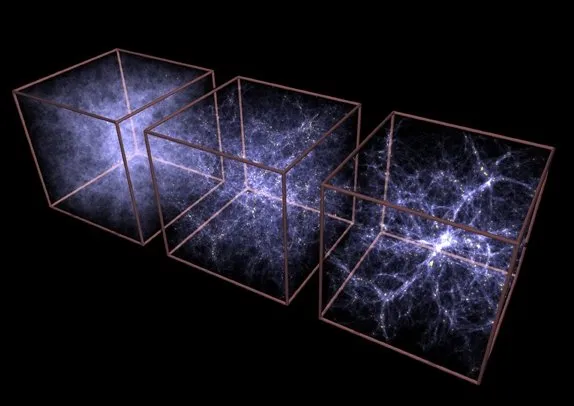
A massive computational simulation of the way galaxies form reveals where to look in the galaxy to finally detect dark matter directly.
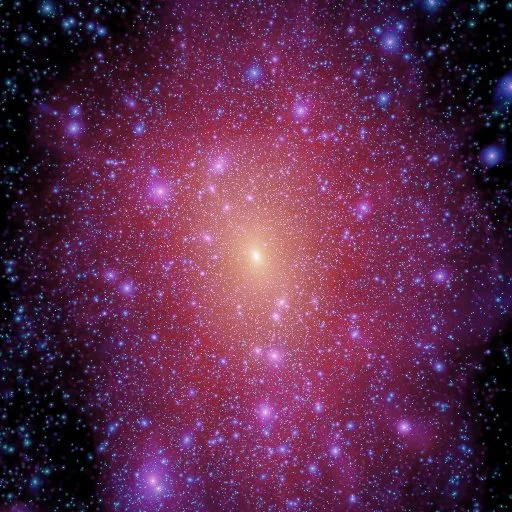
Dark matter is a form of matter that cannot be detected directly, it is invisible, but it is known to be there due to its gravitational effects. We recently talked about the matter in "The Dark Side of the Universe".
Now, the international Virgo Consortium, a team of scientists, used computational simulations that took 3.5 million hours to create a virtual universe, showing the evolution of a galaxy like the Milky Way to "see" the gamma rays emitted by dark matter. According to the team, their findings could help the Fermi telescope in its search for dark matter and open a new chapter in our understanding of the Universe.
The Virgo Consortium looked into the dark matter halos -structures that surround galaxies- that contain trillions of times the mass of the Sun.
Their simulations -under the title of Project Aquarius- showed how the galaxy's halo grows through a series of violent collisions and mergers between smaller clumps of dark matter.
The researchers found that the gamma rays produced when particles collide in areas of high dark matter density could be more easily detected in regions of the Milky Way towards the center of the galaxy and near the Sun.
"These calculations finally allow us to 'see' what the distribution of dark matter near the Sun should look like where we might have a chance of detecting it," says Professor Simon White, director of the Max Planck Institute.
Carlos Frenk, director of the Institute for Computational Cosmology at Durham University, says that "Solving the mystery of dark matter will be one of the greatest scientific achievements of our time. The search for dark matter has dominated cosmology for decades. Perhaps, soon, it will come to an end."
"These calculations have redefined the cutting edge in cosmological simulations," says Volter Springel, from the Max Planck Institute and author of the paper published in Nature.
Some scientists have said that the dense dark matter halos in satellite galaxies are the main candidates for detecting gamma-ray signals from dark matter. But Springel and his colleagues disagree. They say those signals would be insignificant. Instead, they say the dominant and easiest-to-detect signals would be in the diffuse dark matter halo that permeates the Milky Way itself and that the best place to look is in the area of the sky towards the center of the galaxy and closest to the Sun.
Of course, it must be noted that the result is interesting, but it relies on the assumption that dark matter emits gamma radiation when particles annihilate, as ordinary matter particles do.
Sources and related links
- EurekAlert:Giant simulation could solve mystery of 'dark matter'
- Cosmos:Where to look to see dark matter
- Prospects for detecting supersymmetric dark matter in the Galactic halo
V. Springel et al.
Nature 456, 73-76 (6 November 2008)
DOI:10.1038/nature07411 - Virgo Consortium
About the images
Credit:Virgo Consortium