NASA's Galaxy Evolution Explorer has lifted the veil on a cosmic ghost residing in the local universe, generating new insights into the formation and evolution of galaxies.
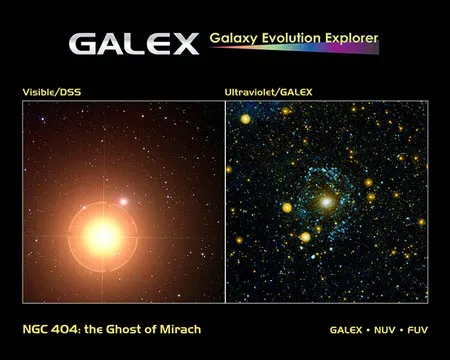
The rare creature, called NGC 404, is a type of galaxy known as a "lenticular." These galaxies have a disk shape, with little star formation and no spiral arms. NGC 404 is the closest example of a lenticular galaxy and, therefore, of great interest. But it lies hidden in the glare of a red giant star called Mirach or Beta Andromedae. For this reason, NGC 404 became known to astronomers as the "Ghost of Mirach."
When the Galaxy Evolution Explorer (GALEX) spied the galaxy in ultraviolet light, a spooky ring materialized.
"We thought this celestial ghost was essentially dead, but we have been able to show that it has an extended ring of new stars. The galaxy has a hybrid character in which the well-known population of old stars tells only part of the story," explains David Thilker of Johns Hopkins University. "It's like the walking dead."
The scientist and colleagues from the GALEX team detected the "Ghost of Mirach" in images taken during the space telescope's survey. The Galaxy Evolution Explorer is a relatively low-cost NASA mission, launched in 2003, with the ambitious goal of surveying the entire sky in ultraviolet light. Since Earth's atmosphere absorbs ultraviolet photons—good for us, as it would be harmful—ultraviolet telescopes must operate from space.
The first images of the Ghost of Mirach taken by the telescope gave hints of an extensive ultraviolet structure. Longer exposures showed that the lenticular galaxy is surrounded by a never-before-seen ring of stars.
What is this mysterious ultraviolet ring doing around this lenticular galaxy? Apparently, previous observations with the Very Large Array (VLA) radio telescope in New Mexico discovered a ring of hydrogen gas that matches the ultraviolet ring observed by GALEX. The authors of the VLA study attribute the gas ring to a violent collision between NGC 404 and a smaller neighboring galaxy, 900 million years ago.
The ultraviolet observations demonstrated that, when the hydrogen from the collision settled into the plane of the lenticular galaxy, stars began to form in a ring. The young and relatively hot stars in star clusters distributed across the ring of NGC 404 emitted the ultraviolet light that the instrument was able to see.
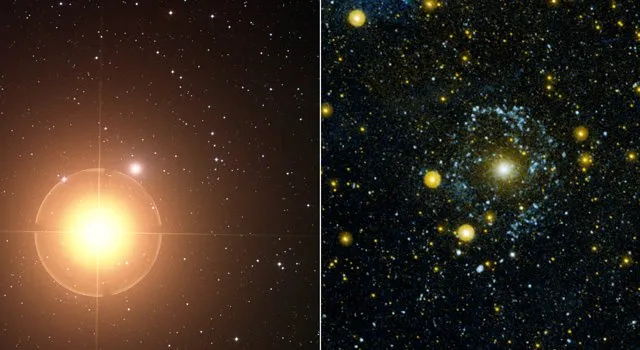
"Before the Galaxy Evolution Explorer image, NGC 404 was thought to contain only old, evolved red stars distributed in a smooth elliptical shape, suggesting an old galaxy that had not evolved significantly," says Mark Seibert of the Carnegie Observatories. "Now we see it has come back to life, to grow again."
The findings indicate that the evolution of lenticular galaxies might not be complete. In fact, they could continue forming stars slowly, by taking gaseous material from smaller neighboring galaxies. It seems that, rather than a ghost, it is a cosmic vampire, feeding on its neighborhood.
In the image, the field of view expands 55,000 light-years. The Ghost of Mirach is located 11 million light-years from Earth. The star Mirach is very close by comparison, at only 200 light-years, and is visible to the naked eye.
The visible data come from the Digitized Sky Survey of the Space Telescope Science Institute.
Sources and related links
About the images
Credit: NASA/JPL-Caltech/DSS