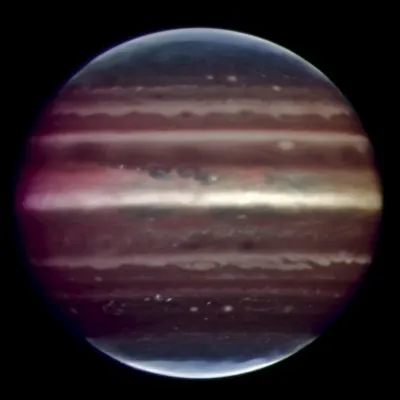
Two hours of observing Jupiter using a technique to remove atmospheric effects produced the sharpest image of the entire planet taken so far from Earth. The series of 265 images obtained with a prototype instrument mounted on the VLT reveals changes in the planet's haze, likely in response to global changes in the gas giant last year.
Being able to correct wide-field images of atmospheric distortions has been a dream of scientists and engineers for decades. The new images of Jupiter demonstrate the value of the advanced technology used by the Multi-Conjugate Adaptive Optics Demonstrator prototype instrument, MAD, which uses two or more guide stars instead of one as a reference to remove blurring caused by atmospheric turbulence, over a field of view 30 times larger than existing techniques.
Ground-based telescopes suffer from atmospheric effects. Turbulence causes stars to twinkle, to the delight of poets and the frustration of astronomers. However, with adaptive optics (AO) techniques, this disadvantage can be overcome to produce images as sharp as theoretically possible. AO systems work with a computer-controlled deformable mirror system that counteracts image distortion. It is based on real-time optical corrections calculated from image data obtained by a special high-speed camera. Current AO systems can only correct the effect of atmospheric turbulence in very small regions of the sky - typically 15 arcseconds or less - because the correction degrades rapidly when moving away from the central axis. Engineers then developed new techniques to overcome this limitation, one of which is multi-conjugate adaptive optics (MCAO).
"This type of adaptive optics has a great advantage for observing large objects like planets, star clusters or nebulae," says researcher Franck Marchis, from UC Berkeley and the SETI Institute. "While regular adaptive optics provides excellent correction in a small field of view, MAD provides good correction over a large area of the sky."
MAD allowed researchers to observe Jupiter for almost two hours between August 16 and 17, 2008, a record duration, according to the observing team. Conventional AO systems use a single moon of Jupiter as a reference and cannot monitor the planet for long because the moon moves too far from the planet. The Hubble Space Telescope cannot observe Jupiter continuously for more than about 50 minutes, because its view is regularly blocked by Earth during its 96-minute orbit.
Using MAD, astronomer Paola Amico, from ESO, project manager Enrico Marchetti and Sébastien Tordo tracked two of the gas giant's largest moons, Europa and Io, one on each side of the planet, to provide good correction across the entire disk of the planet. "It was the most challenging observation we performed with MAD, because we had to track with great precision two moons moving at different speeds," says Marchetti.
With this unique series of images, the team found a major alteration in the brightness of the equatorial haze, which lies in a belt 16,000 kilometers above the planetary equator.
The haze - which could be hydrazine, a compound used for rocket fuel, or possibly frozen crystals of ammonia, water or ammonium hydrosulfide - is very prominent in infrared images. Since visible light can penetrate to deeper levels than the light at infrared wavelengths detected by MAD, optical telescopes see light reflected by deeper clouds, below the haze. The haze behaves like particles at the top of cumulonimbus clouds on Earth or in the volcanic ash from large eruptions, which rise into the upper atmosphere and spread around the world. On Jupiter, ammonia in the upper atmosphere also interacts with sunlight to form hydrazine, which condenses into a haze of fine ice particles. The hydrazine chemistry in Jupiter's atmosphere is similar to what happens in Earth's atmosphere after a volcanic eruption, when sulfur is converted by ultraviolet sunlight into sulfuric acid.
More sunlight on the upper atmospheric haze means the amount of haze increased or it moved to higher altitudes. The conclusion comes from comparing with images taken in 2005 by Mike Wong and his colleague Imke de Pater using Hubble. Those images, taken at infrared wavelengths very close to those used in the VLT study, show more haze in the northern half of the bright equatorial zone, while the images from the new study show a clear shift to the south.
"The change we see in the haze could be related to major changes in cloud patterns associated with Jupiter's planetary disturbance last year, but we need more data to determine precisely when the changes occurred," states Wong.
The MCAO concept
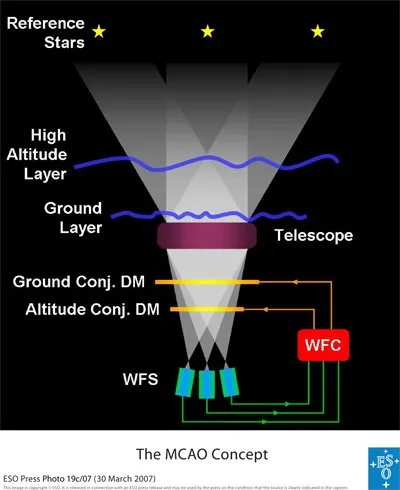
In the concept of Multi-Conjugate Adaptive Optics, several guide stars (Reference Stars) located in the field of view are used simultaneously to perform tomography of the cone volume of atmospheric turbulence above the telescope by wavefront sensors (WFS). The measured wavefronts are combined in real time to calculate the instructions to be applied by the deformable mirrors (two in the case of MAD) optically conjugated to different altitudes above the telescope (Ground Conj. DM and Altitude Conj. DM). These deformable mirrors are optimized to homogeneously maximize correction over the scientific field of view.
Sources and related links
- Sharpening Up Jupiter
About the images
ESO PR Photo 33/08
A MAD view of Jupiter