Images of the cosmos amaze us with their beauty and color. Photos that ground-based or space telescopes take of nebulae or supernova remnants are aesthetically beautiful and incredible to us. We can help scientists make better photographic compositions by answering a survey they have prepared for that purpose.
Images of the cosmos provide snapshots of the diverse stages of life and death, as well as the different physical phenomena found throughout the known universe. Today, some 400 years after Galileo created his, modern telescopes have allowed us to "see" what the human eye cannot. This new generation of instruments—on the ground and in space—has created an explosion of images for the public to explore.
The images we usually see produced by observatories are often made up of a great deal of data and in several wavelengths. Spitzer can take data in the infrared, Chandra in X-rays, and Hubble in the optical spectrum, and in that way combine an image with data from the different wavelengths.
Scientists, when "assembling" the image composition, choose colors that represent each wavelength. They might choose blue for ultraviolet, green for optical, red for infrared, and purple for X-rays. And thus form an image like that of the fantastic spiral galaxy M51, the Whirlpool Galaxy.
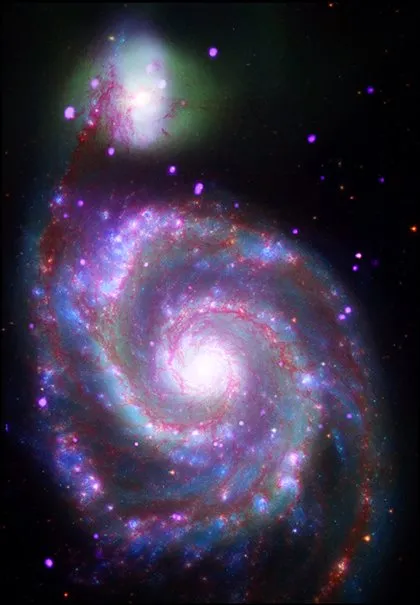
But the composition could be assembled by choosing the colors in another way. The colors are used to convey information visually, but it is inevitable that we evaluate it from an aesthetic point of view.
On the other hand, we tend to associate colors with other meanings, for example, temperature. If an image has more red than blue, do we associate it with higher or lower temperature? Does it mean the object is approaching or moving away from us?
This data is valuable because it allows us to know how we evaluate and relate colors, so that scientists can use them to compose better images.
This survey, conducted by the Harvard-Smithsonian Center for Astrophysics, will study the perception of astronomical images in multiple wavelengths and the effects of scientific and artistic choices in the processing of astronomical data. The images come from a variety of observatories, including the Chandra X-ray Observatory, the Hubble Space Telescope, the Spitzer space telescope, the Very Large Array, the Hinode satellite, and many others. The evaluation of this data will benefit astronomy across the electromagnetic spectrum of astronomical images, and can help with data visualization in other scientific disciplines.
The survey, which is in English, takes no more than about 15 minutes to complete. Every answer counts and our participation is very valuable.
The survey is at:
http://astroart.cfa.harvard.edu/
The survey in Spanish
What follows is a guide to be able to take the survey on the original site, translated into Spanish. I repeat, nothing is answered here, but if you don't know English, you can use it as a guide to answer the survey in that language.
Aesthetics & Astronomy
I
Age:
15-24
25-34
35-44
45-54
55-64
65-74
75 years or older
Sex: M (Male) F (Female)
Residence: Choose country
(Zip Code): For residents in the USA
What is the highest level of education you have completed?
Elementary School :Elementary school
Middle School: Middle school
High School:High School
Some College:College Bachelor's Degree:Bachelor's degree
Some Graduate School:Graduate school
Master's Degree: Master's degree
PhD:Doctorate
Other:other
How would you rate your own expertise in astronomy?
1 2 3 4 5 6 7 8 9 10
Novice Expert
I:
Am not blind or visually impaired
Do not have problems distinguishing the colors red and green
Do not have problems distinguishing the colors yellow and blue
If you came from the Astronomy Picture of the Day (APOD) website
(http://antwrp.gsfc.nasa.gov/apod/), the number of times you visited APOD in the past month:
Daily
Weekly
Less than once a month
A few times a month
Other
Never visited APOD
Click here to continue >>>
****************
II
Which of these images is more attractive?
Image on the right
Image on the left
Which of these images seems hotter in temperature?
Image on the right
Image on the left
Click here to continue >>>
******************
III
Please, study the top image
>>> Click here to continue >>>
*****************
IV
1) Evaluate this image in terms of how hot (temperature) you think the image appears. Use a scale of 1 (extremely cold) to 10 (extremely hot)
1 2 3 4 5 6 7 8 9 10
Extremely cold Neither cold nor hot Extremely hot
2) Now rate this image in terms of how attractive you find it. Use a scale of 1 (not at all attractive) to 10 (very attractive)
1 2 3 4 5 6 7 8 9 10
Not at all attractive Moderately attractive Extremely attractive
3) What is this?
A galaxy
An exploded planet
The debris from an exploding star
I don't know
Gases condensing around a black hole
4) How sure are you of your answer to question 3?
1 2 3 4 5 6 7 8 9 10
I'm guessing Moderately sure I am absolutely certain
5) How large do you think it is?
Smaller than Earth
Between the size of Earth and the size of the solar system
Larger than a galaxy
Between the size of the solar system and the size of the galaxy
6) How sure are you of your answer to question 3?
1 2 3 4 5 6 7 8 9 10
I'm guessing Moderately sure I am absolutely certain
>>> Click here to continue >>>
**********
V
A composite image of M51, also known as the Whirlpool Galaxy, shows a magnificent spiral galaxy. Chandra finds point-like sources that are black holes and neutron stars in binary star systems, along with a diffuse glow of hot gas. Data from Hubble and Spitzer highlight long lanes of stars and gas intertwined with dust.
A view of M51 with GALEX shows hot, young stars that produce lots of ultraviolet energy.
>>> Click here to continue >>>
***********
VI
1) In general, how well do you think you understand this image?
1 2 3 4 5 6 7 8 9 10
Not at all Moderately well Completely
2) How much does the text help in understanding this image?
1 2 3 4 5 6 7 8 9 10
Does not help at all Helps moderately Helps a great deal
3) If an astronomer visited you, what question(s) would you like to ask him/her?
Space to write
4) Why are some regions blue and others red?
Some of the stars are closer and others are farther away
Some stars are hotter than others.
Some regions were created before other regions.
The stars have arbitrarily different colors assigned
5) What is the white area in the center of the spiral?
A very bright star
Another galaxy crossing in front
A collection of bright stars
The remnant of an exploding star
>>> Click here to continue >>>
*********
VII
1) What do you think is being described here?
2) Evaluate this image in terms of how much it makes you want to read more about this image.
1 2 3 4 5 6 7 8 9 10
Not at all likely Somewhat likely Very likely
>>> Click here to continue >>>
**********
VIII
The Hinode satellite obtained high-resolution images of the Sun's poles. One of these, seen above, shows many spicules protruding from the Sun's surface, each of which is approximately 300 miles wide. For scale, the circle is 300 miles in diameter.
>>> Click here to continue >>>
******
IX
1) Would you like to learn more about this topic?
1 2 3 4 5 6 7 8 9 10 not at all Somewhat Definitely
2) Would you like to see more images like this?
1 2 3 4 5 6 7 8 9 10 not at all Somewhat Definitely
3) How interested are you in Solar Astronomy?
1 2 3 4 5 6 7 8 9 10 not at all Somewhat Very
4) Here are some statements about spicules. Choose all the statements that are true.
Spicules are more than 3,000 miles high
Spicules last for about a month.
You cannot see spicules unless you look at the edge of the Sun.
Spicules are found only at the Sun's poles.
Spicules are hotter than the center of the Sun.
Spicules cause sunspots.
Spicules emit radiation.
Spicules are visible to the naked eye.
Astrophysicists are not sure how wide spicules actually are.
Spicules can be detected just before they fall back to the Sun.
>>> Click here to continue >>>
**********
X
Thank you for your participation.
Thank you for your participation!
If you are interested in being contacted for research purposes only, you can send us your contact information, which will be kept safe and private and used only to contact you for future studies.
Your name:
Your phone:
Your email:
Register No, thank you
****
Send it to a friend
URL: http://astroart.cfa.harvard.edu/
Enter the email address of up to three friends, below.
1.
2.
3.
Enter your email address to send the message.
Register No, thank you
Sources and related links
About the images
M51-Credits: X-ray: NASA/CXC/Wesleyan Univ./R.Kilgard et al; UV: NASA/JPL-Caltech; Optical: NASA/ESA/S. Beckwith & Hubble Heritage Team (STScI/AURA); IR: NASA/JPL-Caltech/ Univ. of AZ/R. Kennicutt