The documentary "El Ojo de la Tierra" shows the work of five scientists from the Research Group in Theoretical and Experimental Astronomy (IATE) of the Universidad Nacional de Córdoba and CONICET, who have found in the puna of Salta a place where the world's largest telescope could be installed.
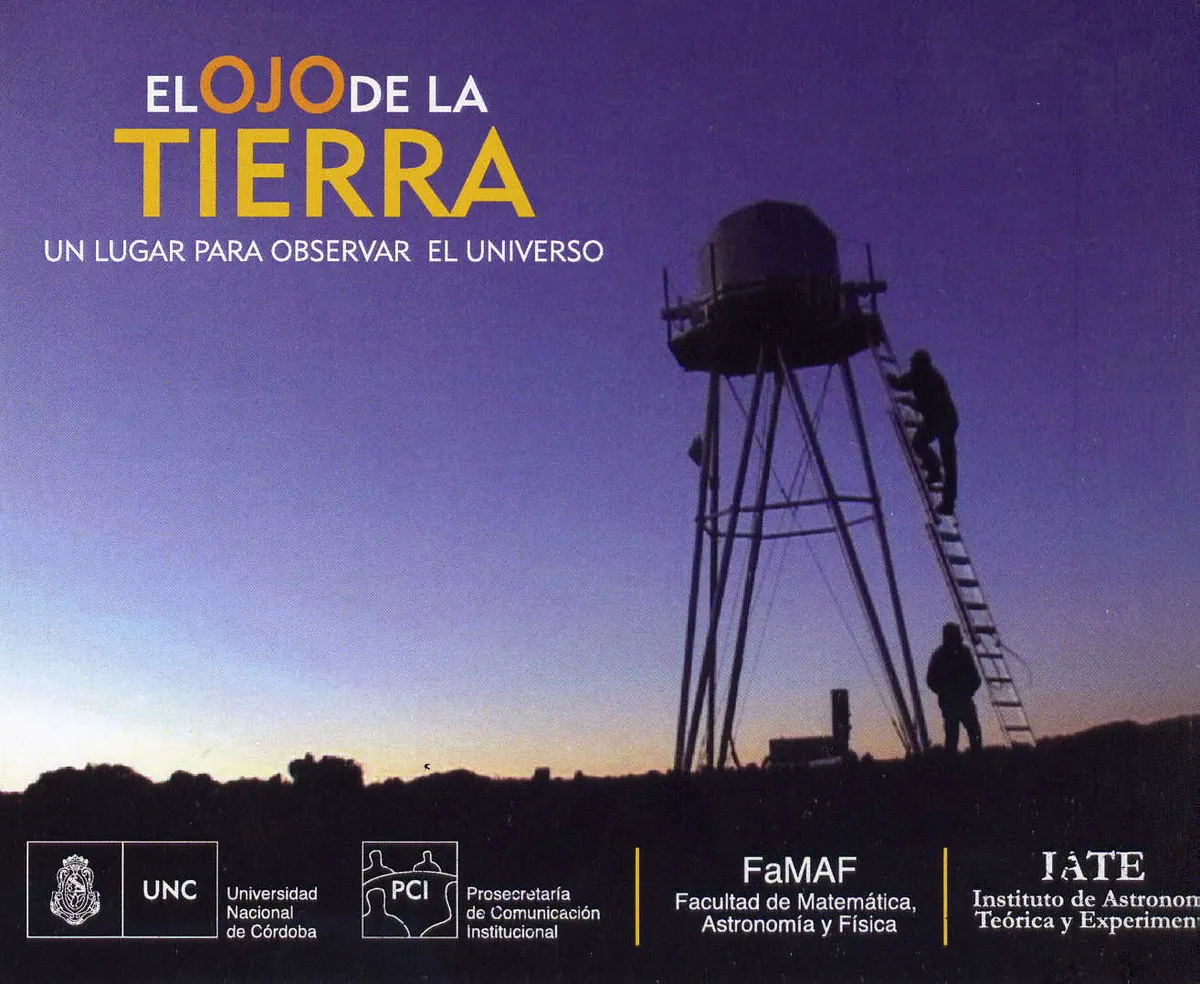
Choosing the site to install a high-precision astronomical instrument is not a matter of chance. It is not resolved by playing "Tic-Tac-Toe" with geographic coordinates. Variables such as easy accessibility to the place or its beautiful vegetation may be taken into account for installing a hotel or a fair, not a telescope. If the place has many cloudy nights, high temperature, seismic movements, or if it receives a lot of surrounding artificial lighting, it would affect the quality of the observations. These are not minor details when making a highly complex installation that functions as "The eye of the Earth," a place to observe the Universe. That is what this documentary directed by Diego Ludueña is about, regarding the work that researchers from IATE have been carrying out to characterize Cerro Macón as a candidate site for the installation of a future (and huge) telescope.
I knew about the existence of the documentary, but I only got to see it yesterday. It turns out the news channel TN broadcast it on the program TN Ciencia hosted by Guillermo Lobo.
We had already commented here on the possibility that the E-ELT telescope, the European Extremely Large Telescope, could be installed in the Province of Salta. See for example the note on this blog: "Salta and the extremely large telescope".
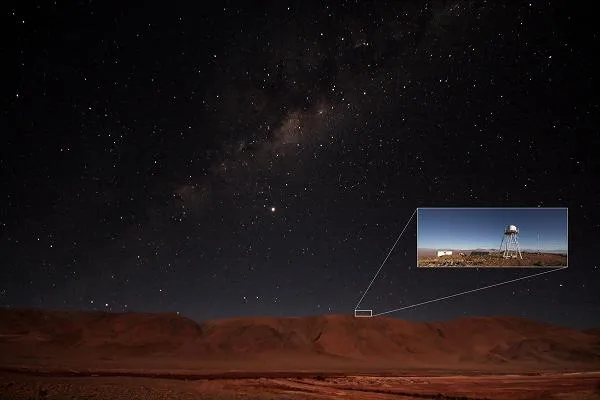
The Cordón de Macón, a hill 4,650 meters high located on the outskirts of the town of Tolar Grande, situated 350 kilometers from the capital of Salta, was the place chosen by researchers from the Universidad Nacional de Córdoba Pablo Recabarren, Hernán Muriel and Diego García Lambas to carry out measurements of sky quality, with the logistical and technical support of Víctor Renzi and Rubén Vrech.
Characterizing the site means carrying out the measurements that allow us to know if the place meets the required conditions for the installation of a high-precision instrument like the one ESO is planning for the E-ELT.
This implies knowing the seismic and geological conditions and, of course, the atmospheric conditions of the place. Unfortunately, there are few places on our planet that are not exposed to light pollution and that, in addition, meet other important conditions such as a high-altitude location with favorable climate.
Throughout its 24 minutes, the director of the documentary "El ojo de la Tierra" allows us to learn about the work of the scientists through themselves, who explain to us their commendable task.
Dr. Diego García Lambas, from the large equatorial telescope of the Observatorio Astronómico de Córdoba, explains to us that in the past, the choice of the installation site for observatories was made a bit with the intuition that it would be a good place. Currently, this is not the case and many studies of the site are needed to know if it will be the right one (besides, there is competition from other sites that are also applying for the installation).
Ludueña then puts us in Dr. Hernán Muriel's car to drive us to Cerro Macón and its nearby town Tolar Grande, with just over 100 inhabitants.
The town of Tolar Grande is located in the department of Los Andes, in the heart of the puna of Salta, 380 km from the capital of the Province of Salta. In the central west of it, surrounded by hills of various heights ranging from 3,700 to 6,000 meters. It is located at 24º36' south latitude and 67º26' west longitude of the Greenwich meridian. Its climate is cold, with an arid desert geography, with a minimum winter temperature of up to 15º below zero, and warmer in summer with an average of 15º, maximums of 25º and minimums below 0º.
From a climatological point of view, it is a place with very little precipitation, clear skies, and far from urban centers, which makes it a place with very little light pollution. This is indicated, almost with astonishment, by Marc Sarazin, a specialist in Experimental Physics at ESO, who says he believes he has never seen a place like that, lacking light pollution.
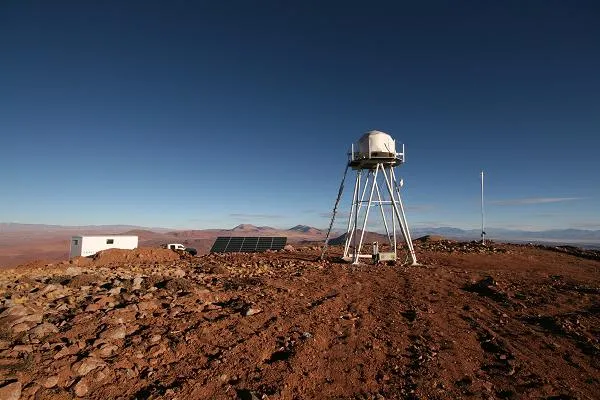
Pablo Recabarren points out to us how important what has been done so far is, considering that it started from scratch. An autonomous meteorological station (in operation for more than two years), a shelter, and an observation tower from where a DIMM instrument that measures image quality is operated have been installed. The DIMM allows estimating the average size of a point image (seeing), this being one of the fundamental parameters in the process of astronomical characterization of a site.
The documentary "El ojo de la Tierra: Un lugar para observar el Universo" is an effort to record the work of Argentine researchers. In its brief duration, it is possible to understand the fundamental points: what the undertaken task is, who the scientists in charge of the task are, where it is carried out, and what the site and the scale of the project are like. This is why, although those of us passionate about the topic are left wanting more, I believe the film amply fulfills its objectives.
It is, at the same time, a document of our scientific history, as well as of our film history. And we hope it will also be a document for a promising future of astronomical observations.
The construction and installation of the ELT will require an investment close to 1,000 million euros. And competing with Argentina are Spain (Canary Islands), Morocco, and Chile. The Atacama Desert, in our mountainous neighboring country, is home to one of the best current astronomical instruments, on Cerro Paranal.
To conclude, it is necessary to emphasize some points:
Everyone, fundamentally the Argentine astronomical community, as well as the informed public, wishes that Cerro Macón will finally be the site chosen by ESO, and undoubtedly that is the primary and fundamental objective of those working on the project. However, there are other good candidate sites and it is possible, of course, that another place will ultimately be selected.
If the second case were to occur, that is, if the Argentine location were not finally chosen for the construction of the E-ELT, the dedicated effort should not be in vain.
The formidable site characterization tasks could be used for the installation of some other instrument. Based on the data collected to date, even if the Argentine site were not selected this time, the place has ideal conditions for establishing an astronomical instrument there. I want to believe that if not for this ESO project, the place will be used anyway, so the development of the Argentine researchers is, without a doubt, extremely important, beyond the specific outcome of the ESO selection.
On the other hand, the execution of the work itself of rigorous measurements once again places Argentine researchers as highly qualified, and this must also be noted.
And finally, the efforts to record and disseminate our scientific history will be equally valuable in any case. Thus, from here, we encourage and thank the work done by director Diego Julio Ludueña, who had the journalistic production of Yamila Abad and Eliana Piemonte.
The documentary has participated in Ciencia y Cine de A Coruña, Spain and in December will participate in CineCien 2008, 3rd Festival of Scientific Film and Video of MERCOSUR. We wish them the best of luck, which they well deserve for having made an excellent contribution to Argentine scientific documentary film.
Sources and related links
- ESO:E-ELT
- Scientists from the UNC study the Puna of Salta to determine the possibility of installing an "Extremely Large" Telescope
About the images
Cover of the documentary
Image of Cerro Macón
Photos:Gianluca Lombardi (ESO and INAF-Bologna).
Higher resolution images in the ESO archive:
Night view of Cordón Macon:
1200 x 800 pix and 3888 x 2592 pix
Test site:
1200 x 800 pix and 3888 x 2592 pix