Illustrating the power of submillimeter astronomy, an image from APEX reveals how an expansive bubble of ionized gas about 10 light-years in diameter is causing the surrounding material to collapse into dense clumps that will form new stars. Submillimeter light is key to revealing some of the coldest materials in the Universe, such as these dense, icy clouds.
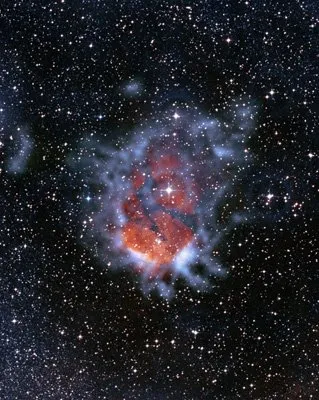
The region, called RCW120, lies about 4,200 light-years from Earth, toward the constellation of Scorpius. A hot, massive star at the center is emitting large amounts of ultraviolet radiation that ionizes the surrounding gas, stripping electrons from hydrogen atoms and producing the characteristic red glow of so-called H-alpha emission.
As this ionized region expands, the associated shock wave sweeps up a shell of surrounding interstellar dust and gas. This shell becomes unstable and collapses under its own gravity into dense groupings, forming dense, cold hydrogen clouds where new stars are born. However, as the clouds are still very cold, with temperatures around -250º Celsius, their faint glow can be seen only at submillimeter wavelengths. This light is thus vital in studying the early stages of the birth and life of stars.
The data were taken with the LABOCA camera on the 12-meter Atacama Pathfinder Experiment or Atacama Pathfinder Experiment (APEX) telescope, located on the Chajnantor plateau in Chile. Thanks to the instrument's sensitivity, astronomers were able to detect clumps of cold gas four times fainter than previously possible. Since the brightness of these clumps is a measure of their mass, this means astronomers can now study the formation of less massive stars than they could before.
The Chajnantor plateau is where ESO, together with international partners, is building a next-generation submillimeter telescope: ALMA, the Atacama Large Millimeter/submillimeter Array. ALMA will be used with 60 12-meter antennas linked together to form a giant telescope.
RCW Catalog
The designation RCW refers to the catalog of H-Alpha emission regions in the southern Milky Way, published in 1960 by: A. W. Rodgers, C. T. Campbell and J. B. Whiteoak. It is an extended version of Colin Gum's 1955 catalog.
Sources and related links
- APEX reveals glowing stellar nurseries
- The RCW catalog
About the images
Composite image of RCW120
The submillimeter emission is shown as the blue clouds surrounding the reddish glow of the ionized gas (shown with data from the SuperCosmos H-alpha survey). The image also contains data from the Second Generation Digitized Sky Survey.
Credit:ESO/APEX/DSS2/SuperCosmos