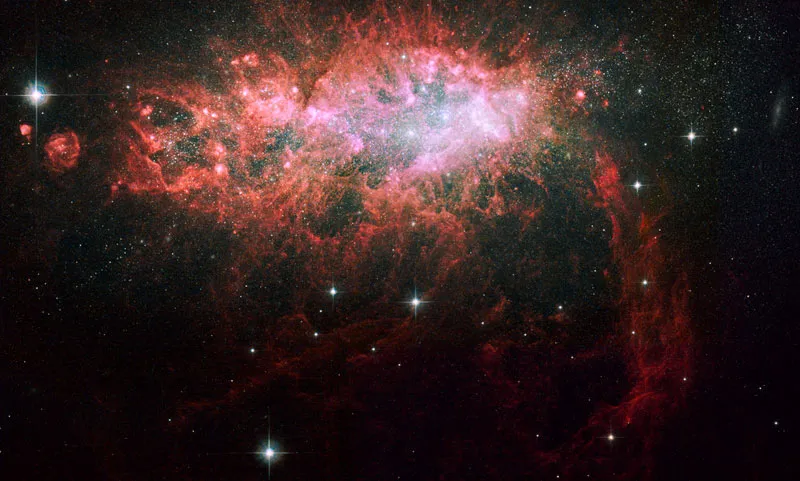
Astronomers have wondered why a small, nearby, isolated galaxy is generating new stars faster than any other in our local neighborhood.
Now, the Hubble Space Telescope helped astronomers solve the mystery of the galaxy called NGC 1569, by showing that it is one and a half times farther away than thought.
The extra distance places the galaxy in the middle of a group of about 10 galaxies, centered on the spiral galaxy IC 342. Gravitational interactions within the group could be compressing gas in NGC 1569 and igniting star birth in a frenzy.
The greater distance not only implies that the galaxy is intrinsically brighter but that it is producing stars twice as fast as thought. The star formation there is more than 100 times greater than the rate in the Milky Way. This high rate of star formation has been almost continuous for the past 100 million years.
Discovered by William Herschel in 1788, NGC 1569 is home to three of the most massive star clusters known in the local universe. Each cluster contains more than a million stars.
"This is an example of the type of massive star generation that drives the evolution of galaxies in the distant and young universe," says Roeland van der Marel of the Space Telescope Science Institute. "Galaxies with high star formation can only be studied in detail in the nearby universe, where they are rarer. Hubble observations of our cosmic neighborhood, including this study, are helping astronomers put together a picture of galaxies in our local universe." By putting the pieces of this puzzle in the right place, as in the case of NGC 1569, the picture makes more sense.
The study leader, Alessandra Aloisi, and her team, discovered the new distance by accident. They were using Hubble's Advanced Camera for Surveys to hunt, in NGC 1569, the type of red giant stars, near the end of their lives, that shine because they fuse helium nuclei in their cores. These stars are fainter than the bright red giants that do not burn helium, but when detected they can be used to estimate the galaxy's age.
"When we did not find traces of them, we suspected that the galaxy was farther away than originally thought," says Aaron Grocholski author of the paper describing the results. "We could only see the bright red giants, but we were able to use those stars to recalibrate the galaxy's distance". The bright red giants are reliable "standard candles" for measuring distances because they shine with the same luminosity. When astronomers know the true brightness, they can calculate their distance to Earth.
Previous estimates of the galaxy's distance, made with ground-based telescopes, were not reliable because they observed the crowded core of the galaxy and could not detect individual red giant stars.
The Hubble study observed the very crowded galactic core and its less populated outer limits. Thus, it could observe individual red giant stars. The astronomers measured the distance at about 11 million light-years, which is almost 4 million light-years farther than previously stipulated.
Sources and related links
- Hubble Resolves Puzzle about Loner Starburst Galaxy
- A New Hubble Space Telescope Distance to NGC 1569: Starburst Properties and IC 342 Group Membership
Aaron J. Grocholski,Alessandra Aloisi, et al.
The Astrophysical Journal Letters, 686:L79–L82, October 20, 2008
About the images
Credit for the Advanced Camera Data: NASA, ESA, A. Aloisi (STScI/ESA), J. Mack and A. Grocholski (STScI), M. Sirianni (STScI/ESA), R. van der Marel (STScI), L. Angeretti, D. Romano, and M. Tosi (INAF-OAB), and F. Annibali, L. Greggio, and E. Held (INAF-OAP)
Credit for the Wide Field Planetary Camera 2 Data: NASA, ESA, P. Shopbell (California Institute of Technology), R. Dufour (Rice University), D. Walter (South Carolina State University, Orangeburg), and A. Wilson (University of Maryland, College Park)
Image credit: NASA, ESA, the Hubble Heritage Team (STScI/AURA), and A. Aloisi (STScI/ESA)