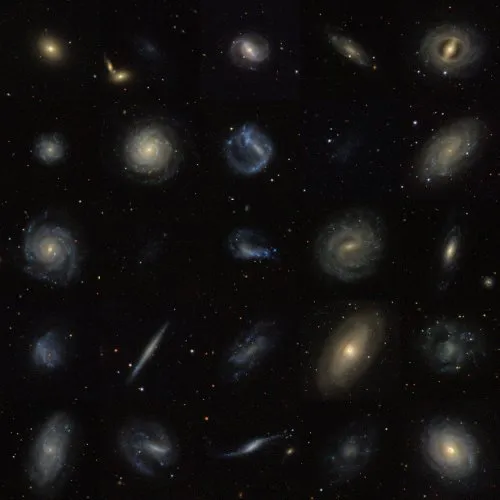
Anyone who has ever wondered what it would be like to dive into a pool of millions of distant galaxies of different shapes and colors will enjoy the latest image released by ESO: Obtained in part at the Very Large Telescope, the image is the deepest, taken from the ground and in ultraviolet, ever obtained. It contains more than 27 million pixels and is the result of 55 hours of observations.
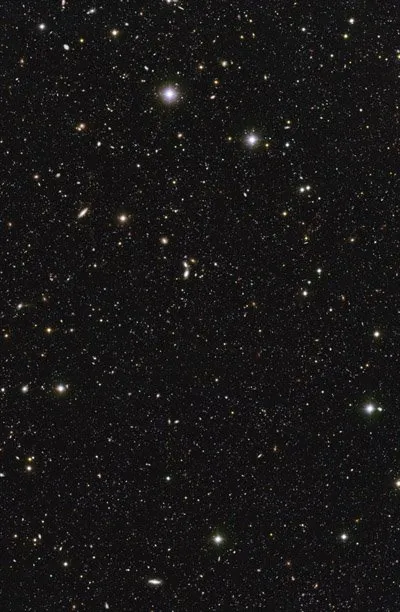
The incredible image with its myriad of bright and colorful galaxies shows the Chandra Deep Field South (CDF-S), possibly the most observed and studied region of the entire sky. The CDF-S is one of two regions selected as part of the GOODS survey, an international effort by the astronomical community that brings together the deepest observations from the ground and space at all wavelengths, from X-rays to radio. Its primary goal is to provide astronomers with the most sensitive census of the distant Universe to assist them in their studies on the formation and evolution of galaxies.
The new image released by ESO, the result of 40 hours of observing the same region of the sky, is the deepest ever taken from the ground at this wavelength. The image combines data obtained in different bands and with the VIMOS and WFI (Wide Field Imager) instruments on the 2.2-meter MPG/ESO telescope at La Silla, Chile, within the framework of the GABODS survey.
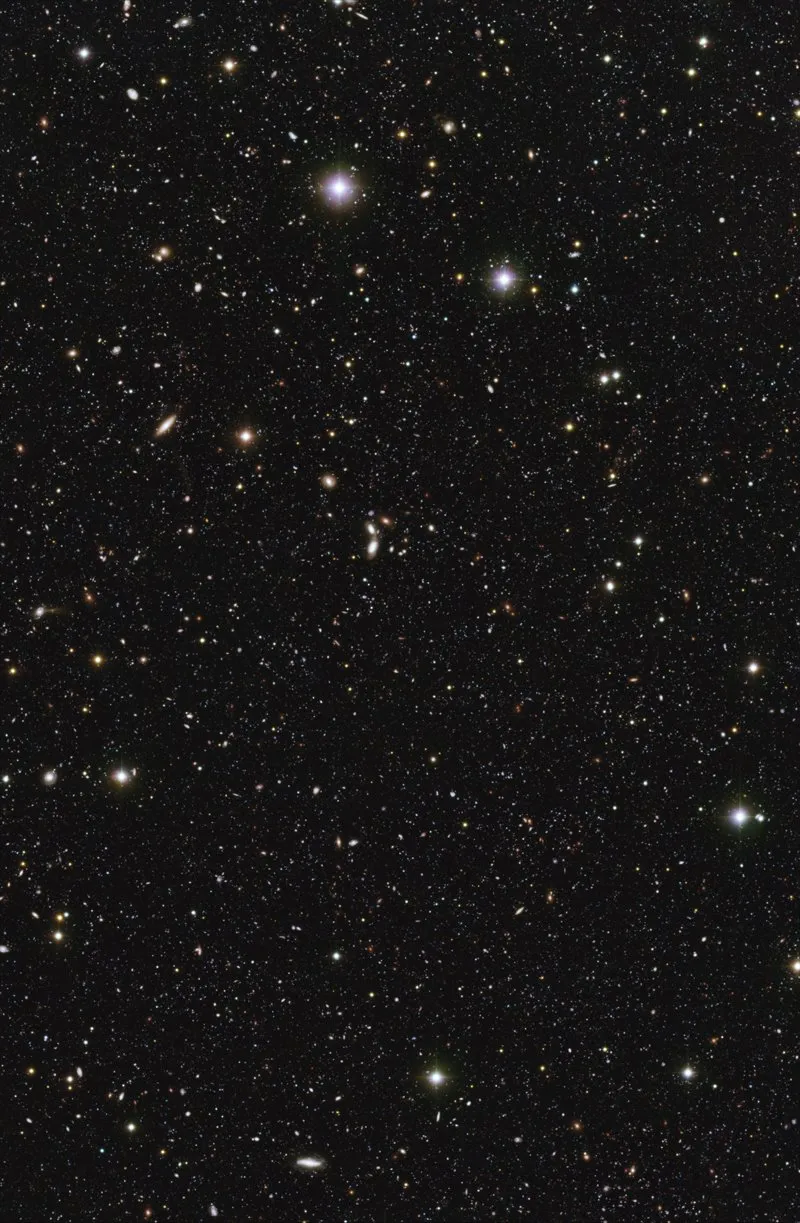
Galaxies were detected that are billions of times fainter than what the naked eye can see and over a range of colors not directly observable by the eye. The deep photograph has been essential in discovering a large number of new galaxies that are so far away that they are seen as they were when the Universe was only 2 billion years old.
In this sea of galaxies, or Island-Universes as Kant once called them, only a few stars belonging to the Milky Way are seen. One of them is so close that it moves very fast across the sky. This "ultrafast star" is visible to the left of the second brightest star in the image. It appears as a "funny rainbow of colors" because the star moved while data were being taken through different filters.
Since the Universe looks similar in all directions, the number, type, and distribution of galaxies is the same everywhere. Consequently, very deep observations of the Cosmos can be made in any direction. A series of fields were selected where no foreground object could affect the observations of deep space (such as a bright star in our galaxy or dust from our Solar System). These fields have been observed using a number of telescopes and satellites, thus collecting information from all possible wavelengths and characterizing the entire spectrum of objects in the field.
Observations in the U-band, that is, at the boundary between visible and ultraviolet light, are a challenge: Earth's atmosphere becomes more and more opaque towards the ultraviolet, a useful property for protecting our skin, but a limit for observations from the ground. At shorter wavelengths, observations can only be made from space, using, for example, the Hubble Space Telescope. On the ground, only the very best sites, such as Paranal in the Atacama Desert, can perform useful observations in the U-band. Even under the best atmospheric conditions, instruments are at their limit at those wavelengths: the glass of normal lenses transmits less UV light and detectors are less sensitive, so instruments designed for UV observations, like VIMOS, can gather enough light.
The U-band image was obtained as part of the GOODS program, based on 40 hours of observations with the VLT. The VIMOS R-band image was obtained by adding a large number of archive images, totaling 15 hours of exposure. The WFI B-band image is part of the GABODS survey.
VIMOS instrument
VIMOS is a Spectrograph designed for observing many objects simultaneously, rather than studying a single object. It can take images and spectra of up to 1,000 objects simultaneously in the visible light range, which is very useful for conducting censuses of distant galaxies.
Sources and related links
- A Pool of Distant Galaxies – the deepest ultraviolet image of the Universe yet
About the images
Credits:ESO/ Mario Nonino, Piero Rosati and the ESO GOODS team.