A team of French astronomers discovered an object located very close to the star Beta Pictoris, and which apparently lies within its disk. With an estimated distance to the star of about 8 times the distance between Earth and the Sun, the object is probably a giant planet that was suspected to be there. If it were, it would be the first image of a planet as close to its star as Saturn is to the Sun.
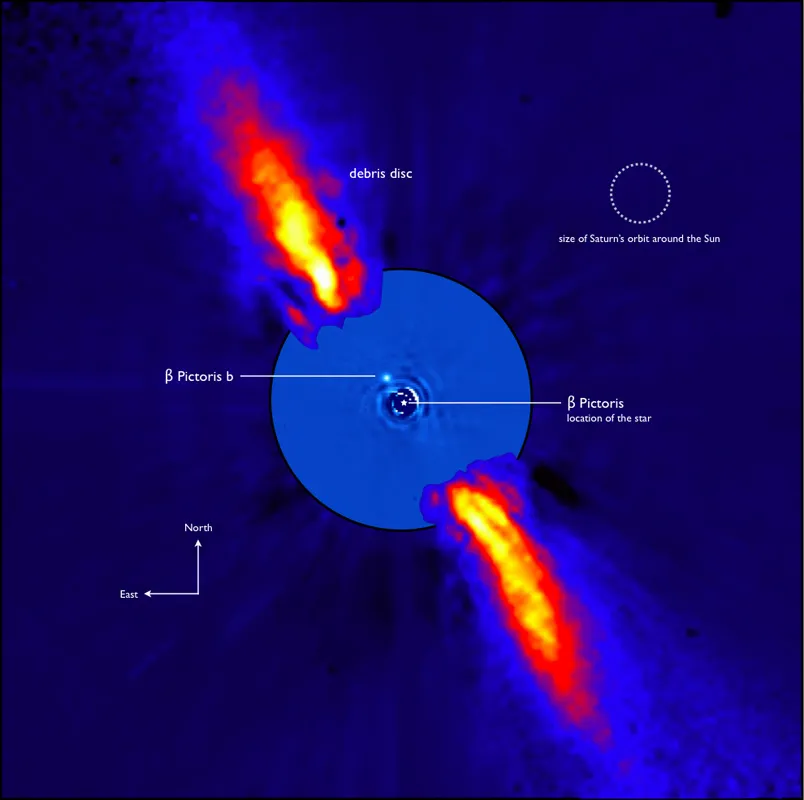
The hot star Beta Pictoris is one of the best-known examples of a star surrounded by a dusty debris disk. These disks are composed of dust resulting from collisions between larger bodies such as planetary embryos or asteroids. It is a larger version of the zodiacal dust in our Solar System. This disk was the first to be observed -as early as 1984- and remains the best-studied system. Previous observations showed a warp in the disk, a tilted secondary disk and comets falling into the star. "These are indirect signs that strongly suggest the presence of a massive planet that would be located at a distance from its star of between 5 and 10 times the Earth-Sun distance," says Anne-Marie Lagrange, a team member. "However, investigating the innermost region of the disk, so close to the bright star, is a more challenging task."
In 2003, the French team used the NAOS-CONICA instrument, mounted on one of the 8.2-meter telescope units of ESO's Very Large Telescope (VLT), to benefit from both the very good image quality provided by the adaptive optics system at infrared wavelengths and the good dynamics offered by the detector, to study the immediate surroundings of the star.
Recently, a team member reanalyzed the data differently to search for the trace of a companion star. For this difficult task it was necessary to identify the halo of the bright star as precisely as possible. "We were able to achieve this goal after a precise and drastic selection of the best images recorded during our observations," explained Lagrange.
The strategy paid off and the astronomers were able to discern a faint point-like glow well within the star's halo. To eliminate the possibility that this was not real, a battery of tests was performed and several team members, using different methods, analyzed the data independently, always with the same result. Furthermore, the companion was discovered in another dataset, reinforcing the team's conclusion: the companion is real.
"Our observations point to the presence of a giant planet, about 8 times the mass of Jupiter and with an estimated distance to its star of about 8 times the Earth-Sun distance, which is similar to Saturn's distance in our Solar System," explains Lagrange.
Gael Chauvin, Lagrange's colleague, is cautious in stating that new observations will be necessary to rule out the small possibility that it is a background or foreground object.
The team found no foreground or background object in the Hubble archives, which presumably should have been detected if it existed. The fact that the object lies in the plane of the disk strongly implies that it is bound to the star and its protoplanetary disk.
If confirmed, this companion to the star would be the closest planet to its star ever observed. In particular, it would be located within the orbits of the system's outer planets. Many other planet candidates have been observed, but much farther from their host star. If it were located in our Solar System, it would be near the orbit of the farthest planet, Neptune.
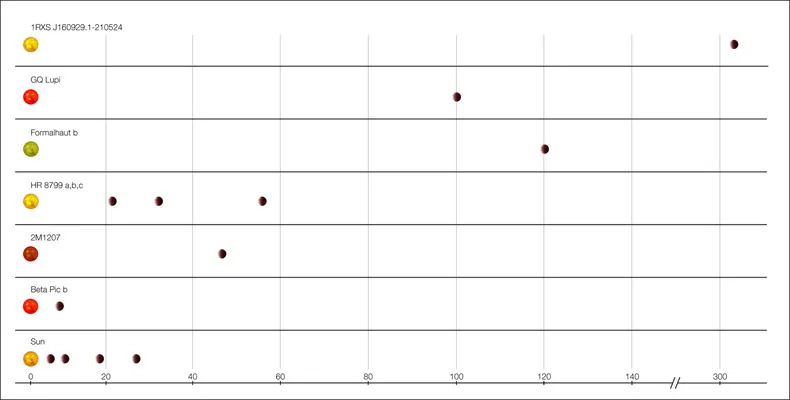
http://exoplanet.eu/catalog-imaging.php
"The direct observation of exoplanets is necessary to test the various models of formation and evolution of planetary systems. But these observations are only the beginning. Limited today to giant planets around young stars, in the future it will extend to the detection of older and colder planets, with the next generation of new instruments.
At only 12 million years old, the young star Beta Pictoris is located 70 light-years away in the direction of the constellation Pictor (the painter).
Sources and related links
- Beta Pictoris planet finally imaged?
- A probable giant planet imaged in the ß Pictoris disk. VLT/NACO Deep L-band imaging
A.-M. Lagrange et al., 2008,
Letter to the Editor of Astronomy and Astrophysics, in press.
About the images
Composite image representing the close environment of Beta Pictoris seen in the near-infrared.
Credit: ESO/A.-M. Lagrange et al.
Diagram of candidate planetary systems
Credit: ESO