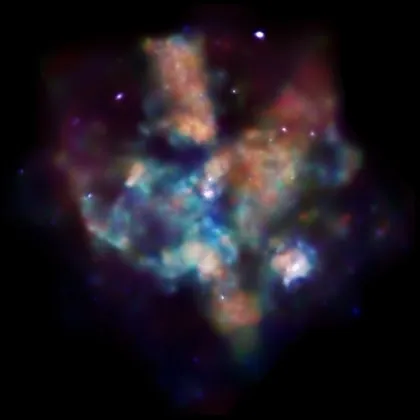
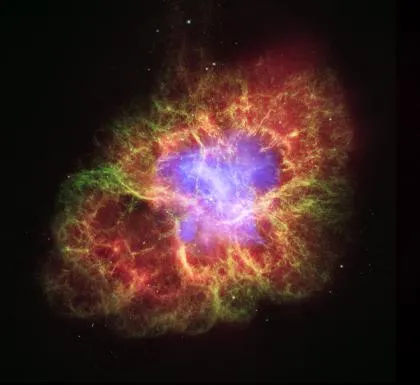
This image offers the first clear view of the faint boundary of the Crab Nebula.
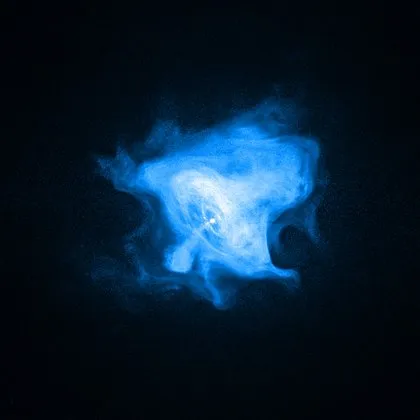
The nebula is powered by a pulsar (PSR0531+121), a highly magnetized and rapidly rotating neutron star (the white dot in the center). The combination of rapid rotation and strong magnetic fields generates an intense electromagnetic field that creates jets of matter and antimatter moving from the pulsar's poles and an intense wind flowing from the equator.
The Crab Nebula (also known as M1, NGC 1952, Taurus A and Taurus X-1) is a supernova remnant (SN 1054).
The inner X-ray ring is thought to be a shock wave marking the boundary between the surrounding nebula and the flow of matter and antimatter particles from the pulsar. Energetic electrons and positrons move from this ring and produce an extended glow of X-rays.
The fingers, loops and holes in the image indicate that the nebula's magnetic field and filaments of cooler matter are controlling the movement of the electrons and positrons. The particles can move quickly along the magnetic field and travel several light-years before radiating their energy. In contrast, they move much more slowly perpendicular to the magnetic field and travel only a short distance before losing their energy.
This effect can explain the shapes of the long fingers and loops as well as the clear shape of the holes.
Sources and related links
About the images
Credit: NASA/CXC/SAO/F.Seward et al
Composite image of the Crab Nebula: X-ray data in light blue, optical in green and blue, infrared in red.
NASA/CXC/ASU/J.Hester et al.; Optical: NASA/ESA/ASU/J.Hester & A.Loll; Infrared: NASA/JPL-Caltech/Univ. Minn./R.Gehrz