30 Doradus is one of the most massive star-forming regions close to the Milky Way. Enormous stars in this Tarantula Nebula, as it is called, are producing intense radiation and superheated winds that carve out gigantic bubbles in the surrounding gas and dust.
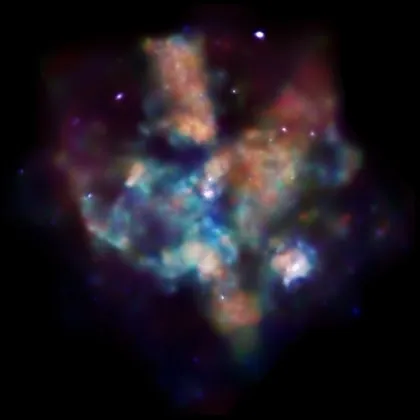
Other massive stars exploded as supernovae that left behind pulsars and supernova remnants that trigger the collapse of large clouds of gas and dust to form new generations of stars.
At the center of 30 Doradus (also cataloged as NGC 2070) lies the star cluster R136, at the intersection of three of these bubbles. However, with ages of only one to two million years, the stars in the cluster are too young to be the source of the supernovae that make the superbubbles shine in X-rays. Instead, it is very likely that R136 is the latest cluster to form in 30 Doradus. It could be as massive as it is because these superbubbles combined to concentrate their gas in this region and thus trigger intense star formation there.
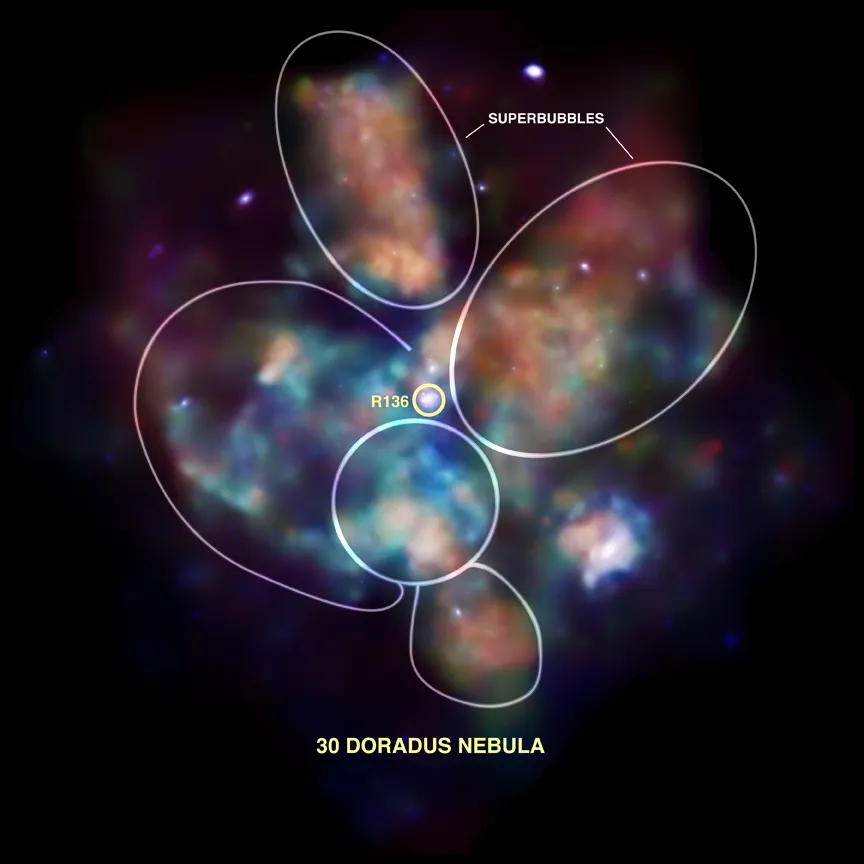
This region, in the Large Magellanic Cloud, is located 160,000 light-years from Earth, in the constellation Dorado. It extends 800 light-years and is very bright at several wavelengths. If it were at the distance of the Orion Nebula (1,300 light-years) it would be seen as an area whose extent would be 60 full moons.
This latest image produced by the Chandra X-ray Observatory represents 114,000 seconds (or 31 hours) of observing time, that is, three times longer than the previous exposure. In the image, red represents the low range of X-rays that Chandra detects, the medium range is green and the highest is blue.
Sources and related links
About the images
Credit:NASA/CXC/Penn State/L.Townsley, et al.