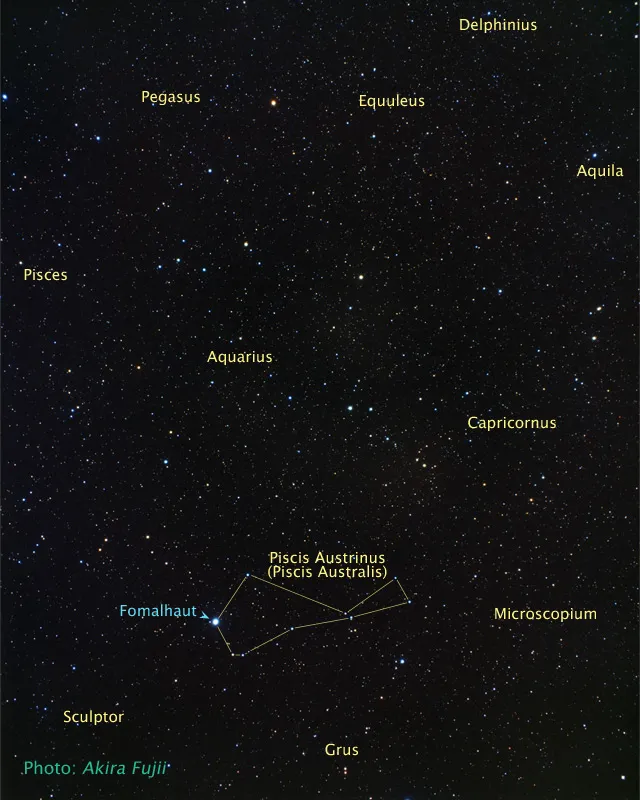
NASA's space telescope has taken the first image in visible light of a planet orbiting another star. Estimated at no more than three times the mass of Jupiter, the planet, called Fomalhaut b, orbits the bright star, located 25 light-years away in the constellation of Piscis Austrinus.
Fomalhaut has been a candidate for planet hunters since an excess of dust was discovered around it in the 1980s, thanks to the IRAS satellite (Infrared Astronomy Satellite)
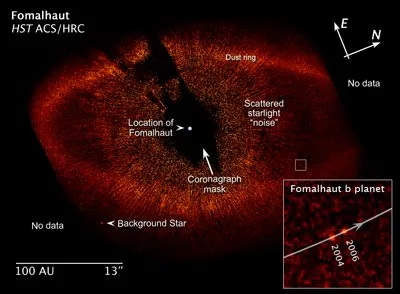
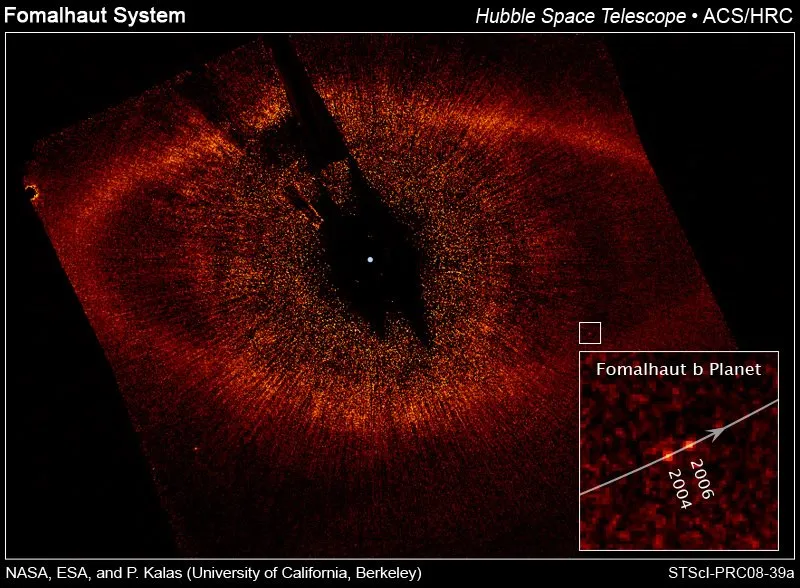
In 2004, the coronagraph on Hubble's Advanced Camera for Surveys produced the first image in visible light of a large dust belt surrounding the star. It clearly showed that this structure is a protoplanetary debris ring approximately 21.5 billion miles across.
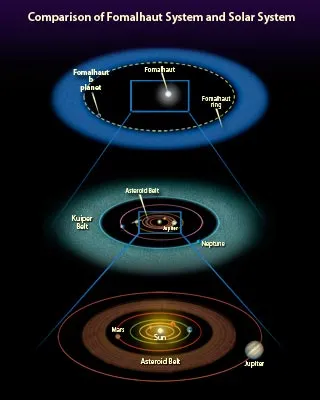
The large disk is similar to the Kuiper Belt, which surrounds the Solar System and contains icy bodies, from dust grains to dwarf planets like Pluto.
Paul Kalas, a Hubble astronomer at the University of California, Berkeley, and a team proposed in 2005 that the ring was being gravitationally modified by a planet lying between the star and the inner boundary of the ring.
Subsequent investigations supported that idea. We already commented on this in "Hidden planet in dust ring". Now, Hubble has photographed a point source of light lying 1.8 billion miles inside the inner boundary of the ring. The results are being reported in Science.
"Our Hubble observations were incredibly demanding. Fomalhaut b is a billion times fainter than the star. We began this program in 2001 and our persistence finally paid off," says Kalas.
"Following the unexpected discovery of the dust ring, we have now found an exoplanet at the location suggested by the analysis of the dust ring's shape. The lesson for exoplanet hunters is 'follow the dust'," says Mark Clampin of the Goddard Space Flight Center.
Observations taken 21 months ago by the coronagraph of Hubble's Advanced Camera for Surveys show that the object is moving along a path around the star and is therefore gravitationally bound to it. The planet is 10.7 billion miles from the star or about 10 times the distance of the planet Saturn from the Sun.
The upper mass limit for the planet is constrained by the appearance of the ring. If the planet were much more massive it would distort the ring and the effect would be observable.
However, the planet is brighter than expected for an object three times the mass of Jupiter. One possibility is that it has a ring like Saturn's of ice and dust reflecting sunlight. That ring could eventually form moons. The ring has an estimated size comparable to the region around Jupiter that contains the orbits of four large satellites.
Kalas and his team used Hubble to photograph Fomalhaut in 2004 and discovered the debris disk. At that time they noted a few bright sources in the image that could be planet candidates. A follow-up image, in 2006, showed that one of the objects is moving with Fomalhaut but changed its position relative to the ring from the 2004 image. The amount of displacement between the two exposures corresponds to an 872-year orbit, as calculated with Kepler's laws of planetary motion.
Fomalhaut is much hotter than our star and about 16 times brighter. This implies that the system could be scaled with a Kuiper Belt and proportional orbits.
Future observations will attempt to see the planet in infrared light and search for evidence of clouds of water vapor in the atmosphere.
Sources and related links
- HubbleSite:Hubble Directly Observes Planet Orbiting Fomalhaut
- NASA:Hubble Directly Observes a Planet Orbiting Another Star
- More information and graphics
- Optical Images of an Exosolar Planet 25 Light-Years from Earth
Published Online 13 November, 2008
Paul Kalas et al.
DOI: 10.1126/science.1166609 - More images and documents at SpaceTelescope
About the images
Credits
First image and Location:
NASA, ESA, and Z. Levay (STScI)
System comparison:
NASA, ESA, and A. Feild (STScI)
Fomalhaut and Fomalhaut b:
NASA, ESA, P. Kalas, J. Graham, E. Chiang, E. Kite (University of California, Berkeley), M. Clampin (NASA Goddard Space Flight Center), M. Fitzgerald (Lawrence Livermore National Laboratory), and K. Stapelfeldt and J. Krist (NASA Jet Propulsion Laboratory)