Three students from Leiden University in the Netherlands discovered an exoplanet. The discovery occurred while doing their research project. It is an object five times more massive than Jupiter orbiting a fast-rotating star.
The students were testing a method for researching light fluctuations of hundreds of stars in the OGLE database in an automated way. The brightness of one of the stars decreased for two hours every 2.5 days by 1%. Subsequent observations with ESO's VLT confirmed that the phenomenon is caused by a planet passing in front of the star and blocking the light at regular intervals.
According to Ignas Snellen, supervisor of the research project, the discovery was a complete surprise. "The project aimed to teach the students how to develop search algorithms. But they did so well that it was time to test their algorithm on a database that had been unexplored until now. At one point they came to my office and showed me the light curve. They completely surprised me!"
Meta de Hoon, Remco van der Burg, and Francis Vuijsje, are the three enthusiastic students. It is the hottest star found with a planet and the computer needed more than a thousand hours to perform all the calculations.
The exoplanet received the designation OGLE2-TR-L9b, although the students baptized it ReMeFra-1, after their own names.
The planet was discovered by searching all the brightness variations of 15,700 stars that had been observed by the OGLE survey once or twice per night between 1997 and 2000. As the data were made public they were a good test case for the students' algorithm.
After detecting the brightness variation, the GROND instrument was used to learn more about the planet and the star, and spectroscopy was performed to be sure it was not a brown dwarf, a small star.
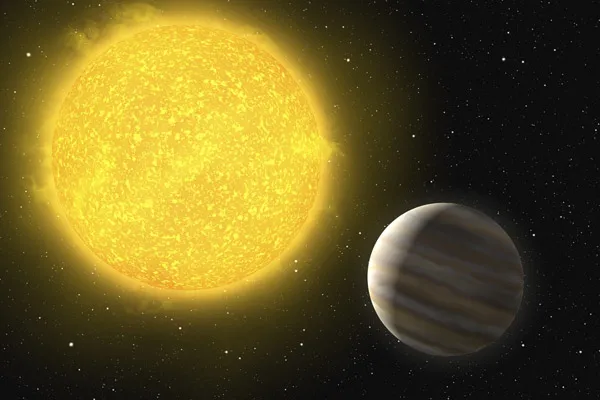
The exoplanet orbits its star every two and a half days. It lies at only 3% of the Earth-Sun distance from its star, making it very hot. The studies showed that the star is very hot too - about 7,000 degrees, 1,200 more than our Sun. It is the hottest star with a planet that has been discovered so far. And it is very fast. The radial velocity method, used to discover most exoplanets, is less efficient on stars with these characteristics. "This makes the discovery even more interesting," concludes Snellen.
Sources and related links
- Students Discover Unique Planet
- OGLE2-TR-L9: An extrasolar planet transiting a fast-rotating F3 star
I.A.G. Snellen, J. Koppenhoefer, R.F.J. van der Burg, S. Dreizler, J. Greiner, M.D.J. de Hoon, T.O. Husser, T. Kruhler, R.P. Saglia, F.N. Vuijsje
arXiv:0812.0599v1
Forthcoming in Astronomy & Astrophysics
About the images
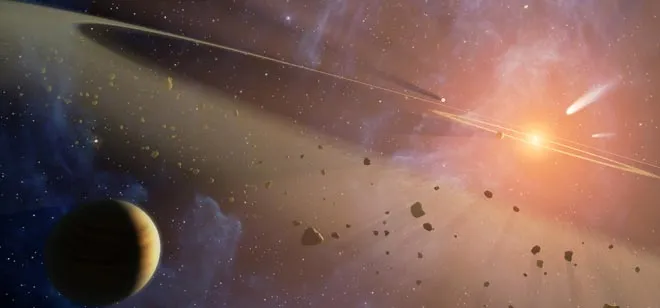
Artist's impression of OGLE-TR-L9b
Credit: ESO/H. Zodet
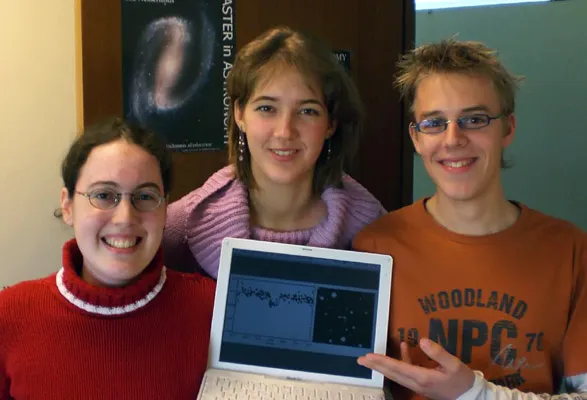
The students Francis Vuijsje, Meta de Hoon, and Remco van der Burg (from left to right)
Credit: Leiden Observatory